
A lot of commercial solar projects start with one simple objective:
Reduce grid electricity consumption during the day.
That usually works well.
The factory or commercial building uses solar while the sun is available, and grid purchases fall.
A few years later, however, the customer often notices something else.
There may be excess PV around midday.
Peak demand may still occur in the afternoon.
Grid outages may still interrupt production.
And once the sun goes down, the site goes back to buying electricity from the grid.
That leads to the next question:
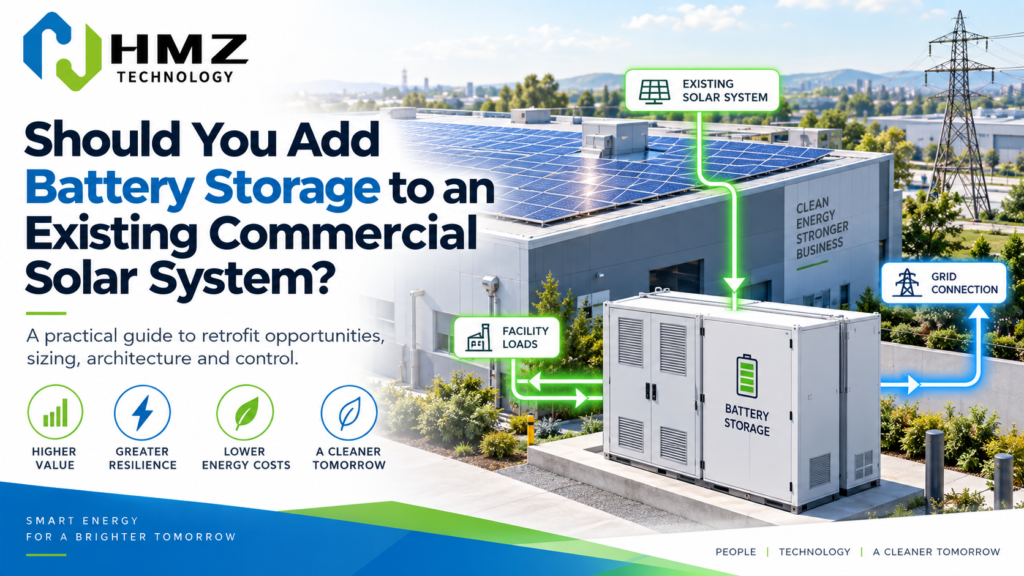
Should we add battery storage to the solar system we already have?
In many cases, yes.
But an existing PV system does not automatically become a good battery-storage project.
The real answer depends on what the solar system is doing today, what the load looks like, how the customer is billed and what the battery is expected to improve.
The First Question: What Problem Are You Trying to Solve?
Before choosing a battery size, define the reason for adding storage.
Typical objectives include:
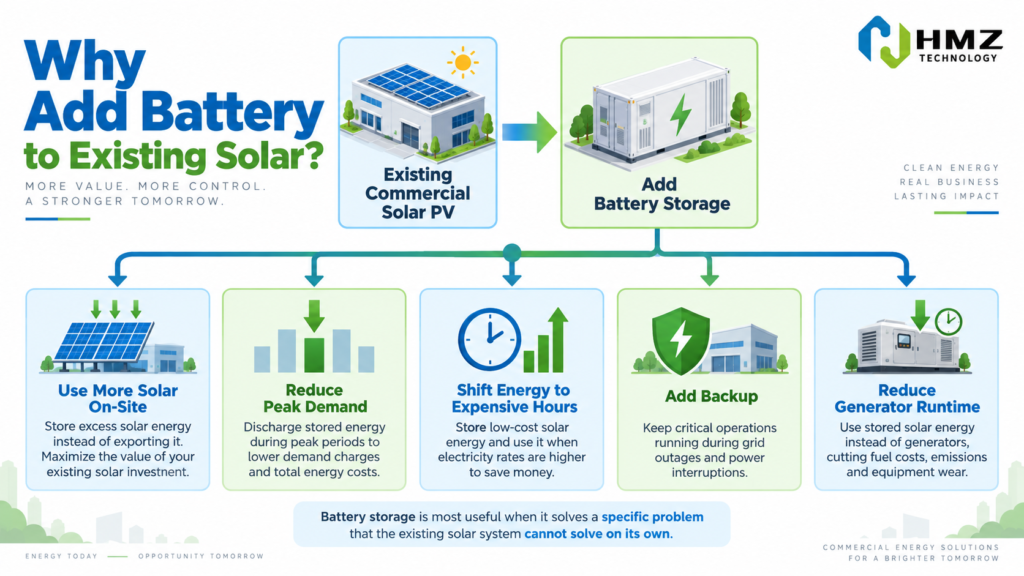
- increasing solar self-consumption,
- reducing peak demand,
- shifting energy into expensive tariff periods,
- adding backup capability,
- reducing generator runtime,
- improving energy resilience.
A retrofit project becomes much easier to evaluate once the main objective is clear.
If the customer simply says:
We already have solar. Now we want a 500 kWh battery.
that is not enough information.
The battery size should come later.
Reason 1: Too Much Solar Is Being Exported
This is one of the most common retrofit opportunities.
Imagine a factory with a large rooftop PV system.
Production demand is relatively low between 12:00 p.m. and 2:00 p.m., but solar generation is strong.
The site produces more electricity than it can use.
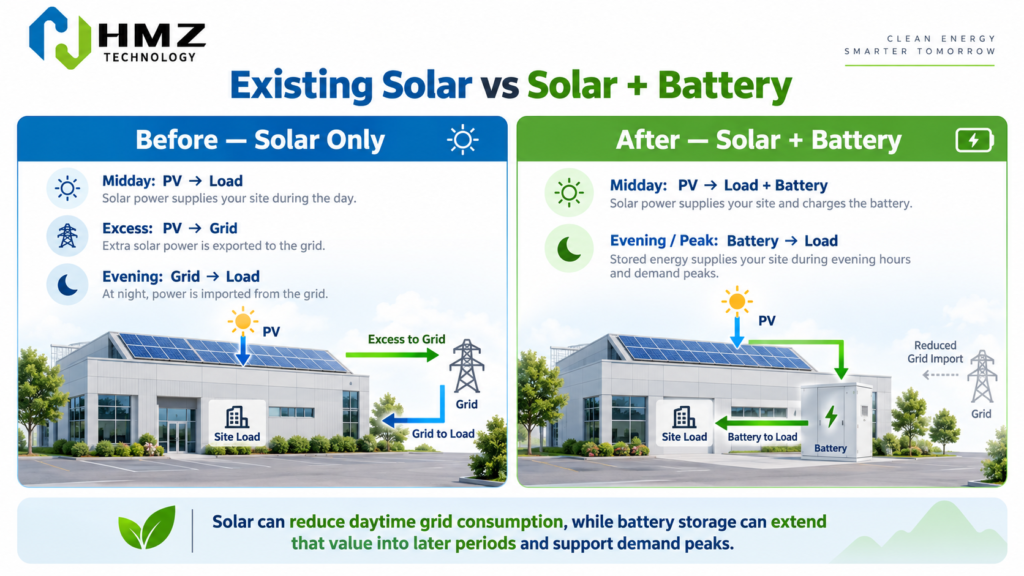
Without a battery, the surplus may be:
- exported to the grid,
- curtailed,
- or compensated at a low export tariff.
A battery changes the path.
Instead of:
Solar → Grid Export
the site can use:
Solar → Battery → Later Facility Load
This increases solar self-consumption.
The economic value depends heavily on the difference between:
what the site pays for grid electricity
and
what it receives for exported solar.
If exported PV is worth very little but purchased electricity is expensive, storage may be more attractive.
For more detail on that relationship, see our article on electricity tariffs and C&I battery storage economics.
Reason 2: Solar Reduced Energy Consumption, But Not Demand Charges
A commercial solar system may reduce total kWh purchased from the grid while doing very little to reduce the site’s maximum demand.
Why?
Because the peak may occur at a different time.
Suppose rooftop PV performs well at noon.
But the factory’s highest load occurs around 5:00 p.m. when:
- production is still active,
- air-conditioning remains high,
- and solar output is already falling.
The PV system helps during the day.
It may not solve the late-afternoon peak.
A battery can discharge during that short period and reduce grid demand.
For example:
Facility demand: 700 kW
Grid target: 550 kW
Battery contribution: 150 kW
That is a classic peak shaving retrofit case.
Reason 3: The Customer Wants Backup Power
This is where retrofit projects need more careful engineering.
Adding a battery does not automatically mean the entire building can continue operating during a grid outage.
The existing PV system may use grid-following inverters that shut down when utility power disappears.
This is normal anti-islanding behavior.
If the customer wants backup capability, the project may need:
- suitable battery PCS,
- switching equipment,
- critical-load separation,
- protection changes,
- EMS or microgrid control,
- islanding capability,
- and safe grid reconnection.
The first step should be identifying critical loads.
A factory may have:
Total load: 900 kW
but only:
Critical load: 180 kW
during an outage.
Designing backup for 180 kW and designing backup for 900 kW are very different projects.
For the broader design sequence, see our commercial microgrid design process.
Reason 4: The Site Wants Better Control Over When Solar Is Used
An existing solar system mainly answers one question:
How much electricity can we generate when the sun is available?
Adding storage introduces another question:
When should we use that energy?
That difference matters.
A battery allows the site to shift solar energy across time.
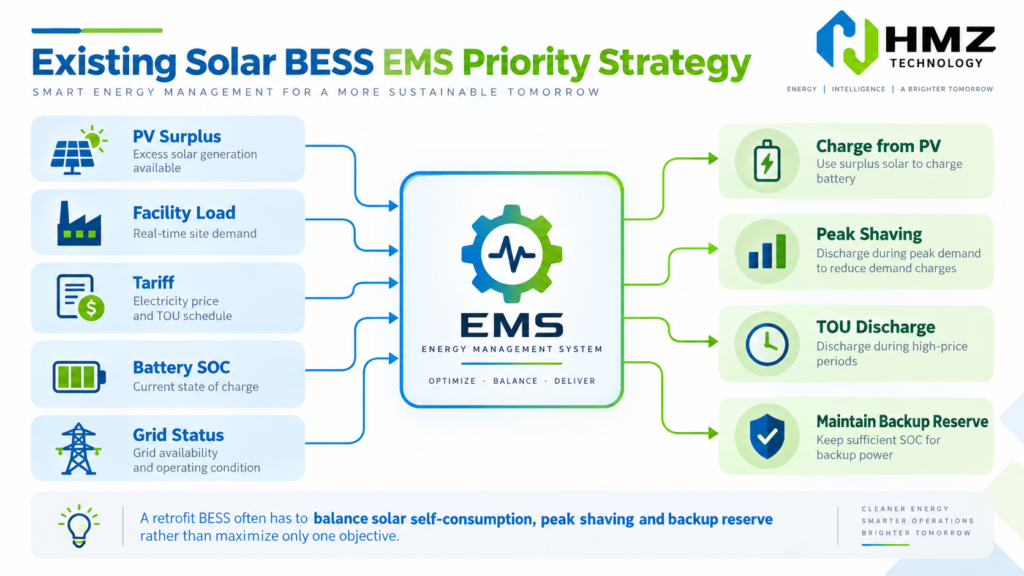
The EMS can decide whether to:
- charge from excess PV,
- discharge during peak tariff periods,
- maintain backup reserve,
- reduce demand peaks,
- or hold energy for later use.
That moves the system from simple solar generation toward more active energy management.
When solar, storage, grid supply and control begin operating together, the site starts to behave more like a microgrid.
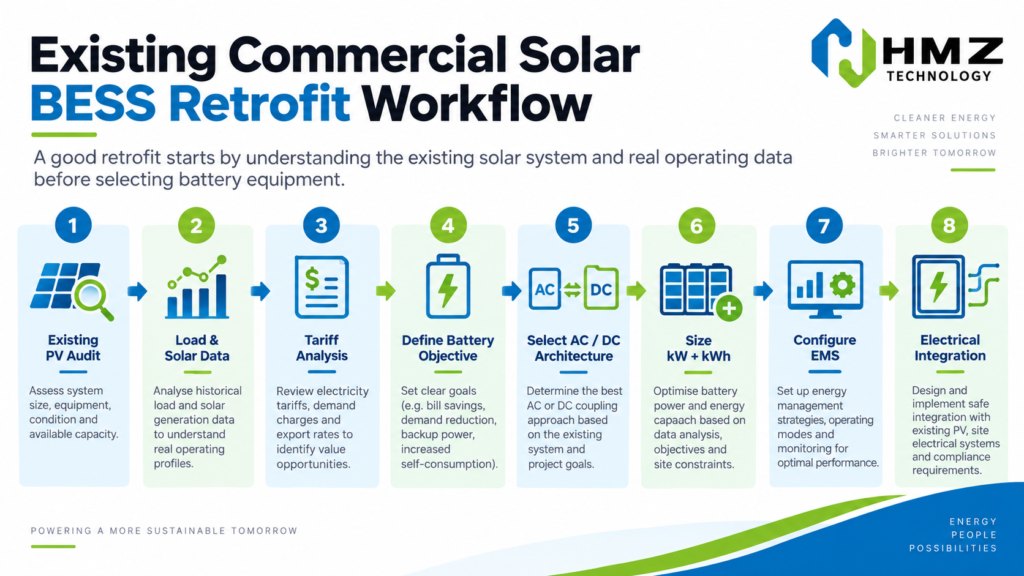
Step 1: Check the Existing PV System
Before adding battery storage, document what is already installed.
Useful information includes:
- total PV capacity,
- module configuration,
- inverter models,
- inverter AC rating,
- installation date,
- existing single-line diagram,
- point of interconnection,
- available switchboard capacity,
- protection settings,
- metering arrangement,
- current export behavior.
This avoids designing a battery system around assumptions.
The retrofit has to work with the electrical system that already exists.
Step 2: Measure How Much Solar Is Actually Surplus
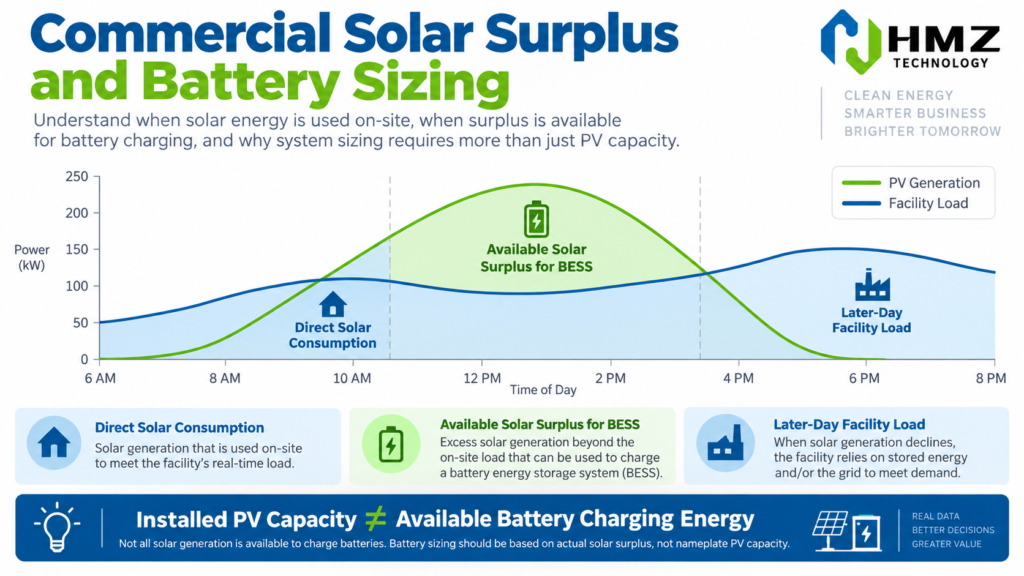
Installed PV capacity is not the same as available charging energy.
A site may have a 1 MW rooftop PV system.
That does not mean 1 MWh is available every day to charge a battery.
If the factory already consumes most of the solar generation directly, there may be little surplus left.
This is why the project should review actual PV and load data together.
Useful questions include:
- How much PV is exported each day?
- At what time does export begin?
- How long does it last?
- What is the maximum export power?
- How seasonal is the surplus?
If the answer is:
We only export 100–150 kWh on most days,
installing a 1 MWh battery purely for solar capture may create poor utilization.
This is where battery oversizing becomes a real risk.
Step 3: Review the Existing Inverter Architecture
This is one of the most important technical checks.
Existing commercial solar systems already have a power-conversion architecture.
When battery storage is added, the project team has to decide how the new BESS will integrate with it.
For many retrofits, AC coupling can be practical.
The existing PV inverter remains in service.
The battery connects separately through its own PCS on the AC side.
A simplified architecture is:
Solar PV → Existing PV Inverter → AC Bus
and:
Battery ↔ PCS ↔ AC Bus
This approach can reduce the amount of redesign required on the existing PV system.
But AC coupling is not automatically the right answer for every project.
New-build and retrofit architecture choices are explained in more detail in our DC-coupled vs AC-coupled solar + storage guide.
Step 4: Check Whether the Electrical System Can Accept the BESS
A battery cabinet cannot simply be placed beside the building and switched on.
The AC system has to support it.
The project may need to verify:
- switchboard rating,
- available breaker capacity,
- cable capacity,
- transformer loading,
- short-circuit level,
- protection coordination,
- point of connection,
- grid interconnection rules.
A site may have enough physical space for the BESS but insufficient electrical capacity at the intended connection point.
This can materially change project cost.
Step 5: Decide What the Battery Should Prioritize
A retrofit battery may be able to perform several functions.
But these functions can compete for the same stored energy.
Suppose the project has three objectives:
- store excess PV,
- shave the 5:00 p.m. demand peak,
- keep 30% SOC reserved for outages.
The EMS has to balance those priorities.
If the battery fully discharges for tariff savings every afternoon, backup reserve may be unavailable.
If it keeps a large backup reserve every day, less capacity is available for economic optimization.
The correct strategy depends on what matters most to the customer.
How Much Battery Should Be Added?
This is where many projects go wrong.
A customer may assume:
Large PV system = large battery.
Not necessarily.
Battery sizing should consider both:
power in kW
and
energy in kWh.
Suppose the customer wants to reduce a 150 kW demand peak lasting one hour.
The theoretical energy requirement is:
150 kW × 1 hour = 150 kWh
Now suppose the site also has approximately 350 kWh of useful midday PV surplus.
The final design may need to balance both requirements.
It should not automatically become a 1 MWh project just because the roof has a large PV system.
For the basic power-and-energy distinction, see kW and kWh in commercial energy storage.
A Practical Retrofit Example
Consider a commercial factory with:
- 800 kWp rooftop solar,
- an existing grid-connected PV inverter system,
- 550 kW normal daytime load,
- around 250 kWh of midday solar export on a typical clear day,
- a late-afternoon demand peak,
- 120 kW of critical load.
The customer wants to:
- use more solar on-site,
- reduce the afternoon peak,
- and maintain limited backup capability.
The project team would not start by selecting a battery model.
It would first look at:
- the actual exported PV profile,
- peak magnitude and duration,
- existing inverter architecture,
- electrical connection capacity,
- critical-load duration,
- tariff structure.
From there, the BESS power, usable energy and EMS strategy can be matched to the site.
That is a much more reliable retrofit process than choosing a battery from the PV capacity alone.
How Does Battery Storage Change the Economics of Existing Solar?
The economic case usually comes from one or more additional value streams.
Higher Solar Self-Consumption
More PV is used inside the facility instead of exported.
Peak Shaving
Battery discharge reduces expensive demand peaks.
TOU Optimization
Stored energy is used during expensive tariff periods.
Backup Value
Battery supports critical operations during outages.
Generator Reduction
Storage can reduce generator runtime in weak-grid sites.
The strongest retrofit projects often combine more than one of these.
But each value stream should be calculated from real site data.
This connects directly to the battery storage payback period.
When Adding Storage May Not Make Sense Yet
Battery storage is not automatically the right next step for every solar site.
The project may be weak if:
- almost all PV is already self-consumed,
- there are no demand charges,
- the electricity tariff is flat,
- solar export compensation is attractive,
- outages are rare and low-cost,
- there is little evening load,
- BESS utilization would be low.
In that case, the customer may be better off waiting, changing the operating objective or considering another energy measure first.
A technically possible battery project is not automatically a financially useful one.
When a Retrofit Is More Compelling
Adding storage becomes more attractive when several conditions appear together.
For example:
- significant midday solar export,
- low export compensation,
- expensive late-day grid power,
- high demand charges,
- weak grid reliability,
- expensive diesel backup,
- meaningful critical loads.
A site with several of these conditions gives the battery more useful work to do.
That generally creates a stronger project case.
How HMZ Technology Approaches Existing Solar Retrofits
For an existing commercial PV project, HMZ would first need to understand the installed system and current operating conditions.
Useful project information includes:
- PV capacity,
- PV inverter model and quantity,
- single-line diagram,
- hourly PV generation,
- hourly or 15-minute facility load,
- grid import/export data,
- electricity tariff,
- peak demand,
- available connection capacity,
- critical loads,
- backup requirement.
From there, the project can evaluate an appropriate storage configuration.
HMZ’s C&I storage portfolio includes:
50kW / 112kWh All-in-One C&I ESS
Suitable for smaller commercial retrofit and distributed solar + storage projects.
125kW / 241kWh All-in-One C&I ESS
Suitable for larger commercial and industrial energy-management applications.
125kW / 261kWh Liquid-Cooled C&I ESS
Suitable for higher-duty applications requiring more precise thermal management.
Learn more about the 50kW/112kWh and 125kW/241kWh All-in-One C&I Energy Storage Systems.
Retrofit Checklist: What Should Be Confirmed Before Quotation?
Existing PV
- PV capacity
- PV inverter model
- Current PV generation
- Export data
- Existing SLD
Load
- 15-minute or hourly load profile
- Peak demand
- Evening load
- Critical loads
- Future expansion
Tariff
- Peak rate
- Off-peak rate
- Demand charge
- Export tariff
Electrical System
- Main switchboard capacity
- Transformer loading
- Available breaker capacity
- Protection
- Grid connection requirements
Battery Objective
- Solar self-consumption
- Peak shaving
- TOU optimization
- Backup
- Generator reduction
If those items are available, the battery recommendation becomes much more meaningful.
Conclusion
Adding battery storage to an existing commercial solar system can be a very logical next step.
But the reason should not simply be:
“We already have solar, so now we need a battery.”
The retrofit should solve a real operating problem.
That may be:
- too much midday export,
- expensive evening electricity,
- high demand charges,
- poor grid reliability,
- or generator dependence.
The existing PV system also matters.
Its inverter architecture, electrical connection, export behavior and remaining equipment life all affect how storage should be integrated.
So before selecting a battery, review the site.
Understand where the solar energy goes today.
Understand when the facility still buys expensive electricity.
Understand which loads need backup.
Then design the battery around those gaps.
That is how an existing solar system becomes a stronger solar + storage system.
FAQ Schema
Question 1
Can battery storage be added to an existing commercial solar system?
Answer
Yes. In many cases, battery storage can be added to an existing commercial PV system, but the existing inverter architecture, electrical connection, protection, load profile and project objectives should be reviewed first.
Question 2
Is AC coupling suitable for an existing solar system?
Answer
AC coupling is often practical for retrofit projects because the existing PV inverter can remain in service while the battery connects separately through its own PCS. The final architecture should still be confirmed at project level.
Question 3
How much battery should be added to an existing solar system?
Answer
Battery size should be based on actual solar surplus, load profile, peak-demand requirement, backup duration and tariff structure rather than the installed PV capacity alone.
Question 4
Will adding a battery increase solar self-consumption?
Answer
It can. The battery can store excess solar generation that would otherwise be exported or curtailed and use it later when the facility still has demand.
Question 5
Can an existing solar system provide backup after a battery is added?
Answer
Potentially, but backup requires suitable PCS or inverter functions, switching, protection, critical-load design and control logic. Adding battery capacity alone does not automatically provide island operation.
Question 6
When does adding storage to existing solar make the most sense?
Answer
Retrofit storage is often more attractive when the site has meaningful solar export, low export compensation, demand charges, expensive peak-period electricity, backup requirements or high generator costs.
Build Your Intelligent Energy Future with HMZ
HMZ Technology helps businesses move beyond traditional solar systems by combining solar PV, battery storage and intelligent microgrid control.
Our integrated energy solutions are designed for industrial facilities, commercial buildings and remote energy applications requiring reliable, efficient and flexible power.
Contact HMZ Technology today to explore your next solar storage or microgrid project.
Related Insights from HMZ Technology
Industrial energy management is rapidly evolving. While rooftop solar PV provides an effective way for factories to generate clean electricity, many businesses are now looking beyond solar generation and exploring integrated solutions such as energy storage, intelligent energy management, and microgrid systems.
To better understand how commercial and industrial users can optimize their energy strategy, explore more insights from HMZ Technology’s renewable energy knowledge center, including solar PV solutions, C&I energy storage systems, and practical applications for industrial energy management.