
When a commercial project adds battery storage to solar PV, one design decision appears very early:
Should the battery be connected on the DC side or the AC side?
Both approaches are widely used.
Both can support solar self-consumption, peak shaving and backup strategies.
But they do not have the same electrical architecture, conversion path or retrofit flexibility.
The choice becomes especially important when comparing two very different project situations:
Project A
A new factory is being built with solar PV and battery storage planned from the beginning.
Project B
An existing factory already has a functioning rooftop PV system and now wants to add battery storage.
The equipment objectives may sound similar.
The preferred architecture may not be.
That is why “DC-coupled or AC-coupled?” should not be answered by saying one is always better.
It is a project-design question.
First: What Does “Coupled” Mean?
The term describes where the solar PV system and battery storage system are connected relative to the power-conversion equipment.
Solar modules naturally produce DC electricity.
Battery cells also store DC electricity.
Commercial facility loads and the utility grid usually operate on AC.
The architecture determines how power moves between these DC and AC parts of the system.
In simplified terms:
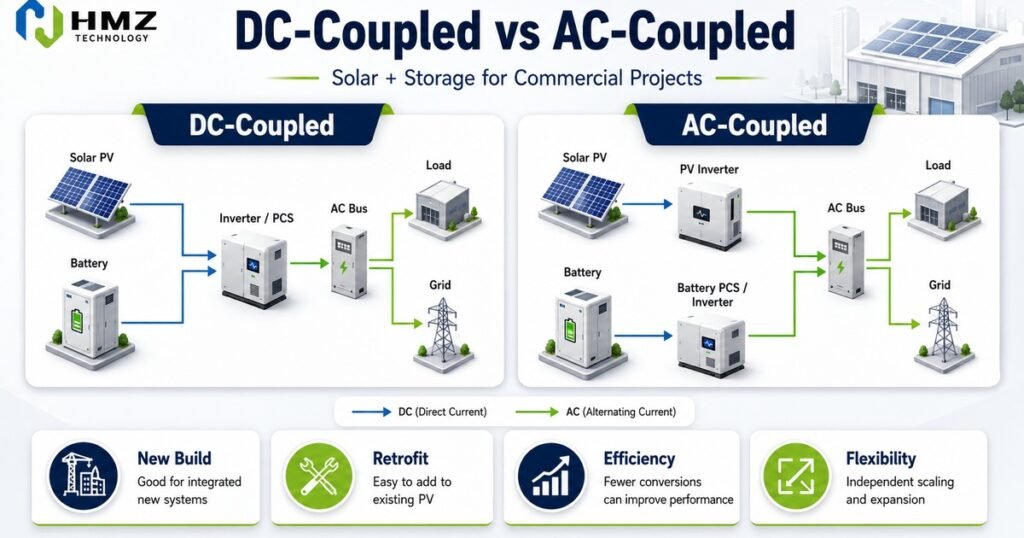
DC-Coupled
Solar PV and the battery share a DC-side architecture before power is converted to AC.
AC-Coupled
The PV system and battery system each connect independently to the AC electrical bus through their own conversion equipment.
That difference may look small on a single-line diagram.
In practice, it affects equipment selection, conversion losses, controls, installation work and how easily storage can be added to an existing PV system.
How a DC-Coupled Solar + Storage System Works
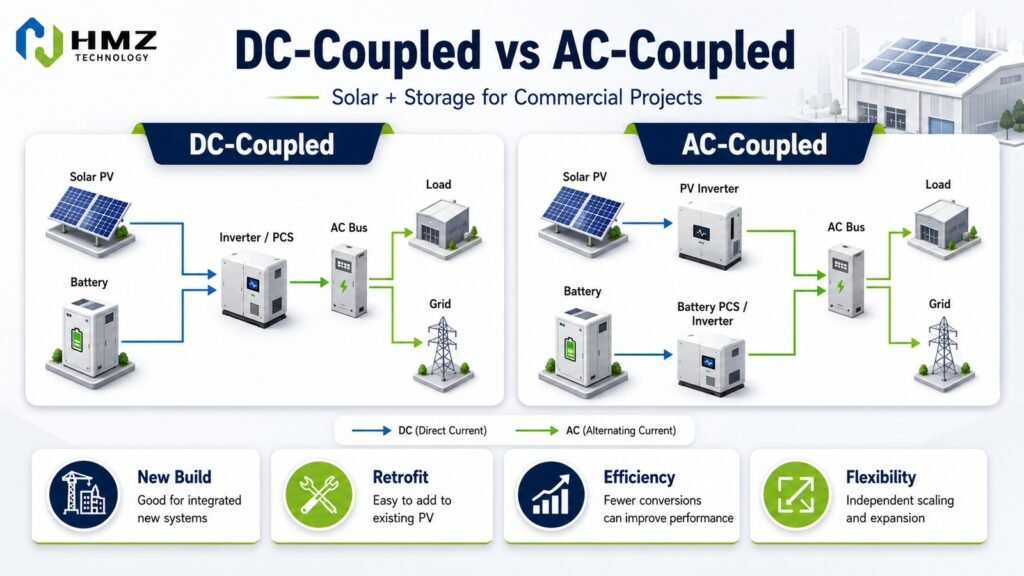
In a DC-coupled architecture, PV and battery storage are integrated on the DC side.
A simplified energy path can look like this:
Solar PV → DC Bus → Battery
or:
Solar PV → DC Bus → Inverter → AC Load
This allows solar energy to be stored before it is converted to AC.
That can be attractive in projects where PV and storage are designed together from the beginning.
Because the complete energy system is planned together, DC coupling can reduce some unnecessary conversion steps between PV and battery.
For readers who want to understand how battery storage fits into the larger system design, see our commercial microgrid design process.
Where DC Coupling Is Often Attractive
DC coupling often deserves serious consideration when:
- the project is new,
- PV and storage are engineered together,
- solar-to-battery charging will happen frequently,
- PV clipping recovery matters,
- equipment compatibility is already controlled.
A new-build project has the advantage of a clean electrical design.
The project team can optimize PV, battery, inverter, protection and EMS as one coordinated system.
A New-Build Example
Imagine a new manufacturing facility.
The project includes:
- rooftop PV,
- battery storage,
- grid connection,
- EMS,
- and critical-load backup.
Because the entire electrical system is still being designed, the engineering team can choose:
- PV string layout,
- DC voltage range,
- battery voltage,
- inverter or PCS architecture,
- protection,
- EMS logic,
- and backup operating mode
as one coordinated system.
In this situation, DC coupling may fit naturally into the overall design.
There is no existing PV architecture that needs to be preserved.
How an AC-Coupled Solar + Storage System Works
In an AC-coupled architecture, the solar system and battery storage system operate as separate AC-connected resources.
The PV side may look like:
Solar PV → PV Inverter → AC Bus
The battery side may look like:
Battery ↔ PCS ↔ AC Bus
Both connect to the same facility electrical system.
This separation is one of the main reasons AC coupling is attractive in retrofit projects.
If a factory already has a working PV installation, it may not be necessary to redesign the existing solar architecture simply to add storage.
The battery can be introduced as another controllable resource on the AC side.
This is especially relevant for customers who already have solar and are now considering solar + battery storage.
Why AC Coupling Is Common in Retrofit Projects
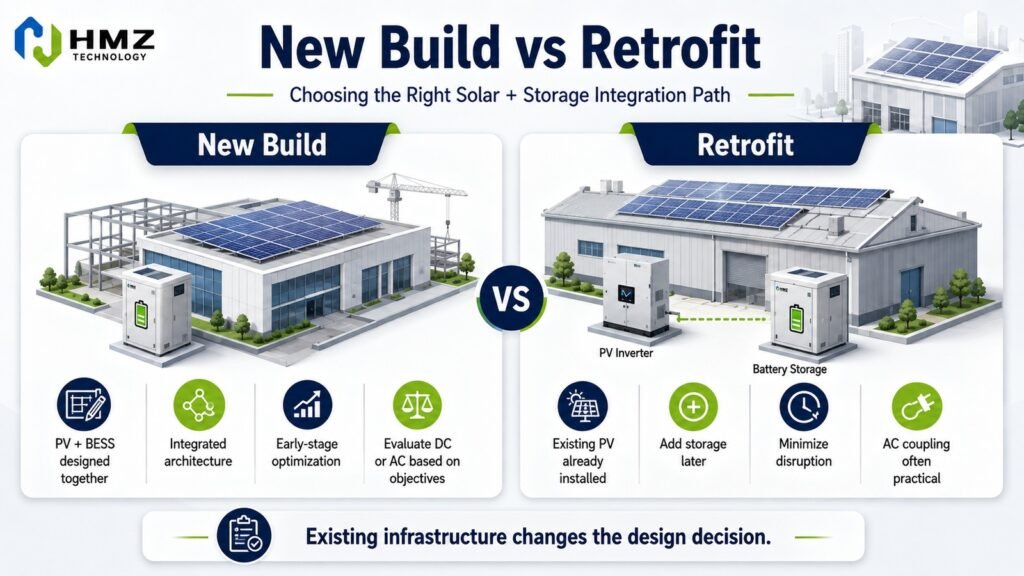
Consider an existing factory.
Five years ago, the company installed a rooftop PV system.
The PV system is still working normally.
Now the factory wants to add battery storage for:
- peak shaving,
- time-of-use optimization,
- increased solar self-consumption,
- limited backup.
Replacing the existing PV system simply to create a new DC architecture may add unnecessary cost and disruption.
An AC-coupled BESS can often be integrated while leaving the existing PV inverter in place.
This can reduce project complexity and shorten installation work.
Conversion Efficiency: DC Coupling Can Reduce Some Conversion Steps
Suppose excess solar energy needs to be stored.
In a DC-coupled architecture, solar energy may remain on the DC side before entering the battery.
In an AC-coupled architecture, solar power is typically converted to AC first and then converted back to DC through the battery PCS.
That adds another conversion stage.
For projects where large amounts of solar energy are shifted through the battery every day, this can matter.
But conversion efficiency should not be viewed in isolation.
A technically more efficient architecture may still be a worse commercial choice if it requires expensive modifications to an existing PV system.
That is why technical architecture should ultimately be evaluated together with commercial battery storage ROI.
Retrofit Flexibility: AC Coupling Has a Practical Advantage
For an existing commercial PV site, AC coupling offers something very useful:
the solar system and the battery system can remain relatively independent.
The site may already have:
- PV modules,
- string inverters,
- AC distribution,
- protection,
- metering.
If that equipment is working properly, the customer may prefer not to replace it.
The battery can be added as a separate AC-connected system while EMS coordinates the overall operation.
This matters in factories where shutdown time is expensive.
The most elegant architecture on paper is not always the most practical architecture in an operating plant.
Solar Clipping and DC-Coupled Storage
DC coupling can also be interesting where the PV array is larger than the inverter’s AC output capability.
During strong solar conditions, PV DC production may exceed what the inverter can export to the AC side.
Without storage, some of that potential generation may be clipped.
A DC-connected battery may be able to capture part of this otherwise unused DC energy, depending on the equipment architecture and control strategy.
This can improve PV utilization.
However, it should be modeled using actual:
- PV array size,
- inverter rating,
- solar resource,
- expected clipping hours,
- and battery availability.
Adding battery capacity simply because clipping “might happen” is not enough.
There needs to be enough clipped or surplus energy to justify the storage investment.
Control Strategy Matters in Both Architectures
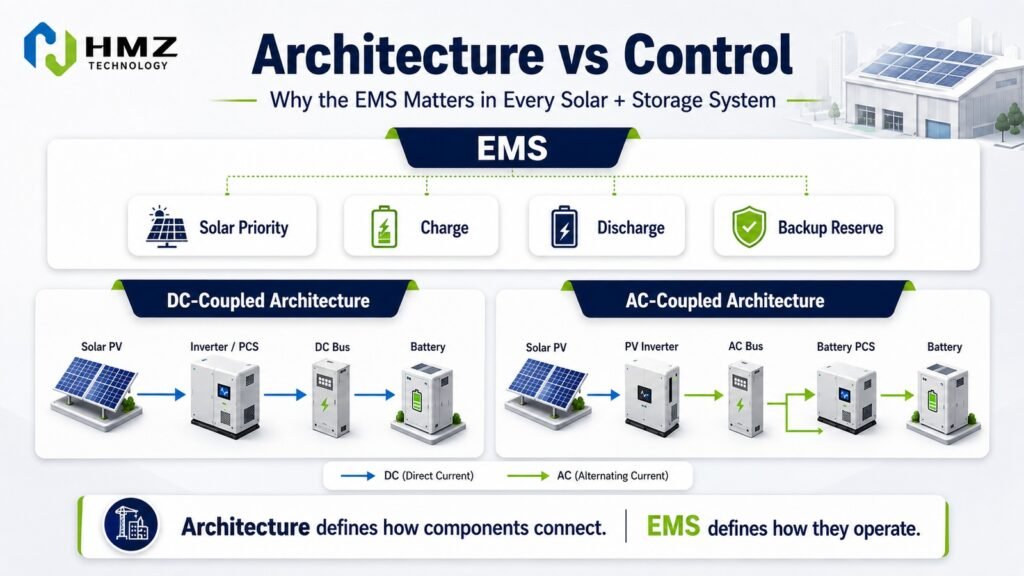
The coupling method determines how equipment is connected.
It does not determine the whole operating strategy.
The EMS still decides:
- when solar supplies the load,
- when the battery charges,
- when it discharges,
- how much SOC remains in reserve,
- when the system should reduce grid demand,
- and how backup logic should work.
For commercial users with short periods of high grid demand, peak shaving may be one of the main reasons for adding battery storage regardless of whether the project is AC- or DC-coupled.
What About Backup Power?
Neither AC coupling nor DC coupling automatically guarantees backup capability.
A system that must continue operating during a grid outage may require:
- grid-forming capability,
- suitable PCS or inverter functions,
- switching equipment,
- protection logic,
- critical-load separation,
- EMS or microgrid controller,
- safe reconnection logic.
This is where the project starts moving beyond “solar + battery” and toward a true microgrid.
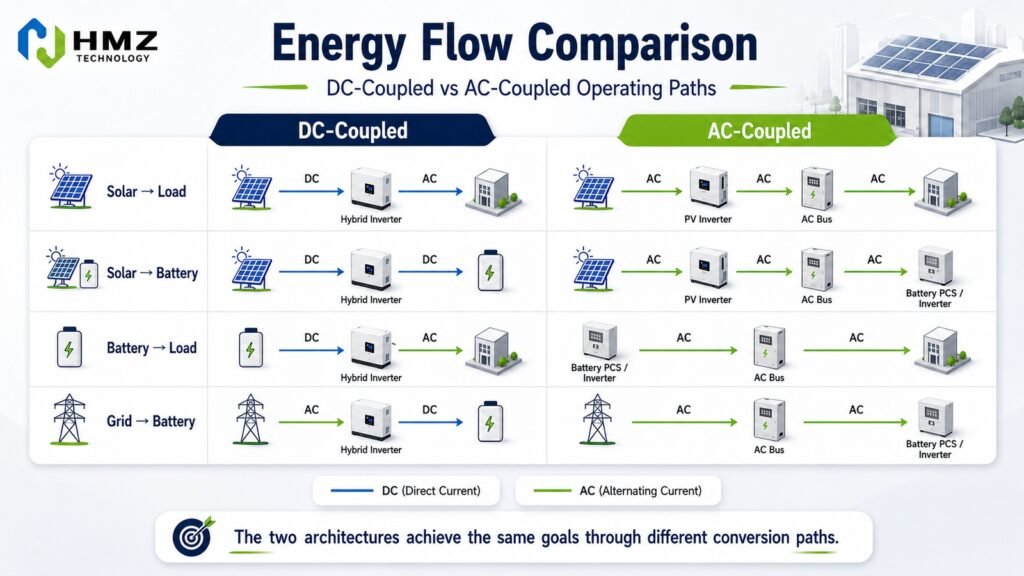
How DC and AC Coupling Affect Power Flow
It helps to look at common operating conditions.
Scenario 1: Solar Directly Supplies the Load
In both architectures, solar ultimately supplies the AC load.
The main difference is the conversion path.
Scenario 2: Solar Charges the Battery
DC coupling may allow solar energy to charge the battery with fewer conversion steps.
AC coupling usually routes solar through the PV inverter before the battery PCS converts it back to DC.
Scenario 3: Battery Supplies the Facility
In both architectures, battery energy must eventually be delivered to the AC load.
The PCS therefore needs enough power to serve the required load.
This is why understanding kW and kWh in commercial energy storage is essential before selecting either architecture.
Scenario 4: Grid Charges the Battery
AC-coupled systems can make grid charging straightforward because the battery PCS already sits on the AC side.
DC-coupled systems may also support grid charging depending on the selected equipment and design.
This function should be confirmed at equipment level.
DC-Coupled vs AC-Coupled: Practical Comparison
| Design Factor | DC-Coupled | AC-Coupled |
|---|---|---|
| New solar + storage projects | Often attractive | Also possible |
| Existing PV retrofit | May require more redesign | Often easier to add |
| Solar-to-battery conversion path | Potentially fewer conversions | Typically more conversion steps |
| Existing PV inverter reuse | Less straightforward | Often easier |
| System integration | More integrated | More modular |
| Independent PV and BESS operation | More closely linked | Stronger separation |
| Solar clipping recovery | Can be an advantage | Usually less direct |
| Future retrofit flexibility | Depends on architecture | Often strong |
| EMS required | Yes | Yes |
| Backup automatically included | No | No |
When DC Coupling May Be the Better Choice
A DC-coupled design may be worth prioritizing when:
- the project is new,
- solar and storage are being engineered together,
- solar-to-battery flow is frequent,
- PV clipping recovery matters,
- and the integrated architecture fits the project.
When AC Coupling May Be the Better Choice
AC coupling may be particularly attractive when:
- the site already has a working PV system,
- existing PV inverters will remain,
- battery storage is being added later,
- the customer wants PV and BESS to remain relatively independent,
- installation disruption needs to be minimized.
Many commercial customers now fall into this category.
They already own solar.
Their next decision is how to add storage without rebuilding the whole system.
A Common Procurement Mistake: Choosing Architecture Before Defining the Objective
It is easy for procurement discussions to become:
We want DC coupling.
or:
We only want AC coupling.
before anyone has looked at the actual project.
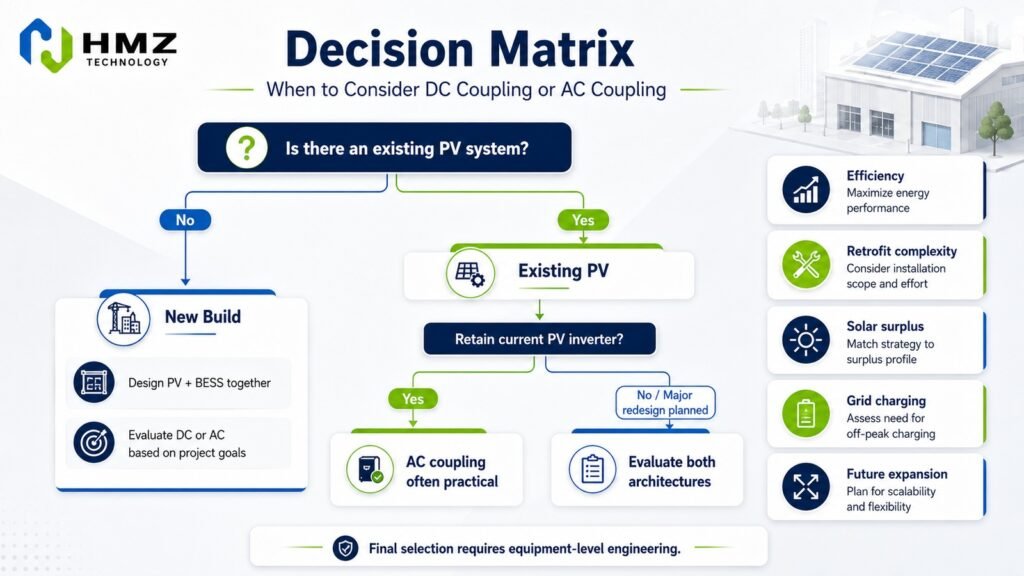
Architecture should follow the objective.
Ask first:
- Is the site new or existing?
- Is PV already installed?
- What inverter equipment is already there?
- How much solar surplus is available?
- Is the main goal peak shaving or solar shifting?
- Is grid charging required?
- Is backup required?
- What kW and kWh does the application need?
- Will the system expand later?
Those answers usually narrow the architecture decision quickly.
The coupling method should therefore be selected as part of the wider commercial microgrid design process.
How This Connects to BESS Sizing
Choosing AC or DC coupling does not solve the sizing problem.
The battery still has to match:
- real charging opportunity,
- real discharge opportunity,
- required kW,
- usable kWh,
- and expected operating strategy.
A technically convenient architecture can still produce poor economics if the battery is too large.
This is where battery oversizing becomes important.
Likewise, installation cost and utilization should ultimately be reflected in the battery storage payback period.
How HMZ Technology Looks at Solar + Storage Architecture
For a commercial solar + storage project, the useful starting information is usually:
- existing PV system,
- PV inverter configuration,
- load profile,
- solar generation profile,
- peak demand,
- grid conditions,
- backup requirements,
- future expansion.
From there, the architecture and storage configuration can be evaluated together.
HMZ provides C&I storage options including:
50kW / 112kWh and 125kW / 241kWh All-in-One C&I ESS
Learn more about our 50kW/112kWh and 125kW/241kWh All-in-One C&I Energy Storage Systems.
125kW / 261kWh Liquid-Cooled C&I ESS
For higher-duty applications, see the 125kW/261kWh Liquid-Cooled C&I Energy Storage System.
Once electrical architecture and duty cycle are clear, thermal-management method becomes another design decision.
Our air-cooled vs. liquid-cooled C&I ESS guide explains that comparison in more detail.
Conclusion
DC-coupled and AC-coupled solar + storage systems are different architectural tools.
DC coupling can be attractive when PV and storage are designed together and solar-to-battery energy flow is frequent.
AC coupling can be especially practical when battery storage is being added to an existing commercial PV installation.
The right choice depends on:
- existing equipment,
- conversion path,
- retrofit complexity,
- required kW and kWh,
- backup strategy,
- and project economics.
A new-build factory and an existing solar-equipped factory should not automatically receive the same design.
Define the job first.
Then choose the architecture.
FAQ
Question 1
What is the difference between DC-coupled and AC-coupled battery storage?
Answer
In a DC-coupled system, solar PV and battery storage are integrated on the DC side before power is converted to AC. In an AC-coupled system, the PV inverter and battery PCS connect separately to the facility’s AC electrical system.
Question 2
Is DC coupling more efficient than AC coupling?
Answer
DC coupling can reduce some conversion steps when solar energy is stored directly in the battery, which may reduce conversion losses in that operating path. Actual project efficiency depends on the complete equipment and operating architecture.
Question 3
Is AC coupling better for existing solar systems?
Answer
AC coupling is often attractive for retrofit projects because battery storage can be added to the AC electrical system while retaining the existing PV inverter architecture, subject to site and equipment compatibility.
Question 4
Is DC coupling better for new solar + storage projects?
Answer
It can be attractive when PV and battery storage are designed together from the beginning, especially where solar-to-battery energy flow is expected to be frequent. The final decision still depends on project requirements.
Question 5
Can both DC- and AC-coupled systems provide backup power?
Answer
Both architectures can be part of a backup solution, but backup capability requires suitable inverters or PCS, switching equipment, protection, controls and critical-load design. Coupling method alone does not guarantee island operation.
Question 6
Which architecture is better for commercial projects?
Answer
There is no universal answer. New-build status, existing PV equipment, retrofit complexity, energy-flow patterns, grid charging, backup requirements and future expansion should all be considered before choosing the architecture.
Build Your Intelligent Energy Future with HMZ
HMZ Technology helps businesses move beyond traditional solar systems by combining solar PV, battery storage and intelligent microgrid control.
Our integrated energy solutions are designed for industrial facilities, commercial buildings and remote energy applications requiring reliable, efficient and flexible power.
Contact HMZ Technology today to explore your next solar storage or microgrid project.
Related Insights from HMZ Technology
Industrial energy management is rapidly evolving. While rooftop solar PV provides an effective way for factories to generate clean electricity, many businesses are now looking beyond solar generation and exploring integrated solutions such as energy storage, intelligent energy management, and microgrid systems.
To better understand how commercial and industrial users can optimize their energy strategy, explore more insights from HMZ Technology’s renewable energy knowledge center, including solar PV solutions, C&I energy storage systems, and practical applications for industrial energy management.