
In commercial energy storage, bigger often sounds safer.
A customer may say:
“If 500 kWh works, why not install 800 kWh and leave more margin?”
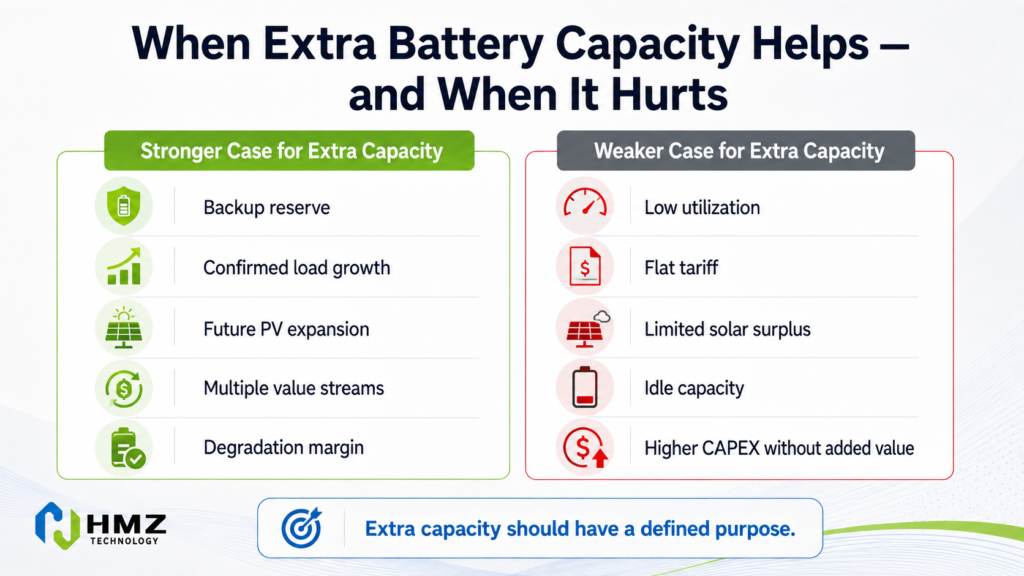
From an engineering point of view, extra capacity can provide flexibility.
From an investment point of view, that extra capacity still has to earn its keep.
If the site rarely uses it, the project is paying for battery modules, cabinet volume, thermal management, electrical equipment and installation work that may sit idle for most of the year.
That can slow down payback and reduce the return created by each installed kWh.
Oversizing is not always wrong.
But it should be a deliberate decision.
The question is not whether a larger battery can technically work.
It is whether the additional capacity creates enough operational or financial value to justify its cost.
What Does “Oversizing” Actually Mean?
Oversizing means installing more battery power or energy capacity than the project can realistically use under its intended operating strategy.
That can happen in different ways.
Too Much Energy Capacity
The site installs more kWh than it can regularly charge and discharge.
Too Much Power Capacity
The PCS or battery system can deliver far more kW than the load or peak-shaving requirement needs.
Too Much Backup Capacity
The system is designed to back up the entire site even though only a smaller group of critical loads actually needs power during an outage.
Too Much Future Capacity
The project installs capacity today for a future expansion that may not happen for several years.
All four situations increase CAPEX.
Whether they are justified depends on how the extra capacity will actually be used.
Why Oversizing Often Starts With the Wrong Question
A common procurement question is:
“What is the largest system we can install?”
A better question is:
“What does the battery need to do?”
That changes the discussion immediately.
If the project is for peak shaving, the key inputs may be:
- size of the demand peak,
- duration of the peak,
- target grid demand,
- and how often the peak occurs.
If the project is for solar shifting:
- how much PV surplus exists,
- when it occurs,
- and how much energy can be used later.
If the project is for backup:
- critical-load power,
- required backup duration,
- and reserve strategy.
The battery size should come from those inputs.
Not from available space or the largest cabinet in the catalogue.
Factor 1: Higher CAPEX Has to Be Recovered Somehow
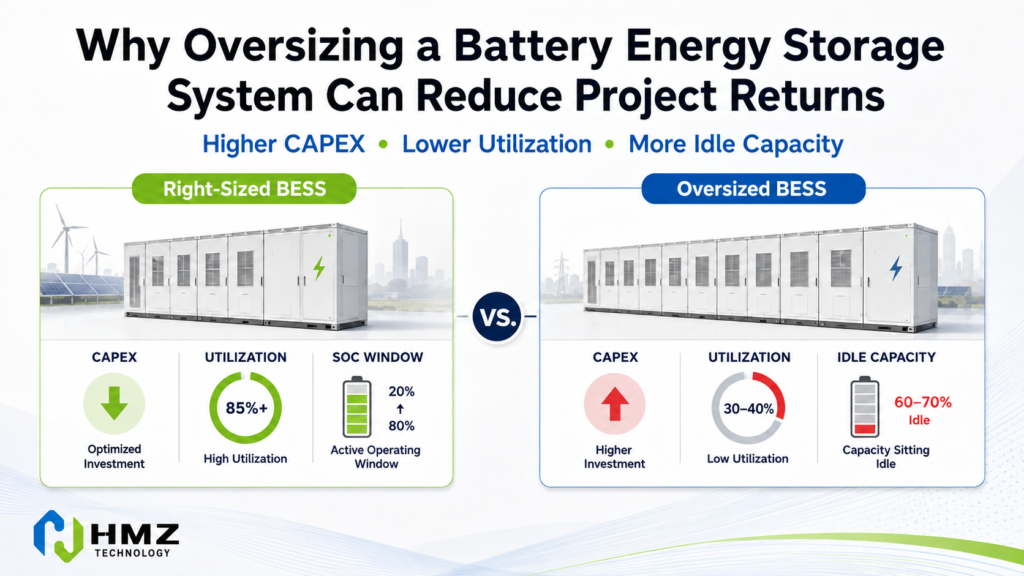
The most obvious effect of oversizing is higher upfront cost.
More battery capacity can mean more:
- cells and modules,
- cabinet capacity,
- BMS hardware,
- thermal-management equipment,
- DC protection,
- cabling,
- installation work,
- transportation,
- and sometimes larger PCS or transformer requirements.
Suppose a site has a realistic daily energy-shifting opportunity of around 400 kWh.
A 500 kWh system may already provide enough usable capacity once reserve and operating margins are considered.
Installing 800 kWh may add flexibility.
But unless the extra 300 kWh creates measurable savings, it becomes additional capital waiting to be recovered.
The project may still save the same amount of money each year.
The denominator gets larger.
The annual value does not.
Payback becomes longer.
Factor 2: Lower Utilization Weakens the Economics
A battery earns value when it is used for something useful.
That may be:
- reducing a demand peak,
- shifting energy from low-price to high-price periods,
- absorbing excess solar,
- supporting critical loads,
- or reducing generator runtime.
If a battery has 1,000 kWh installed but only 300 kWh is normally used each day, most of the system is not contributing to daily value creation.
That does not mean the unused portion has zero value.
It may provide reserve or flexibility.
But if that reserve is rarely needed, the project economics should reflect that.
A larger battery with low utilization can produce a lower return per installed kWh than a smaller battery that is used consistently.
This is one reason “USD/kWh of battery capacity” is not enough to judge a project.
The more useful question is:
How much of the installed capacity will actually be used, and how often?
Factor 3: The SOC Window Means Nameplate Capacity Is Not Fully Available
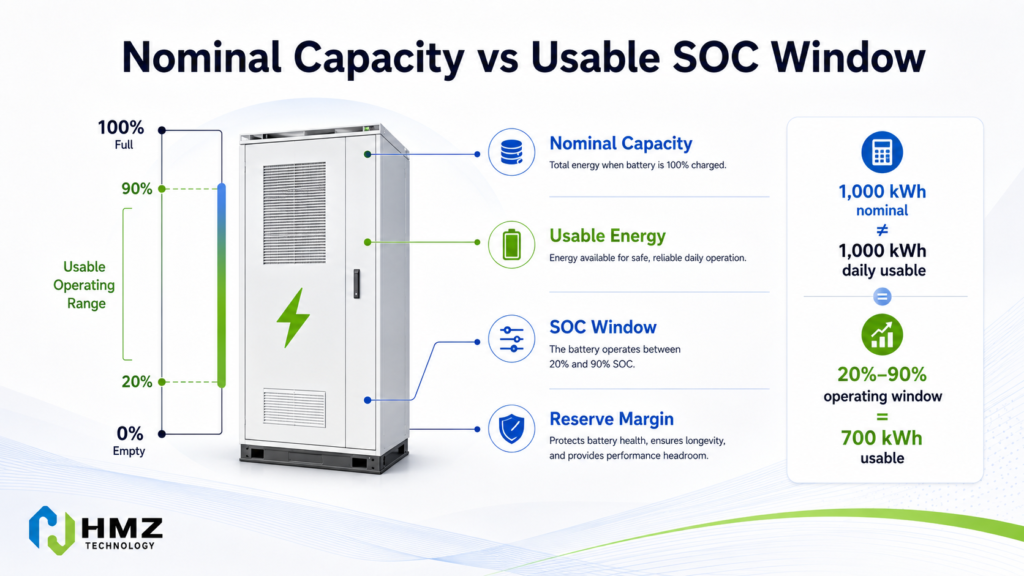
Commercial battery systems do not normally operate from 0% to 100% SOC every day.
The EMS may maintain an operating window such as:
- lower SOC limit,
- upper SOC limit,
- backup reserve,
- or cycling margin.
That means nominal capacity and usable capacity are not the same thing.
Suppose a project installs:
1,000 kWh nominal capacity
but the operating strategy only uses:
20% to 90% SOC
The theoretical operating window is 70% of nameplate capacity before other losses and restrictions are considered.
That gives:
700 kWh within the SOC window
If the site only needs 350–400 kWh of usable energy on most days, the system may already have a large buffer.
Adding more nameplate capacity without changing the operating requirement simply creates even more unused headroom.
The battery may look impressive on the specification sheet.
The load does not care.
Factor 4: Idle Capacity Still Ages
Unused capacity may be underutilized economically, but it does not exist outside the battery-aging process.
Battery aging is influenced by both cycling and calendar time.
A module does not need to complete a full cycle every day to age.
Temperature, SOC, time and operating conditions still matter.
This makes long-term oversizing more complicated.
A customer may pay for extra battery capacity today with the idea that it will become useful five years later.
By the time that future load appears, the battery is no longer a brand-new asset.
That does not make future-proofing a bad idea.
It means the timing of expansion matters.
In many projects, modular expansion can be more rational than installing all future capacity at Day 1.
Factor 5: A Large Battery May Not Have Enough Energy to Charge
This problem often appears in solar-plus-storage projects.
Imagine a facility with a 1 MWh battery.
The customer expects the battery to charge from excess rooftop PV.
But after reviewing the actual PV and load data, the site only produces 250–300 kWh of usable solar surplus on a typical day.
The battery may never get close to full charge.
A large part of the installed energy capacity sits unused because the energy source feeding it is too small.
The issue is not the battery.
The issue is system balance.
Before adding storage capacity, ask:
- How much excess solar is actually available?
- During what hours?
- At what power level?
- Can the PCS absorb it?
- Will that stored energy be used later?
Battery sizing should match the energy opportunity that really exists.
Factor 6: The Load May Not Be Large Enough to Discharge It
The reverse can also happen.
The site may be able to charge a large battery, but there may not be enough later demand to discharge it economically.
Suppose 700 kWh is stored during the day.
At night, the facility only consumes 250 kWh before the tariff drops again.
The remaining stored energy may have little economic reason to discharge.
If that pattern happens every day, the system is not using its installed capacity efficiently.
Again, the mistake comes from sizing the battery independently from the load profile.
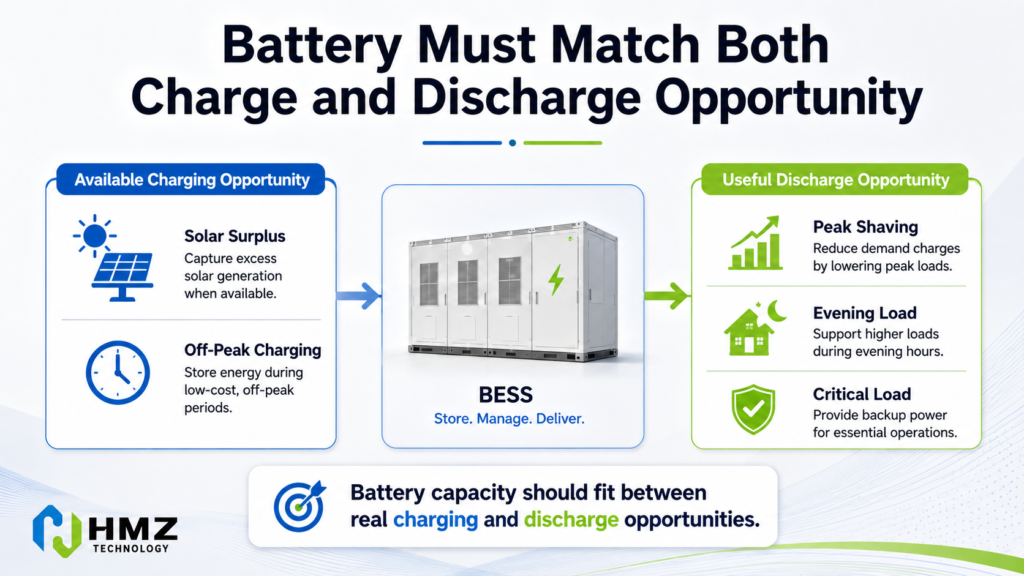
A battery needs both:
an opportunity to charge
and
a useful opportunity to discharge.
Factor 7: Oversizing for Backup Can Become Very Expensive
Backup requirements can push battery size up quickly.
A customer may initially say:
“We want the entire factory backed up.”
Suppose the site has an 800 kW total load.
Backing up 800 kW for two hours suggests a very different system from backing up only 180 kW of critical loads.
The first step should be load classification.
Typical critical loads may include:
- process controls,
- refrigeration,
- communication equipment,
- emergency lighting,
- selected production equipment,
- safety systems.
Non-critical loads may be shed during an outage.
This can reduce both:
- required battery power,
- and required battery energy.
Trying to back up every air conditioner, office socket and non-essential machine can dramatically increase battery CAPEX.
If the business genuinely needs full-site backup, that is a valid requirement.
But it should be an intentional decision based on the cost of interruption.
Factor 8: Oversizing Power and Oversizing Energy Are Different Problems
Not all oversizing is about kWh.
A system can also be oversized in kW.
Suppose a site only needs 100 kW of peak reduction.
Installing a 500 kW PCS does not automatically create additional value.
The higher-power system may increase:
- PCS cost,
- switchgear requirements,
- transformer or cable requirements,
- and interconnection complexity.
Likewise, a project can have the opposite problem:
too much kWh but too little kW.
That is why commercial BESS sizing should always consider the power-to-energy relationship.
Ask separately:
How much power is needed?
and
For how long?
Factor 9: Oversizing Can Reduce Value per Installed kWh
A useful way to think about storage economics is not only total annual savings.
Also consider:
How much value does each installed kWh create?
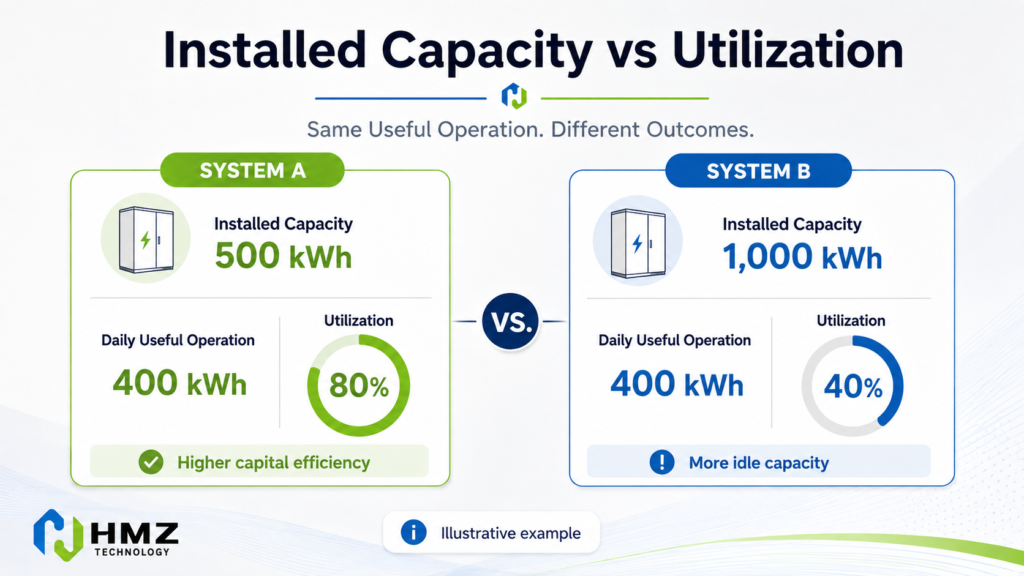
Imagine two projects.
Project A
500 kWh installed
400 kWh regularly used
High daily utilization
Project B
1,000 kWh installed
400 kWh regularly used
Same annual value opportunity
Project B has twice the installed energy capacity, but the load still only provides roughly the same useful daily energy opportunity.
Unless the extra 500 kWh provides another value stream, the return per installed kWh becomes weaker.
This is why a larger system may produce more total flexibility while producing poorer capital efficiency.
When Extra Capacity Is Actually Justified
Not every large battery is oversized.
Additional capacity can be reasonable when there is a clear reason for it.
Examples include:
Backup Reserve
The customer needs part of the battery kept available for outages.
Load Growth
A confirmed production expansion will increase future energy demand.
PV Expansion
More solar capacity will be installed and additional storage will soon be required.
Multiple Value Streams
The same battery is used for peak shaving, solar shifting, backup and other applications.
Degradation Margin
The project requires a certain usable capacity after years of operation.
Grid or Market Requirements
The project needs a specific duration or capacity to participate in a particular energy market or grid service.
The important distinction is this:
Extra capacity should have a defined purpose.
“More is safer” is not the same as a sizing strategy.
Future-Proofing: Oversize Today or Expand Later?
This is a more interesting question.
Suppose a factory expects its load to increase by 40% over the next three years.
Should it install the future battery capacity now?
Maybe.
But there is another option:
design the system for modular expansion.
The decision depends on factors such as:
- expansion certainty,
- equipment architecture,
- installation cost,
- available space,
- future integration complexity,
- battery compatibility,
- and expected energy demand.
Installing all future capacity immediately may simplify later construction.
It also means paying for underused capacity during the early years.
A modular strategy may improve early utilization while preserving a path for growth.
There is no universal answer.
But the trade-off should be visible in the financial model.
A Practical Oversizing Example
Consider a factory that wants battery storage mainly for:
- solar energy shifting,
- and afternoon peak shaving.
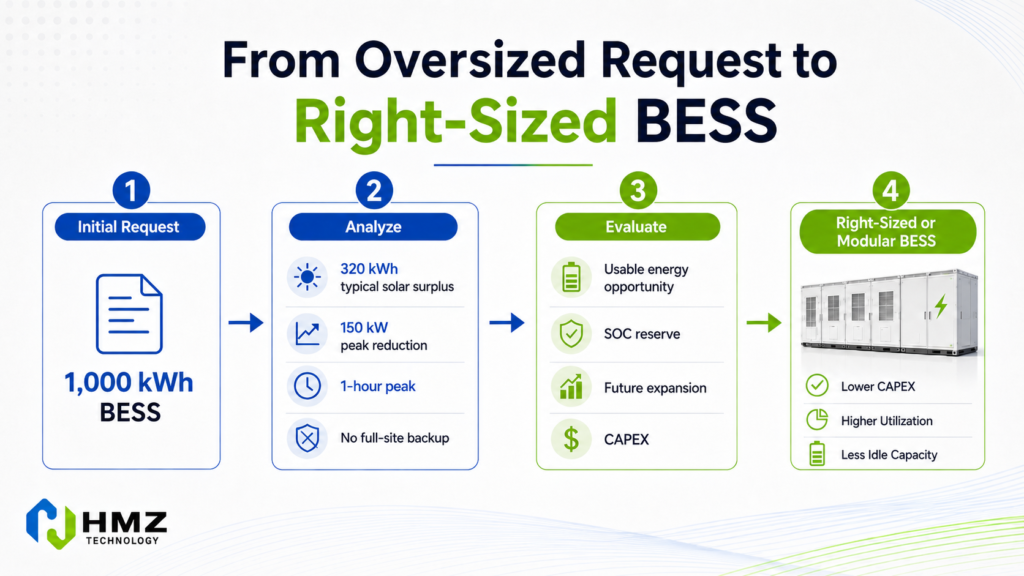
Site analysis shows:
- average useful daily PV surplus: 320 kWh
- normal peak-reduction requirement: 150 kW
- typical peak duration: 1 hour
- no full-site backup requirement
The initial customer request is:
1,000 kWh BESS
Why?
Because the customer wants “more reserve.”
Now compare the actual operating opportunity.
Around 320 kWh of solar surplus is normally available to charge.
Peak shaving may use approximately:
150 kW × 1 hour = 150 kWh
There may be overlap between these applications depending on the operating schedule.
A 1,000 kWh system could certainly work.
But the project team should ask how the remaining capacity will create value.
If a large portion remains unused on most days, the additional CAPEX may extend the payback period.
The correct answer may be:
- a smaller initial system,
- a larger system with justified backup reserve,
- or a modular system designed for later expansion.
The load profile decides which one makes sense.
How HMZ Technology Approaches BESS Sizing
At HMZ Technology, commercial battery sizing should begin with the application rather than the cabinet size.
Useful project inputs include:
- 15-minute or hourly load profile,
- peak demand,
- daily energy consumption,
- existing PV capacity,
- solar surplus,
- electricity tariff,
- critical loads,
- backup duration,
- generator information,
- and future expansion plans.
From those inputs, the project can define:
Required power in kW
and
Required usable energy in kWh
before matching the requirement to available equipment.
HMZ’s current C&I ESS portfolio includes configurations such as:
50kW / 112kWh All-in-One C&I Energy Storage System
Suitable for smaller commercial facilities, distributed solar-plus-storage and light industrial applications.
125kW / 241kWh All-in-One C&I Energy Storage System
Suitable for larger C&I applications requiring more power and energy capacity.
125kW / 261kWh Liquid-Cooled C&I Energy Storage System
Suitable for higher-duty applications requiring higher energy density and more precise thermal management.
These configurations are system options.
They should not replace site-level sizing.
Questions to Ask Before Increasing Battery Capacity
Before changing a project from 500 kWh to 800 kWh or from 1 MWh to 1.5 MWh, ask:
- What additional load will use the extra energy?
- Is there enough energy available to charge it?
- How many days per year will that extra capacity be used?
- Does the customer need backup reserve?
- Is future load growth confirmed?
- Will PV capacity increase?
- Can the PCS use the additional capacity effectively?
- How much additional CAPEX does the larger system create?
- How does the larger system change annual savings?
- Would modular expansion be more efficient?
If those questions do not have clear answers, the larger battery may be solving a problem that does not yet exist.
Quick Procurement Checklist: Is the BESS Oversized?
Load Match
- Daily load profile reviewed
- Peak demand identified
- Peak duration confirmed
- Critical loads separated from non-critical loads
Energy Opportunity
- Solar surplus quantified
- Off-peak charging opportunity quantified
- Daily discharge opportunity quantified
- Expected cycling frequency understood
Battery Capacity
- Nominal kWh checked
- Usable kWh checked
- SOC operating window confirmed
- Backup reserve defined
- Degradation margin considered
Economics
- Additional CAPEX identified
- Additional annual value quantified
- Utilization estimated
- Expansion strategy reviewed
If the additional battery capacity increases cost but does not create a clear additional value stream, the project deserves another sizing review.
Frequently Asked Questions
What does battery oversizing mean?
Battery oversizing means installing more power or energy capacity than the project can realistically use under its normal operating strategy.
Is an oversized battery always bad?
No. Extra capacity may be justified for backup reserve, future expansion, multiple value streams or long-term degradation margin. It becomes a problem when the additional capacity has no clear use.
How does oversizing affect battery ROI?
Oversizing increases CAPEX. If annual savings or operational value do not increase proportionally, the payback period may become longer and return per installed kWh may decline.
Why does the SOC window matter when sizing a BESS?
Commercial batteries normally operate within defined SOC limits rather than continuously using 0%–100% of nameplate capacity. This means nominal capacity and daily usable energy are different.
Can a battery be oversized for solar storage?
Yes. If the site does not produce enough excess solar energy to charge the battery regularly, part of the installed storage capacity may remain underutilized.
Is modular expansion better than oversizing from the beginning?
It can be. Modular expansion may improve early utilization while preserving capacity for future growth, but the decision depends on expansion certainty, system architecture, space and future integration cost.
Build Your Intelligent Energy Future with HMZ
HMZ Technology helps businesses move beyond traditional solar systems by combining solar PV, battery storage and intelligent microgrid control.
Our integrated energy solutions are designed for industrial facilities, commercial buildings and remote energy applications requiring reliable, efficient and flexible power.
Contact HMZ Technology today to explore your next solar storage or microgrid project.
Related Insights from HMZ Technology
Industrial energy management is rapidly evolving. While rooftop solar PV provides an effective way for factories to generate clean electricity, many businesses are now looking beyond solar generation and exploring integrated solutions such as energy storage, intelligent energy management, and microgrid systems.
To better understand how commercial and industrial users can optimize their energy strategy, explore more insights from HMZ Technology’s renewable energy knowledge center, including solar PV solutions, C&I energy storage systems, and practical applications for industrial energy management.