
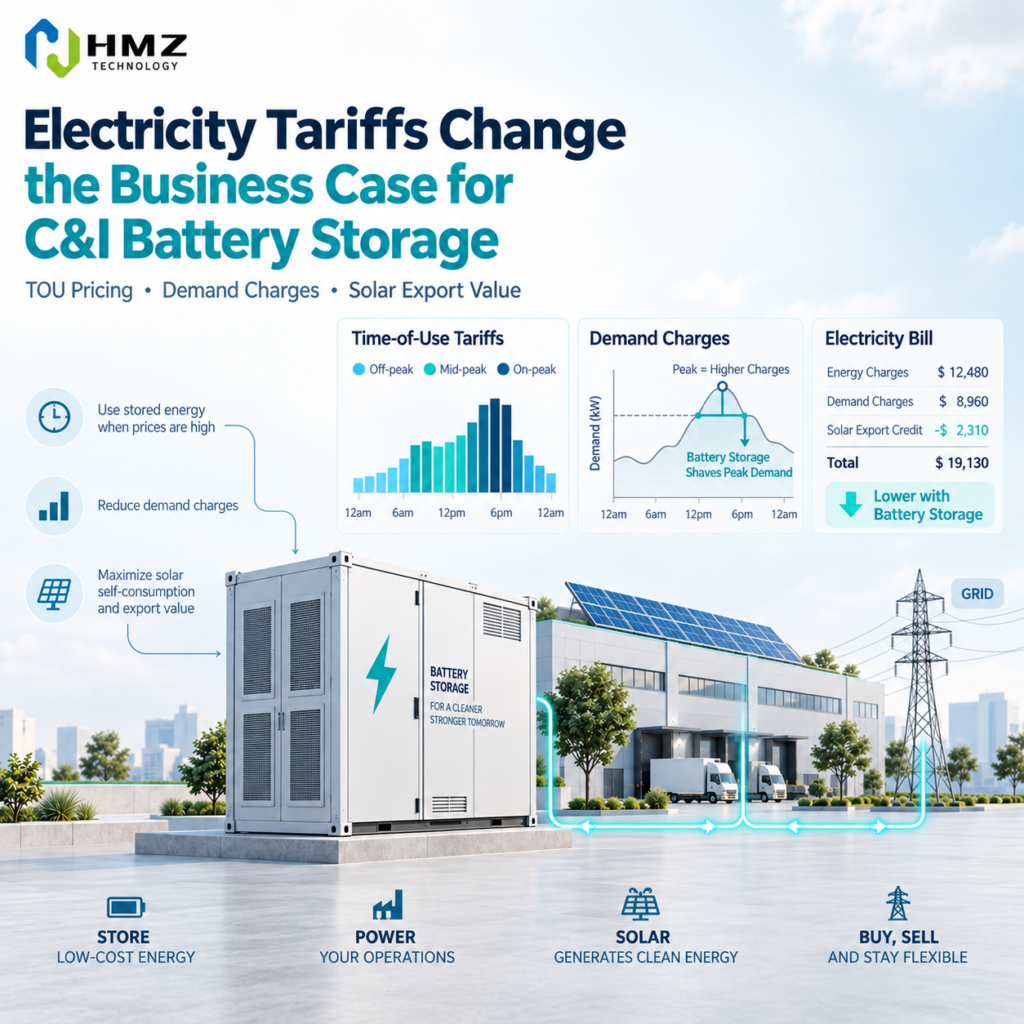
Two factories can install the same battery system and get very different financial results.
The equipment may be identical.
The battery capacity may be identical.
The PCS power may be identical.
Even the daily load can look similar.
Yet one project may have an attractive payback while the other struggles to justify the investment.
The reason is often not the battery.
It is the electricity tariff.
A C&I battery creates value by changing when, how much, or from where a business buys electricity.
If the tariff rewards that flexibility, storage can be useful.
If the tariff barely changes throughout the day and there are no meaningful demand charges, the same battery may have far less economic work to do.
That is why tariff analysis should come before battery sizing.
Not after it.
Why Electricity Tariffs Matter So Much
A battery does not create savings simply because it can charge and discharge.
It creates savings when charging and discharging changes something that has financial value.
That may be:
- avoiding expensive peak-hour electricity,
- reducing a monthly demand charge,
- increasing the value of rooftop solar,
- reducing generator fuel use,
- or avoiding costly interruptions.
For a grid-connected commercial project, the electricity bill is usually the first place to look.
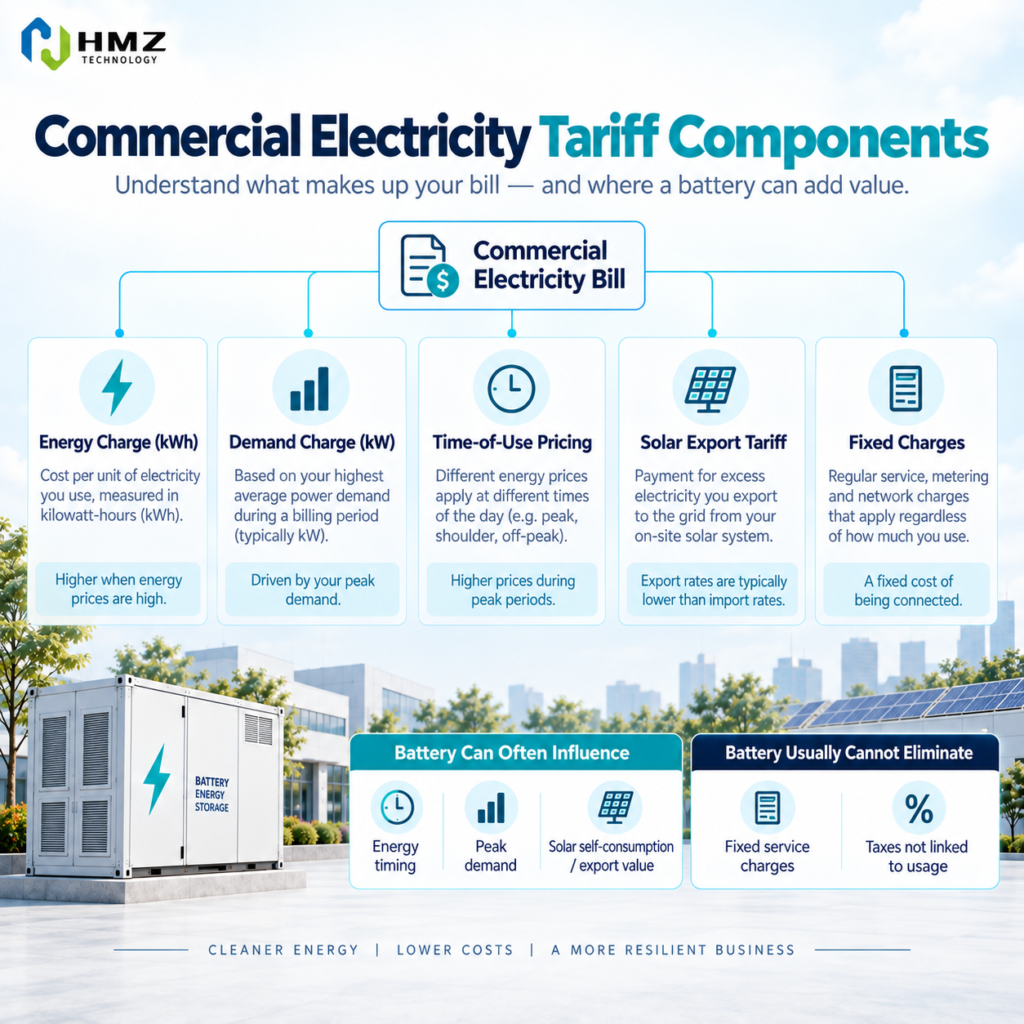
A tariff can contain several different components:
- energy charge in kWh,
- demand charge in kW,
- peak and off-peak pricing,
- seasonal rates,
- export compensation,
- fixed charges,
- taxes or grid fees.
Not all of them can be reduced by a battery.
The useful question is:
Which parts of the bill can storage actually influence?
Tariff Type 1: Time-of-Use Pricing
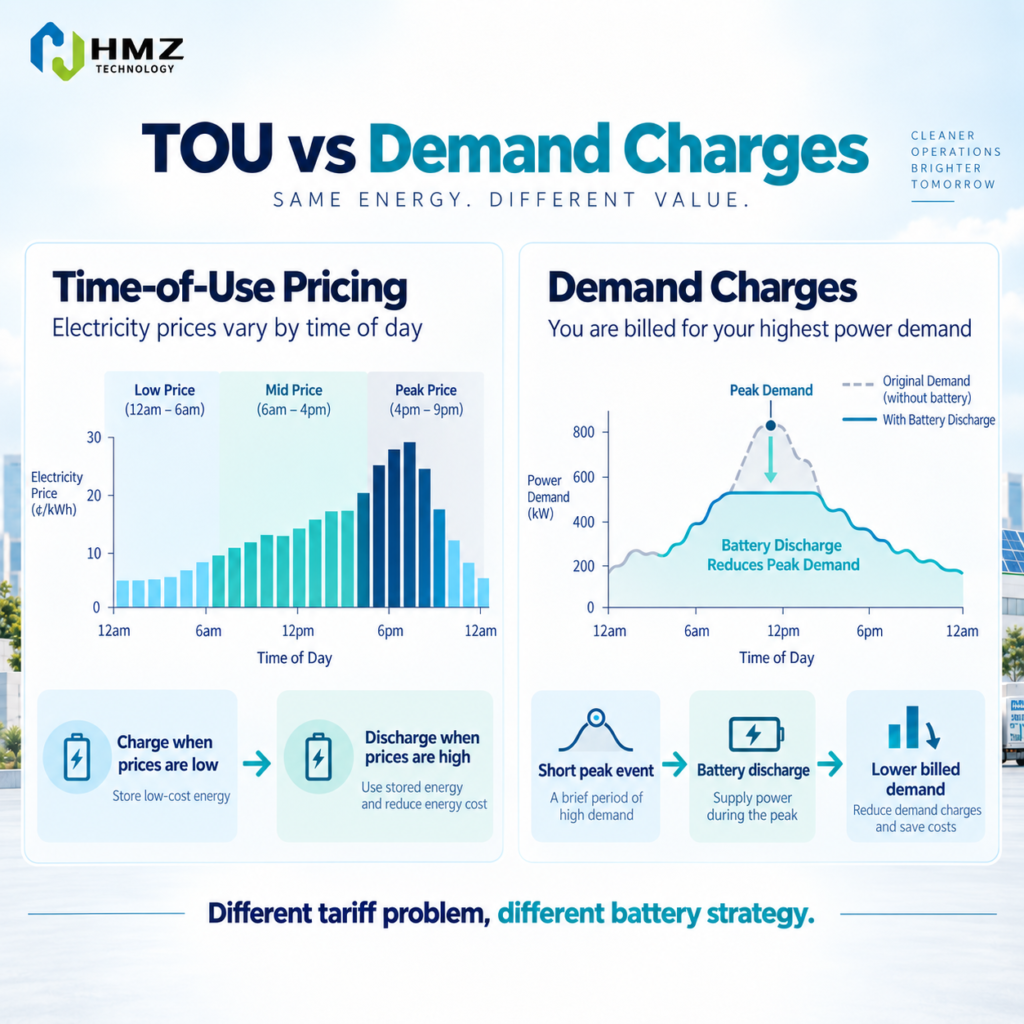
Time-of-use, or TOU, tariffs charge different electricity prices at different times of the day.
A typical structure may include:
- off-peak,
- shoulder,
- peak.
For example:
Off-Peak
USD 0.08/kWh
Peak
USD 0.20/kWh
The difference is:
USD 0.12/kWh
That price spread creates an opportunity.
The battery can charge when electricity is cheaper and discharge when electricity is more expensive.
This is often called energy arbitrage.
The basic logic is simple:
Low-price electricity → Battery → High-price period
But the economics are not as simple as multiplying the price difference by battery capacity.
The real result must account for:
- round-trip efficiency,
- usable SOC range,
- auxiliary consumption,
- degradation,
- cycle frequency,
- and the actual amount of energy shifted.
A 261 kWh battery does not automatically shift 261 kWh every day.
The usable quantity depends on the operating window and site conditions.
When TOU Arbitrage Works Well
A TOU-based battery project becomes more interesting when:
- the peak/off-peak price spread is large,
- the peak period happens predictably,
- the site has enough load during the expensive period,
- the battery can recharge reliably before the next peak,
- and the value of each cycle is high enough to justify battery use.
Suppose the battery is charged at night.
By 5:00 p.m., electricity prices rise sharply.
If the factory continues operating through the peak tariff period, the battery can discharge into that load.
That is a clear use case.
Now change one detail.
The factory closes at 4:00 p.m.
The peak tariff starts at 6:00 p.m.
The tariff spread still exists.
The site simply has no meaningful load during the expensive period.
The battery opportunity disappears.
This is why tariff data and load data have to be reviewed together.
Tariff Type 2: Demand Charges
Demand charges are different.
They are based on power, not total energy.
A utility may charge the customer according to the highest 15-minute or 30-minute demand recorded during the billing period.
That means one short peak can influence the monthly bill.
Consider a factory that normally operates at:
400–450 kW
but occasionally reaches:
650 kW
If the utility charges based on that 650 kW peak, the customer may pay for a demand level that only occurred briefly.
A battery can reduce that peak.
For example:
Facility load: 650 kW
Battery discharge: 150 kW
Grid import: 500 kW
The battery only needs to cover the portion above the desired limit.
This is why demand-charge projects often start with kW rather than kWh.
For a deeper explanation, see our guide to peak shaving.
A High Energy Price Does Not Automatically Mean a Good BESS Project
This is an important procurement mistake.
A customer may say:
Our electricity price is very high. Battery storage must make sense.
Not necessarily.
Suppose the electricity price is:
USD 0.22/kWh all day
There is no TOU spread.
There is no demand charge.
Solar export is compensated at nearly the same value as self-consumption.
The electricity is expensive.
But the battery has limited opportunity to change the cost.
The system can still provide backup value or generator reduction.
It simply may not have a strong grid-bill savings case.
High electricity price and strong storage economics are not the same thing.
The structure of the tariff matters more than the headline price.
Tariff Type 3: Flat Electricity Rates
A flat tariff charges roughly the same energy price throughout the day.
Under this structure, charging from the grid and discharging later may create little or no energy-arbitrage value.
If electricity costs:
USD 0.15/kWh at 2:00 a.m.
and:
USD 0.15/kWh at 6:00 p.m.
shifting grid electricity between those periods does not reduce the energy charge.
In fact, system losses mean the site would need to purchase more energy than it later receives from the battery.
So is storage useless under flat tariffs?
No.
Other value streams may still exist.
For example:
- demand charges,
- excess solar storage,
- backup power,
- generator reduction,
- grid constraints.
The point is that TOU arbitrage should not be included in the financial model if the tariff does not support it.
Tariff Type 4: Solar Export Compensation
Solar export pricing can completely change the value of storage.
Consider a factory with rooftop PV.
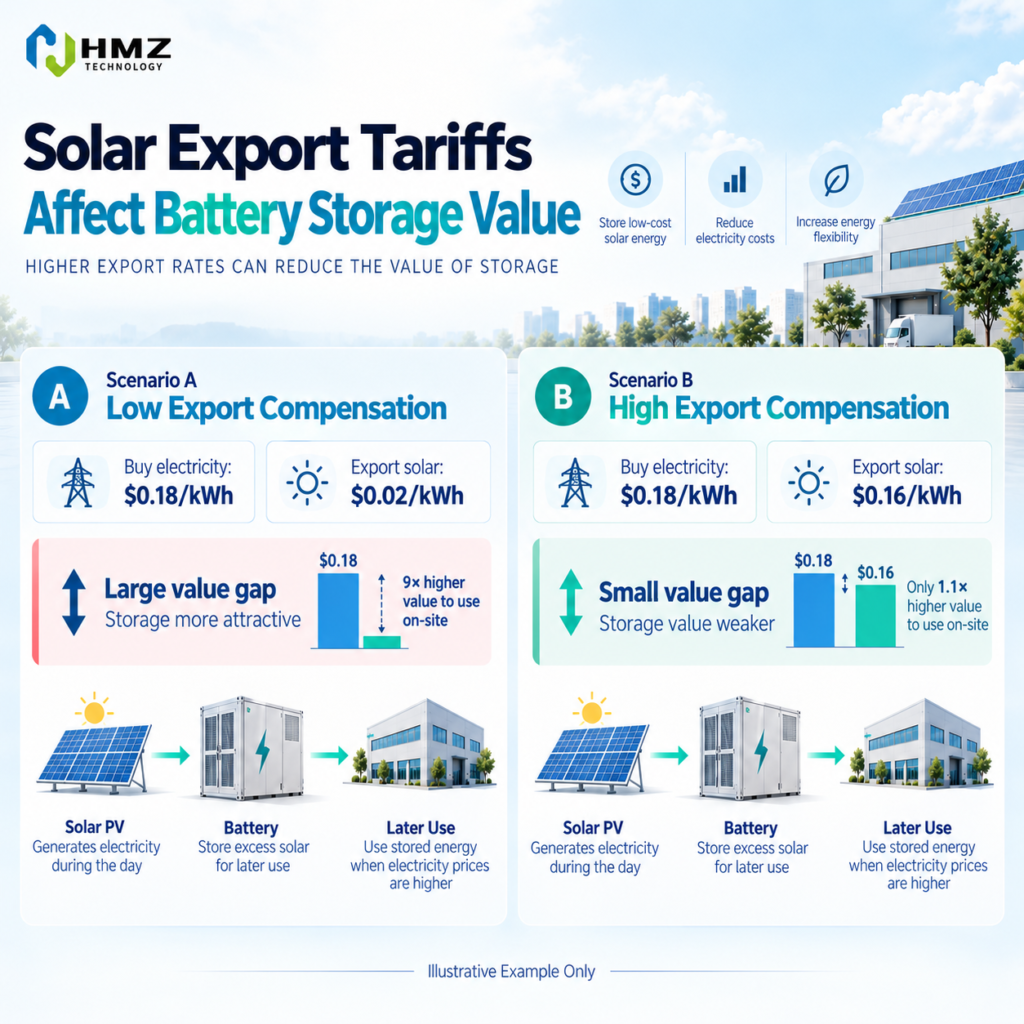
During midday, it has 400 kWh of excess solar generation.
If exported solar receives:
USD 0.02/kWh
but the factory later buys electricity at:
USD 0.18/kWh
then storing more of that solar for later use can create a meaningful value difference.
Now imagine the export tariff is:
USD 0.16/kWh
while grid electricity costs:
USD 0.18/kWh
The gap is much smaller.
Battery storage may still create value, but the economic case for increasing solar self-consumption is weaker.
This is why a solar + battery proposal should not simply say:
“The battery increases self-consumption.”
The next question is:
How much is additional self-consumption actually worth under this tariff?
For the broader solar-storage logic, see our article on solar + battery storage.
The Same Battery Can Need a Different EMS Strategy Under a Different Tariff
Battery hardware does not determine project economics by itself.
The EMS has to respond to the local tariff.
Imagine the same 125 kW / 261 kWh storage system installed at three sites.
Site A — Strong TOU Tariff
The battery charges during low-price hours and discharges during the expensive evening period.
Site B — High Demand Charge
The battery stays available for short load peaks and may not fully discharge every day.
Site C — Large PV Surplus, Low Export Price
The battery prioritizes midday solar charging and discharges later when facility demand remains high.
Same battery.
Different operating logic.
This is why EMS strategy should be designed from the tariff and load profile together.
Tariff Design Also Changes the Required kW and kWh
The electricity tariff does not only affect financial returns.
It can affect battery sizing.
Demand-Charge Project
Suppose the customer wants to reduce:
200 kW
of peak demand for:
30 minutes
The theoretical energy requirement is:
200 kW × 0.5 hour = 100 kWh
Power is the dominant requirement.
TOU Project
Suppose the site wants to shift:
150 kW
for:
3 hours
The theoretical energy requirement is:
450 kWh
Energy capacity becomes much more important.
These two projects require very different power-to-energy ratios.
For more detail on that relationship, see kW and kWh in commercial energy storage.
Why Tariff Analysis Should Come Before BESS Sizing
If a supplier starts by selecting a battery cabinet and only checks the tariff later, the project is being designed backwards.
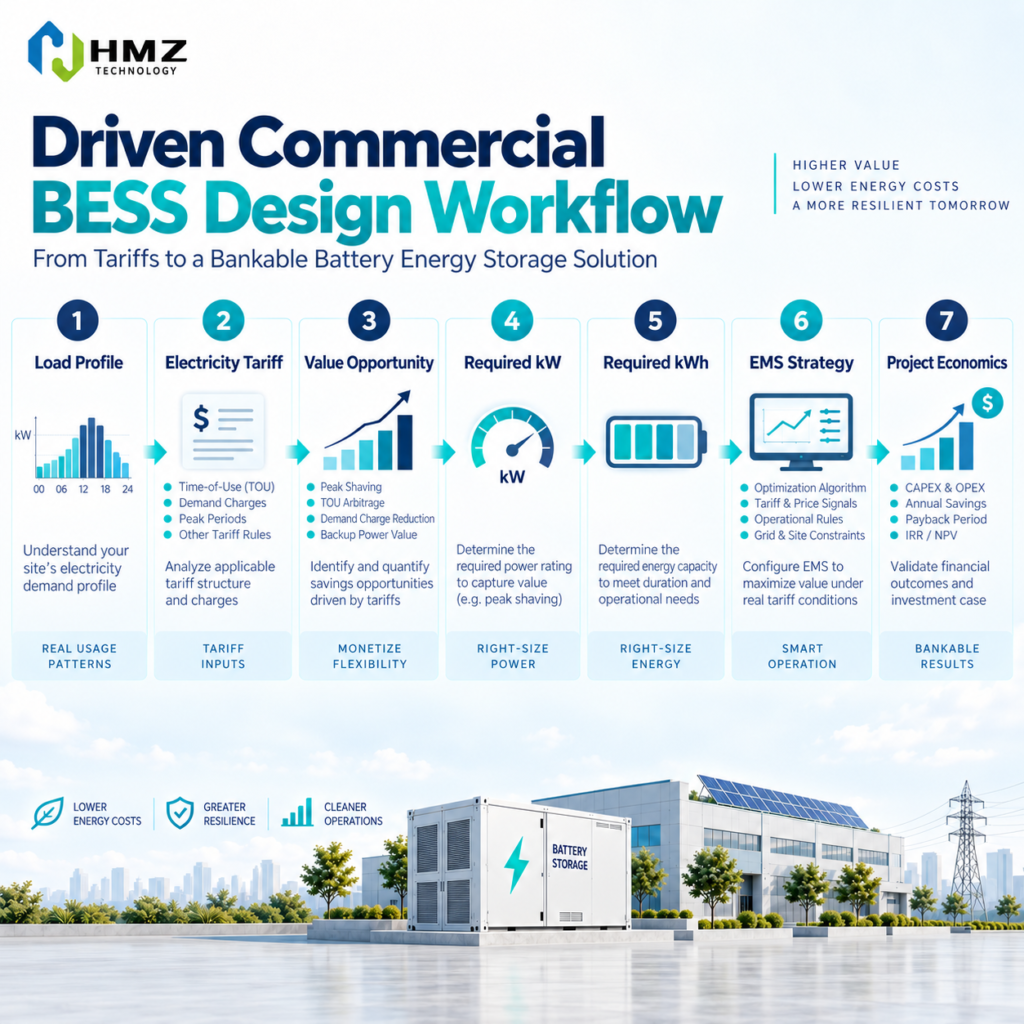
A better sequence is:
Step 1
Understand the load profile.
Step 2
Understand the electricity tariff.
Step 3
Identify the value opportunity.
Step 4
Define the battery power requirement.
Step 5
Define the usable energy requirement.
Step 6
Configure the EMS strategy.
Step 7
Calculate the project economics.
This approach avoids designing a system that is technically impressive but financially underused.
Tariffs Can Also Make an Oversized Battery Look Worse
Suppose a site has a two-hour peak tariff window.
The battery can economically shift approximately 300 kWh during that period.
Installing 600 kWh may provide useful reserve.
Installing 1,500 kWh does not automatically create five times the value.
The tariff window has not changed.
The load has not changed.
The useful economic opportunity may still be around 300 kWh per day.
The additional capacity has to find another job.
Without one, it becomes expensive idle capacity.
This is where battery oversizing begins to reduce project returns.
Tariffs and Battery Payback Are Directly Connected
A battery storage payback model usually relies on expected annual savings.
Those savings cannot be calculated properly without knowing the tariff.
If the project assumes:
- demand-charge savings that do not exist,
- TOU arbitrage under a flat tariff,
- unrealistic solar-export losses,
- or more daily cycling than the load allows,
the payback result will be misleading.
That is why the battery storage payback period should always be based on site-specific tariff data.
The same applies to overall commercial battery storage ROI.
What Information Should a Customer Provide?
Before evaluating the business case for a commercial BESS, ask for more than the monthly electricity bill total.
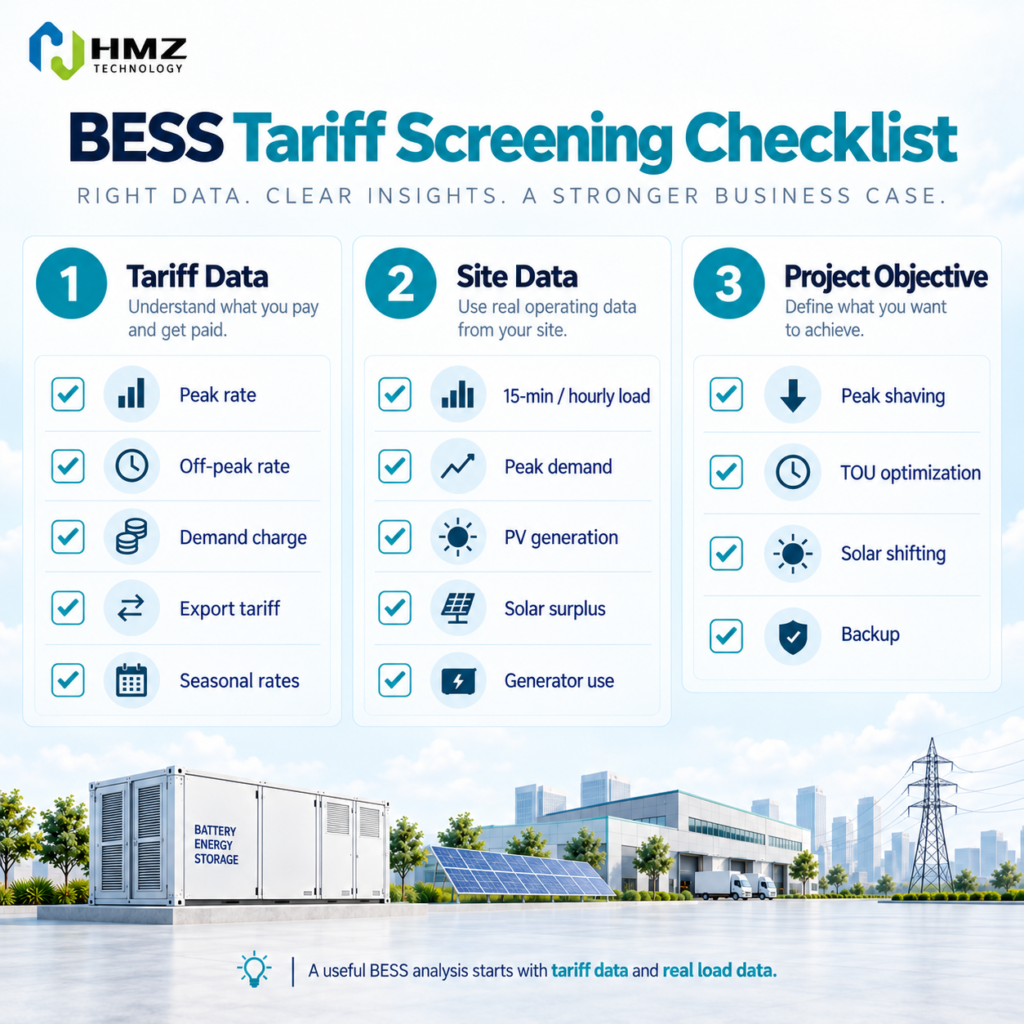
Useful information includes:
- electricity bill,
- tariff schedule,
- peak and off-peak periods,
- demand-charge rate,
- 15-minute or hourly load data,
- peak demand,
- existing PV capacity,
- solar export tariff,
- solar generation data,
- generator operating cost,
- backup requirements.
A monthly bill is useful.
A monthly bill plus interval load data and tariff rules is much better.
That combination shows not only what the customer paid, but why.
How HMZ Technology Looks at Tariff-Driven Storage Design
For a commercial battery project, HMZ does not need only the target battery capacity.
More useful information includes:
- when the site uses electricity,
- how the utility charges for it,
- when peaks occur,
- how much solar is exported,
- and what the customer wants the battery to accomplish.
From there, the project can determine:
- required power in kW,
- usable capacity in kWh,
- expected operating duration,
- charging window,
- discharge window,
- and EMS logic.
HMZ’s C&I storage portfolio includes:
50kW / 112kWh All-in-One C&I ESS
Suitable for smaller commercial facilities and distributed solar + storage applications.
125kW / 241kWh All-in-One C&I ESS
Suitable for larger commercial and industrial energy-management applications.
125kW / 261kWh Liquid-Cooled C&I ESS
Suitable for higher-duty C&I applications requiring more precise thermal management.
Learn more about our 50kW/112kWh and 125kW/241kWh All-in-One C&I Energy Storage Systems.
One Battery, Four Tariffs, Four Different Results
It is useful to think about the same BESS under four different commercial situations.
Site 1 — Strong TOU Spread
The battery has regular daily arbitrage opportunities.
Site 2 — High Demand Charges
The battery earns value mainly by controlling short load peaks.
Site 3 — Flat Tariff + No Demand Charge
Grid-bill savings may be limited unless solar, backup or generator value exists.
Site 4 — Low Solar Export Price
The battery can increase the value of rooftop solar by storing energy that would otherwise be exported cheaply.
Same hardware.
Four different business cases.
That is why the tariff is part of the system design.
Conclusion
Commercial battery storage economics cannot be separated from electricity tariffs.
A BESS creates value when it changes something the customer would otherwise pay for.
That may be:
- expensive peak-hour energy,
- high maximum demand,
- low-value solar exports,
- generator fuel,
- or operational downtime.
A strong TOU spread can favor energy shifting.
A high demand charge can favor peak shaving.
A low solar export tariff can favor PV self-consumption.
A flat tariff may leave fewer bill-saving opportunities.
So before asking:
“Which battery should we install?”
ask:
“How does this site actually pay for electricity?”
That answer often determines what the battery should do, how large it should be and whether the project makes financial sense.
FAQ
Question 1
How do electricity tariffs affect commercial battery storage?
Answer
Electricity tariffs determine when and how a battery can create financial value. Time-of-use rates can support energy arbitrage, demand charges can create peak-shaving value, and low solar export tariffs can increase the value of solar self-consumption.
Question 2
Is a high electricity price enough to justify battery storage?
Answer
No. A high electricity price alone does not guarantee strong BESS economics. The tariff structure, load profile, demand charges, solar surplus and operating strategy are also important.
Question 3
What is a TOU tariff?
Answer
A time-of-use tariff charges different electricity prices at different times of the day. A battery may charge during lower-price periods and discharge when electricity is more expensive.
Question 4
How do demand charges affect battery sizing?
Answer
Demand-charge projects often focus first on the amount of power in kW that must be reduced and how long the peak lasts. This can lead to a different battery power-to-energy ratio than a TOU energy-shifting project.
Question 5
Why does the solar export tariff matter?
Answer
If exported solar receives much less value than electricity purchased from the grid, storing excess PV and using it later may improve the economic value of the solar system.
Question 6
What information is needed to evaluate BESS economics?
Answer
Useful information includes the tariff schedule, electricity bills, interval load data, peak demand, demand-charge rate, PV capacity, solar generation, export tariff, generator usage and backup requirements.
Build Your Intelligent Energy Future with HMZ
HMZ Technology helps businesses move beyond traditional solar systems by combining solar PV, battery storage and intelligent microgrid control.
Our integrated energy solutions are designed for industrial facilities, commercial buildings and remote energy applications requiring reliable, efficient and flexible power.
Contact HMZ Technology today to explore your next solar storage or microgrid project.
Related Insights from HMZ Technology
Industrial energy management is rapidly evolving. While rooftop solar PV provides an effective way for factories to generate clean electricity, many businesses are now looking beyond solar generation and exploring integrated solutions such as energy storage, intelligent energy management, and microgrid systems.
To better understand how commercial and industrial users can optimize their energy strategy, explore more insights from HMZ Technology’s renewable energy knowledge center, including solar PV solutions, C&I energy storage systems, and practical applications for industrial energy management.