
A factory does not need to consume more electricity every month for its bill to increase.
Sometimes one short period of high demand is enough.
Imagine a facility that normally operates between 350 and 450 kW.
Most of the day looks stable.
Then several production lines start at the same time, HVAC demand rises, and the site reaches 650 kW for 30 minutes.
If the utility charges the customer based partly on maximum demand, that short peak can affect the monthly electricity bill.
The site may only reach 650 kW briefly.
The tariff may still treat that peak as important.
This is where peak shaving becomes useful.
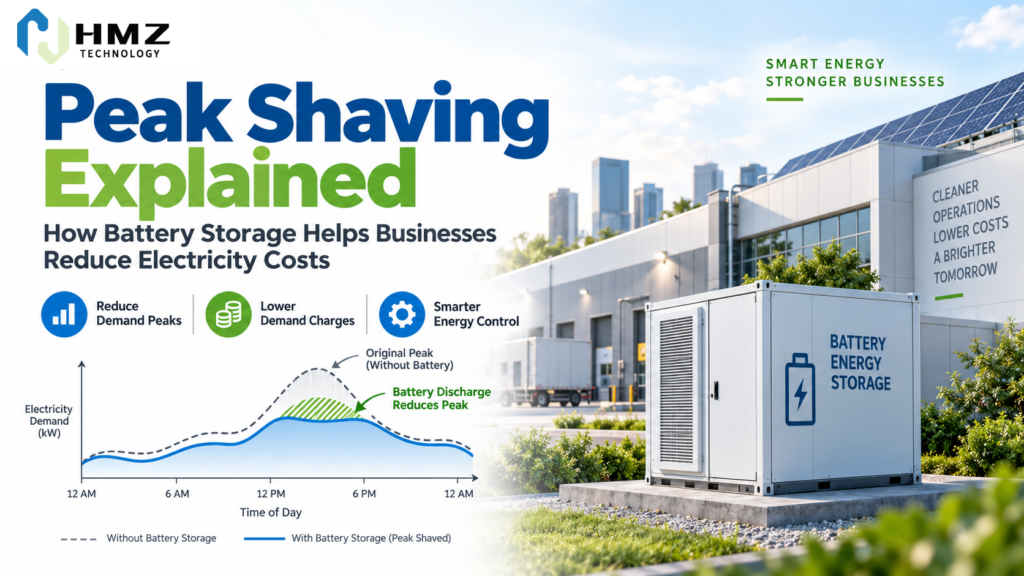
A battery energy storage system can discharge during the peak and supply part of the facility load.
Instead of the grid supplying the full 650 kW, the system might operate like this:
Facility Load: 650 kW
Battery: 150 kW
Grid Import: 500 kW
The factory still receives the power it needs.
The difference is where that power comes from.
What Is Peak Shaving?
Peak shaving is an energy-management strategy that reduces the highest level of power drawn from the grid.
It does not necessarily reduce the total amount of electricity the facility uses.
It reduces the maximum grid demand.
That distinction matters.
Suppose two factories both consume:
100,000 kWh per month
Factory A has a relatively flat load profile.
Factory B has several short but very high demand peaks.
If their tariff includes demand charges, Factory B may pay more even though total monthly energy consumption is similar.
Peak shaving targets those short peaks.
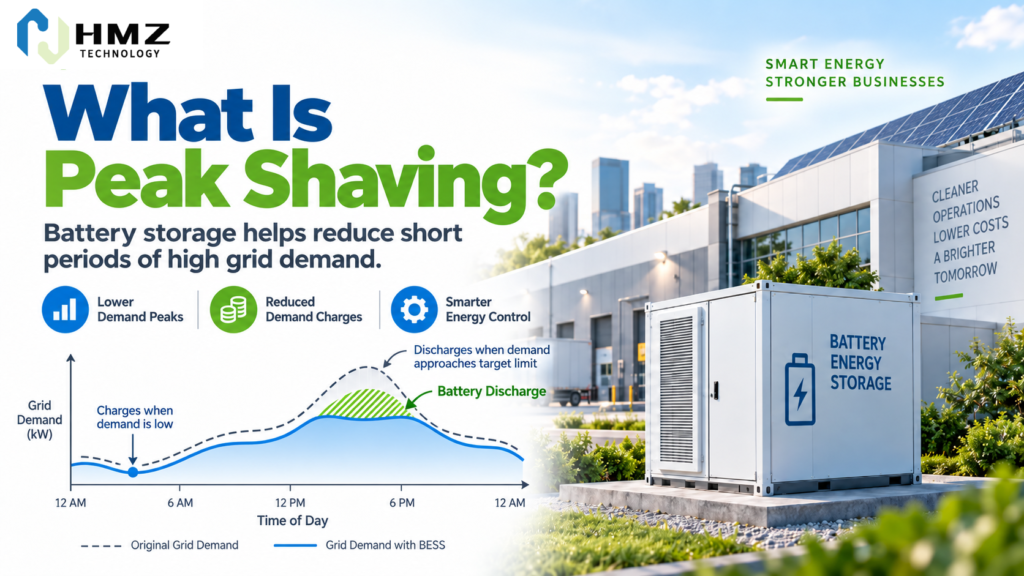
A battery charges when demand is lower or when energy is cheaper.
When site demand begins to rise above a predefined limit, the battery discharges.
The grid sees a flatter demand profile.
Why Demand Peaks Can Be Expensive
Many commercial electricity bills contain more than one charge.
There may be:
- energy charges based on kWh,
- demand charges based on kW,
- time-of-use pricing,
- fixed charges.
The energy charge measures how much electricity is consumed.
The demand charge may be based on the highest average power demand recorded during a defined interval, such as 15 or 30 minutes.
That means the customer may pay for both:
how much electricity was used
and
how high the site’s demand became at one moment.
This is why a short peak can matter economically.
For a more complete explanation of how tariff structures affect storage economics, see our article on electricity tariffs and C&I battery storage economics.
Peak Shaving Is Mainly a kW Problem
This is one of the most important ideas in peak-shaving design.
The first question is usually not:
How many kWh does the battery have?
It is:
How much kW does the site need to reduce?
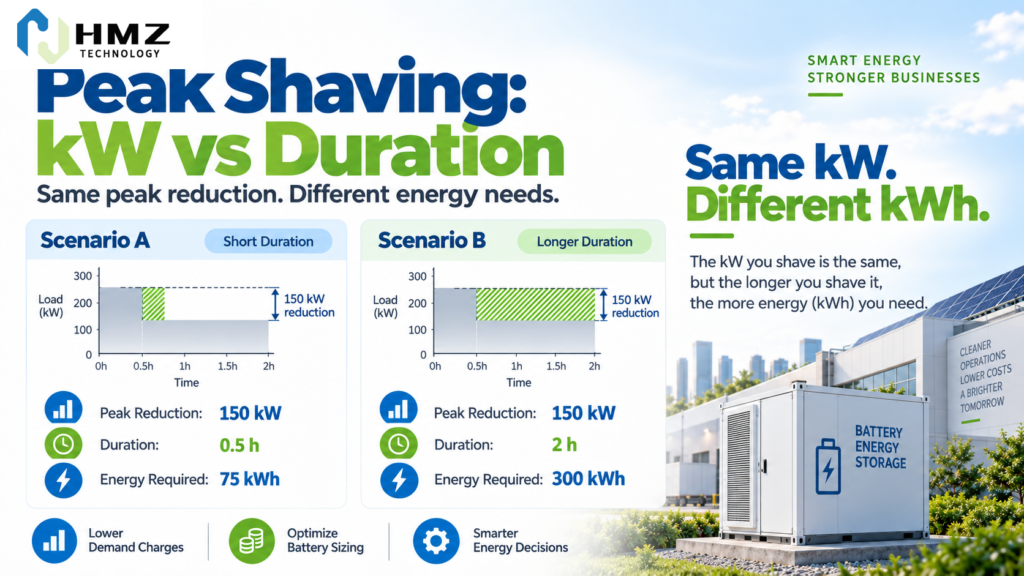
Suppose a facility reaches:
700 kW
but wants grid demand limited to:
550 kW
The battery must supply approximately:
150 kW
during that peak.
That is the power requirement.
Now the project needs to know how long the peak lasts.
If the peak lasts:
30 minutes
the simplified energy requirement is:
150 kW × 0.5 hour = 75 kWh
If the peak lasts:
2 hours
the simplified requirement becomes:
150 kW × 2 hours = 300 kWh
Same peak reduction.
Very different battery energy requirement.
This is why both kW and kWh matter.
For a deeper explanation, see kW and kWh in commercial energy storage.
How the Battery Knows When to Discharge
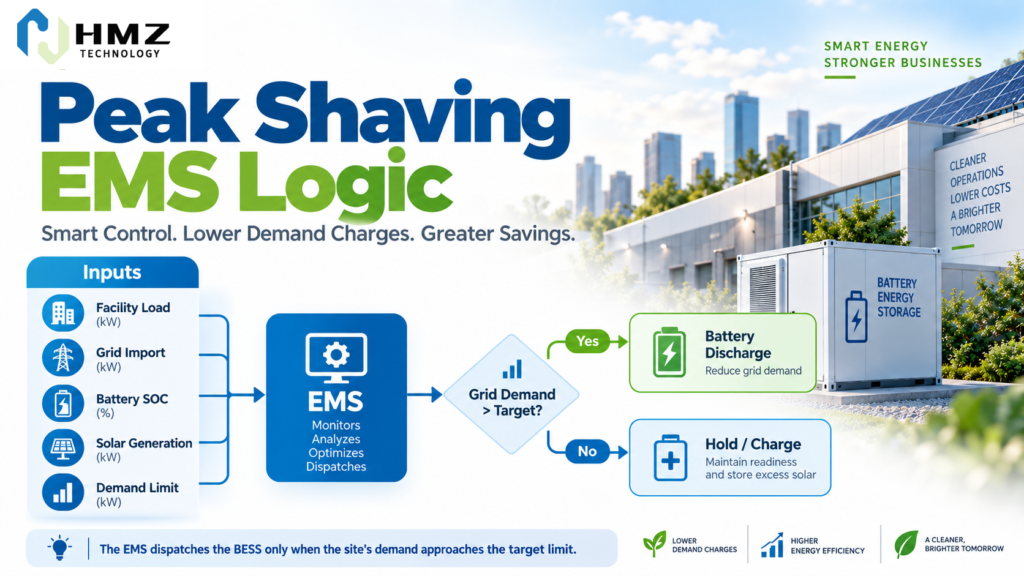
A peak-shaving system normally relies on monitoring and control.
The EMS or controller monitors parameters such as:
- facility load,
- grid import,
- battery SOC,
- demand limit,
- tariff period.
Suppose the customer sets a grid-import target of:
500 kW
As the site load approaches that value, the battery begins to discharge.
If the facility load rises to 580 kW:
Battery supplies approximately 80 kW
and:
Grid remains around 500 kW
If the load later falls below the threshold, the battery can stop discharging.
This control can happen dynamically.
The battery does not need to run at full power all day.
It only needs to respond when the demand peak appears.
Peak Shaving Is Different from Energy Arbitrage
These two applications are often confused.
Peak Shaving
The main objective is to reduce maximum power demand in kW.
Energy Arbitrage
The main objective is to move energy from a lower-price period to a higher-price period.
A battery can sometimes do both.
But the operating logic is different.
Peak shaving asks:
How high is the grid demand right now?
Energy arbitrage asks:
What is the electricity price right now?
A project should define which objective has priority.
Peak Shaving with Solar PV
Solar can already reduce grid demand during daylight hours.
But solar generation and site peak demand do not always occur at the same time.
Consider a factory with strong rooftop PV production from 11:00 a.m. to 2:00 p.m.
Its highest demand occurs around 5:30 p.m.
By then, PV output has fallen substantially.
Solar helped reduce daytime grid imports.
It did not eliminate the late-afternoon peak.
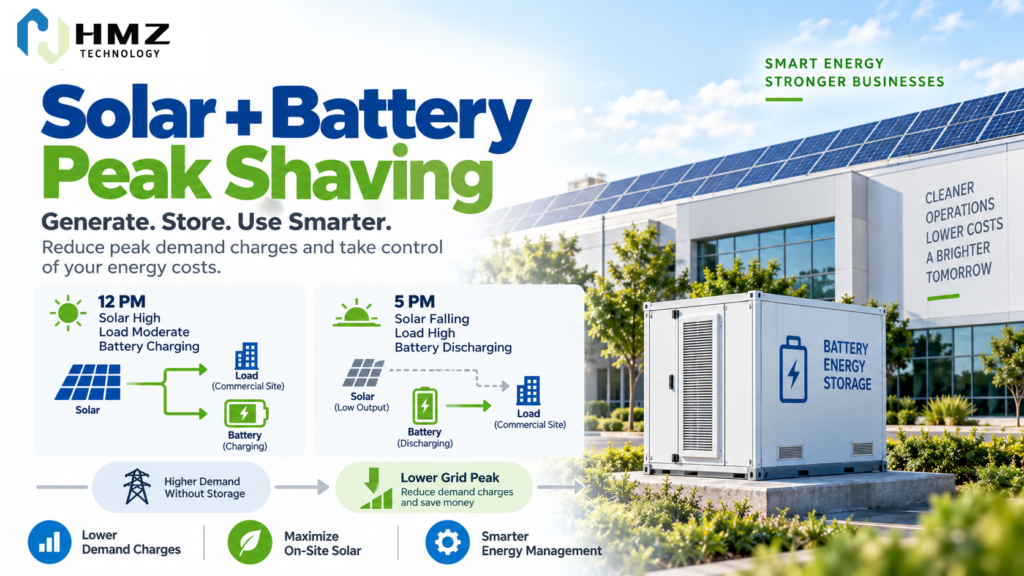
A battery can store some excess solar earlier and discharge later.
The combined strategy becomes:
Midday: Solar → Load + Battery
then:
Late Afternoon: Solar + Battery → Load
This can improve solar self-consumption and reduce peak demand at the same time.
For more on retrofit applications, see adding battery storage to an existing commercial solar system.
Why Oversizing Is Common in Peak-Shaving Projects
Peak shaving can tempt customers to buy more battery than the application needs.
Suppose the site only needs:
150 kW
of peak reduction for:
45 minutes
A very large energy capacity may add little value if the battery only performs that short task once per day.
The customer may pay for hundreds of additional kWh that remain unused.
That increases:
- CAPEX,
- footprint,
- thermal-management requirements,
- and potentially installation cost.
The project should include enough capacity for:
- the expected peak duration,
- efficiency losses,
- SOC limits,
- degradation margin,
- operating reserve.
But “more battery” is not automatically better.
For a detailed explanation, see battery oversizing.
What Happens If the Peak Lasts Longer Than Expected?
This is an important design risk.
Suppose the battery was sized to shave a peak for one hour.
One day, the high load continues for two hours.
The battery may reach its minimum SOC before the peak ends.
At that point, grid demand rises again.
The peak may still be recorded.
That is why the project team should study real load data rather than designing from one monthly maximum value.
Useful information includes:
- 15-minute load profile,
- peak duration,
- frequency of peak events,
- seasonal changes,
- daily production schedule.
One peak number is not enough.
The shape of the peak matters.
Peak Shaving Depends on Battery SOC
A battery cannot shave a peak if it is already empty.
That sounds obvious.
In real multi-purpose systems, this becomes important.
Imagine the battery is also used for:
- solar self-consumption,
- TOU optimization,
- backup reserve.
At 4:00 p.m., the battery may have already discharged significantly.
Then a 5:00 p.m. demand peak appears.
If insufficient SOC remains, peak shaving performance is limited.
The EMS therefore needs to reserve enough energy for expected peak periods.
This is one reason multiple battery objectives must be coordinated rather than operated independently.
The Role of EMS in Peak Shaving
A useful EMS strategy may include:
Demand Threshold
Set a maximum desired grid-import level.
SOC Reserve
Maintain enough energy for expected peaks.
Solar Forecast
Estimate how much PV charging may occur.
Load Forecast
Identify likely peak periods.
Tariff Awareness
Prioritize the most expensive or important demand events.
A simple project may use a fixed threshold.
A more advanced project may adjust operating strategy according to forecast load, tariff and battery condition.
How to Estimate Peak-Shaving Savings
The exact calculation depends on the local tariff.
A simplified example can help explain the logic.
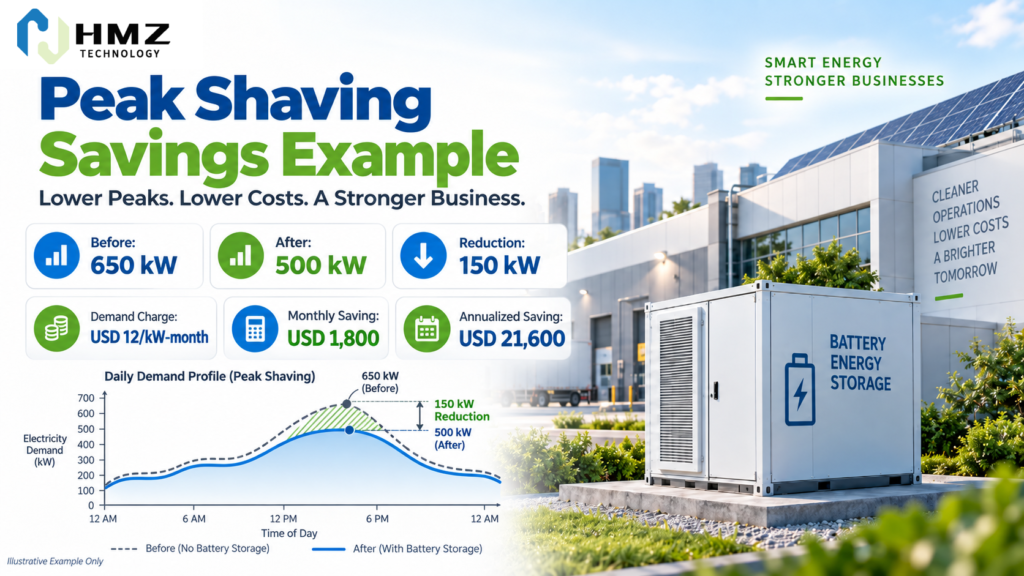
Suppose:
Maximum demand before BESS:
650 kW
Maximum demand after peak shaving:
500 kW
Reduction:
150 kW
Assume the demand charge is:
USD 12/kW per month
Simplified monthly demand-charge reduction:
150 kW × USD 12/kW = USD 1,800/month
Simplified annual value:
USD 1,800 × 12 = USD 21,600/year
This is an illustrative example only.
Real calculations should verify:
- how the utility defines peak demand,
- billing intervals,
- ratchet clauses,
- seasonal pricing,
- whether the battery reliably controls every relevant peak.
A single missed peak can sometimes reduce the expected savings significantly.
Peak Shaving Can Improve Battery Economics — But Only If the Tariff Supports It
A battery may technically shave peaks at any commercial site.
That does not mean the function always creates financial value.
If the electricity tariff has no demand charge, reducing maximum kW may not directly reduce the bill.
The project may still benefit from:
- TOU optimization,
- solar self-consumption,
- backup power,
- generator reduction.
But those are different value streams.
This is why the tariff should be checked before designing the peak-shaving strategy.
Peak Shaving and Battery Payback
Peak-shaving value often becomes part of the annual savings used in a battery payback model.
But the savings should be realistic.
The model should ask:
- How many peak events occur?
- How long do they last?
- Can the battery cover them consistently?
- Is enough SOC available?
- Does the demand charge apply every month?
- Are seasonal peaks different?
If those assumptions are wrong, the calculated battery storage payback period will also be wrong
A Practical Peak-Shaving Project Workflow
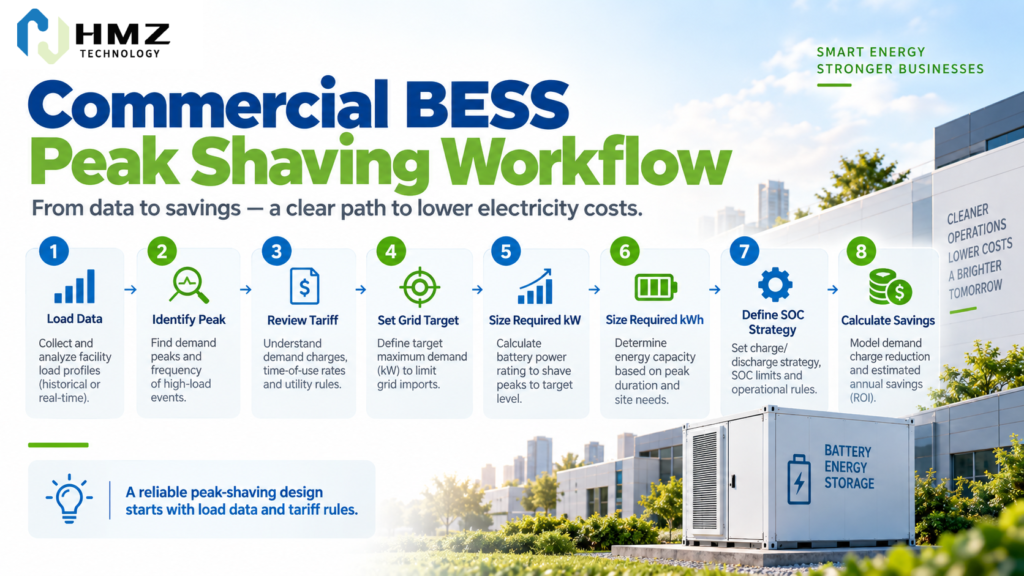
A commercial peak-shaving project can be screened in a simple sequence.
Step 1 — Collect Load Data
Use 15-minute or hourly interval data.
Step 2 — Identify the Peak
Find:
- maximum demand,
- peak duration,
- frequency,
- time of day.
Step 3 — Review the Tariff
Confirm:
- demand charge,
- billing interval,
- peak-period rules.
Step 4 — Define the Target
Example:
Reduce grid demand from:
650 kW
to:
500 kW
Step 5 — Calculate Required Power
Required BESS discharge:
150 kW
Step 6 — Determine Required Energy
Use peak duration plus operating margin.
Step 7 — Define SOC Strategy
Ensure energy is available when peaks occur.
Step 8 — Model Savings
Compare annual demand-charge savings with total project cost.
How HMZ Technology Approaches Peak-Shaving Projects
For a commercial or industrial peak-shaving project, the useful starting point is not simply the requested battery capacity.
HMZ would need to understand:
- 15-minute or hourly load data,
- monthly maximum demand,
- duration of peak events,
- electricity tariff,
- demand-charge structure,
- existing PV,
- available charging periods,
- backup requirements,
- installation environment.
From there, the project can define:
required BESS power in kW
and
required usable energy in kWh.
HMZ’s C&I energy storage portfolio includes:
50kW / 112kWh All-in-One C&I ESS
Suitable for smaller commercial loads and distributed energy-management applications.
125kW / 241kWh All-in-One C&I ESS
Suitable for larger commercial and industrial peak-management requirements.
125kW / 261kWh Liquid-Cooled C&I ESS
Suitable for higher-duty applications requiring higher energy density and more precise thermal management.
Learn more about the 50kW/112kWh and 125kW/241kWh All-in-One C&I Energy Storage Systems.
Peak Shaving Checklist
Before selecting a BESS, confirm:
Load
- Maximum demand
- Peak duration
- Peak time
- Peak frequency
- Seasonal variation
Tariff
- Demand charge rate
- Billing interval
- TOU periods
- Demand ratchet rules if applicable
Battery
- Required discharge power
- Required usable energy
- SOC reserve
- Charge window
- Discharge window
Site
- PV generation
- Grid capacity
- Transformer loading
- Critical loads
- Future load growth
Conclusion
Peak shaving is one of the most practical commercial battery-storage applications because it targets a specific problem:
short periods of high grid demand.
The battery does not need to replace the grid.
It only needs to support the site when demand rises above the desired limit.
That can reduce demand charges where the tariff rewards lower peak power.
But a good peak-shaving project depends on more than battery capacity.
That is the difference between installing a battery and designing a useful peak-shaving system.
FAQ Schema
Question 1
What is peak shaving with battery storage?
Answer
Peak shaving uses battery storage to supply part of a facility’s load during periods of high demand, reducing the maximum power drawn from the grid.
Question 2
How does peak shaving reduce electricity costs?
Answer
Where utilities charge customers based on maximum demand in kW, reducing the grid-demand peak can lower demand charges.
Question 3
Is peak shaving based on kW or kWh?
Answer
Both matter, but peak shaving normally starts with the required power reduction in kW. The required kWh depends mainly on how long the peak must be supported.
Question 4
Can solar PV perform peak shaving without a battery?
Answer
Solar can reduce grid demand when solar production overlaps with the site’s peak. If the peak occurs later in the day or during low solar production, battery storage may be needed to shift solar energy into that period.
Question 5
Does every commercial site benefit from peak shaving?
Answer
No. The financial value depends heavily on the electricity tariff. If the site does not pay meaningful demand charges, peak shaving may provide limited direct bill savings.
Question 6
How much battery is needed for peak shaving?
Answer
The system should be sized using the amount of peak power that needs to be reduced, the duration of the peak, SOC limits, system efficiency and appropriate operating margin.
Build Your Intelligent Energy Future with HMZ
HMZ Technology helps businesses move beyond traditional solar systems by combining solar PV, battery storage and intelligent microgrid control.
Our integrated energy solutions are designed for industrial facilities, commercial buildings and remote energy applications requiring reliable, efficient and flexible power.
Contact HMZ Technology today to explore your next solar storage or microgrid project.
Related Insights from HMZ Technology
Industrial energy management is rapidly evolving. While rooftop solar PV provides an effective way for factories to generate clean electricity, many businesses are now looking beyond solar generation and exploring integrated solutions such as energy storage, intelligent energy management, and microgrid systems.
To better understand how commercial and industrial users can optimize their energy strategy, explore more insights from HMZ Technology’s renewable energy knowledge center, including solar PV solutions, C&I energy storage systems, and practical applications for industrial energy management.