
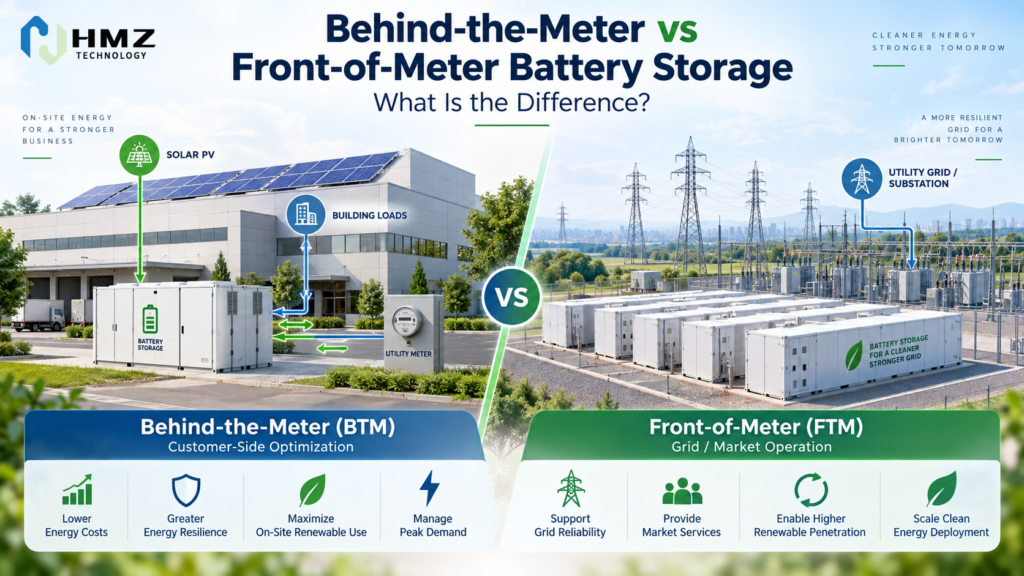
Two battery storage projects can use similar cells, similar PCS technology and even similar container or cabinet designs.
Yet one project is built to reduce a factory’s electricity bill.
The other is built to support the power grid.
The difference often comes down to one simple question:
On which side of the electricity meter is the battery connected?
That is the basic distinction between:
Behind-the-Meter (BTM)
and
Front-of-the-Meter (FTM)
battery storage.
The terms sound technical, but the practical difference is straightforward.
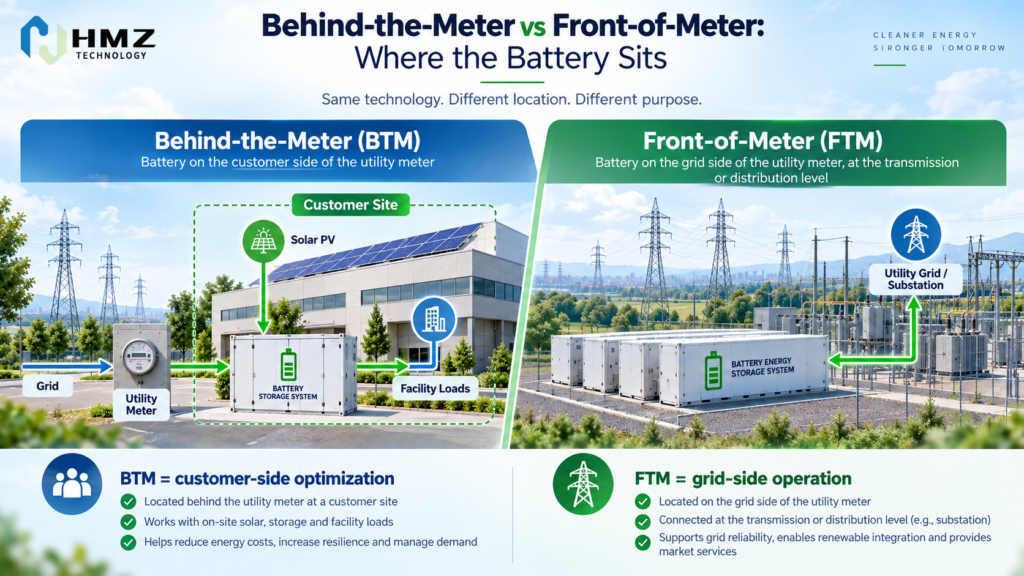
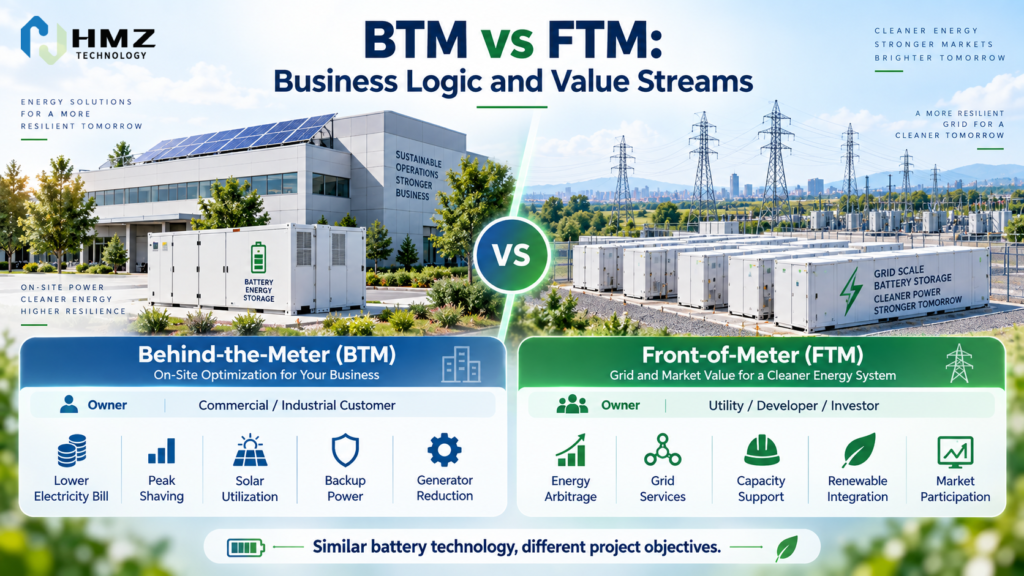
A behind-the-meter system is normally installed on the customer’s side of the utility meter.
A front-of-meter system is connected on the grid side and participates more directly in electricity-market or grid services.
The battery technology may be similar.
The project objectives are usually very different.
What Is Behind-the-Meter Battery Storage?
Behind-the-meter battery storage is installed within the customer’s electrical system, after the utility meter.
Typical locations include:
- factories,
- commercial buildings,
- industrial parks,
- hotels,
- hospitals,
- schools,
- farms,
- data centers,
- and distributed solar projects.
The system is normally designed around the customer’s own electricity use.
The main question is:
How can this battery improve the site’s energy performance?
Typical objectives include:
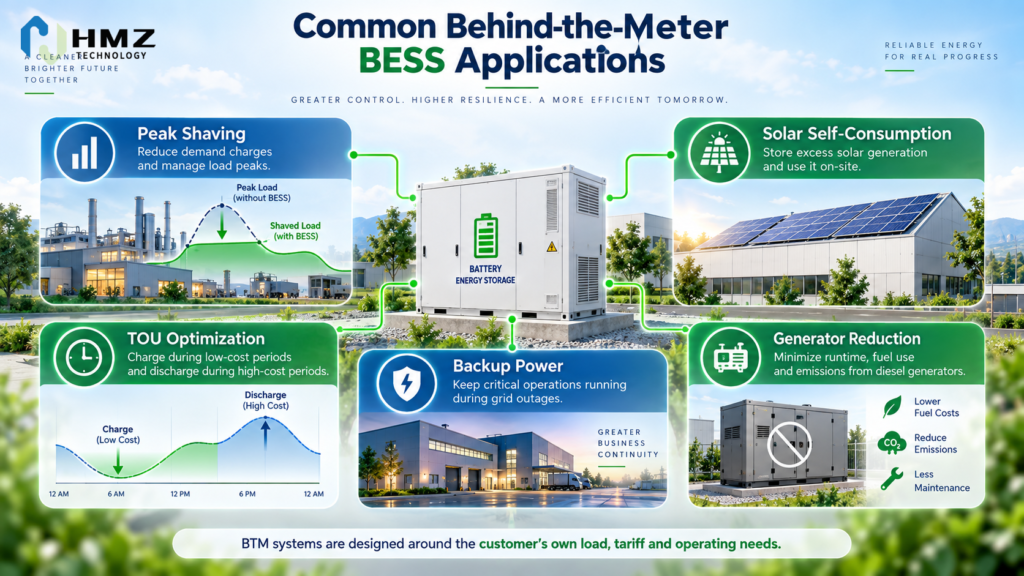
- peak shaving,
- time-of-use optimization,
- increasing solar self-consumption,
- backup power,
- reducing generator runtime,
- and improving local energy resilience.
For most commercial and industrial energy-storage projects, this is the architecture customers are thinking about when they ask for a C&I BESS.
What Does a BTM Battery Actually Do?
A BTM system usually responds to what is happening inside the site.
For example, a factory may normally draw 400 kW from the grid but occasionally rise to 600 kW.
If demand charges are high, the battery can discharge during that short peak.
Instead of:
Grid supplies 600 kW
the system may operate as:
Grid supplies 450 kW
Battery supplies 150 kW
That is a typical BTM peak-shaving application.
For more detail on how this works, see our guide to peak shaving.
BTM Storage and Solar Self-Consumption
BTM storage is also commonly paired with commercial solar PV.
During midday, a rooftop solar system may generate more electricity than the site needs.
Instead of exporting that surplus immediately, the battery can store it.
Later, when solar output falls, the facility can use the stored energy.
The energy path becomes:
Solar PV → Facility Load
then:
Excess Solar → Battery
later:
Battery → Facility Load
This can improve solar self-consumption and reduce electricity purchased from the grid.
The value depends on:
- local electricity price,
- solar export tariff,
- site load profile,
- available PV surplus,
- battery size,
- and operating strategy.
This is why storage should not be added to an existing PV system without first understanding how much solar surplus actually exists.
For a deeper discussion of retrofit solar + storage, see solar + battery storage.
BTM Storage and Backup Power
Many commercial customers also expect BTM storage to provide backup power.
That can be possible.
But battery installation alone does not automatically create a backup system.
The project may also require:
- suitable PCS or inverter functionality,
- switching equipment,
- critical-load separation,
- protection,
- EMS or microgrid control,
- and islanding logic.
A site with 800 kW total demand may not need all 800 kW backed up.
Perhaps only 180 kW of critical loads must continue operating during an outage.
That distinction has a large impact on battery power and energy sizing.
This is one reason the battery should be designed around the actual load rather than simply the total facility size.
For readers who need the broader design logic, see our commercial microgrid design process.
What Is Front-of-Meter Battery Storage?
Front-of-meter battery storage is connected on the utility or grid side of the customer meter.
Instead of serving one factory or building, the project is typically designed to interact with the wider power system.
Applications may include:
- energy arbitrage,
- frequency regulation,
- grid balancing,
- renewable-energy integration,
- capacity support,
- congestion management,
- and other grid services.
These projects are often larger and more market-driven than typical C&I BTM installations.
The core question changes from:
How can the battery reduce this customer’s electricity cost?
to:
How can the battery create value by interacting with the power system or energy market?
FTM Storage Is Usually a Market or Grid Asset
A front-of-meter battery often operates according to:
- wholesale electricity prices,
- utility dispatch,
- grid-service requirements,
- interconnection agreements,
- capacity obligations,
- and market rules.
Its value may come from charging when electricity is inexpensive and discharging when it is more valuable.
That is often called energy arbitrage.
In other projects, the battery may respond to grid frequency or provide fast balancing support.
The economics therefore depend heavily on the local electricity market.
This is very different from a C&I battery project where the main financial driver may be demand-charge reduction.
Ownership Can Also Be Different
BTM projects are often owned or operated by:
- factory owners,
- building owners,
- commercial customers,
- EPC developers,
- energy-service companies.
FTM projects may be owned or operated by:
- utilities,
- independent power producers,
- energy developers,
- infrastructure investors,
- grid-service providers.
The exact ownership structure varies by market, but the business model is usually different because the project earns value from different sources.
BTM vs FTM: The Main Differences
| Factor | Behind-the-Meter | Front-of-Meter |
|---|---|---|
| Connection point | Customer side of meter | Grid side of meter |
| Main user | Commercial / industrial site | Utility / grid / market |
| Main objective | Reduce site energy cost and improve resilience | Generate grid or market value |
| Typical applications | Peak shaving, TOU, solar storage, backup | Arbitrage, frequency response, capacity, balancing |
| Project size | Often smaller / distributed | Often larger |
| Load profile importance | Very high | Less tied to one facility |
| Electricity tariff | Customer retail tariff | Wholesale or market pricing |
| Solar integration | Often site-specific | Often utility-scale renewable integration |
| Backup power | Common project objective | Usually not the main objective |
| EMS strategy | Site optimization | Grid / market dispatch |
| Revenue model | Cost savings + avoided losses | Market revenue + grid services |
The table shows why the same battery hardware can belong to completely different project categories.
Retail Tariff vs Wholesale Market: A Major Difference
One of the clearest distinctions is how electricity value is calculated.
A BTM project usually reacts to the customer’s retail electricity tariff.
That may include:
- peak price,
- off-peak price,
- demand charges,
- export tariff,
- and fixed charges.
A FTM project may instead respond to:
- wholesale electricity price,
- ancillary-service markets,
- capacity markets,
- grid-service contracts,
- or utility dispatch signals.
This difference changes the entire financial model.
For BTM projects, a customer may ask:
“How much can this reduce my electricity bill?”
For FTM projects, the question may be:
“What market revenue can the battery generate?”
Those are not the same economic model.
Why This Matters for BESS Sizing
Battery sizing should follow the project objective.
In a BTM project, sizing may begin with:
- load profile,
- peak demand,
- solar surplus,
- critical load,
- required backup duration.
In a FTM project, sizing may depend more on:
- market duration requirement,
- dispatch profile,
- grid connection capacity,
- energy-market opportunity,
- ancillary-service rules.
This is another reason battery power and energy should be analyzed separately.
A 10 MW / 20 MWh FTM system and a 125 kW / 261 kWh C&I BTM system both use batteries, but they are solving very different problems.
For the basic sizing relationship, see our article on kW and kWh in commercial energy storage.
Does a BTM System Ever Interact With the Grid?
Yes.
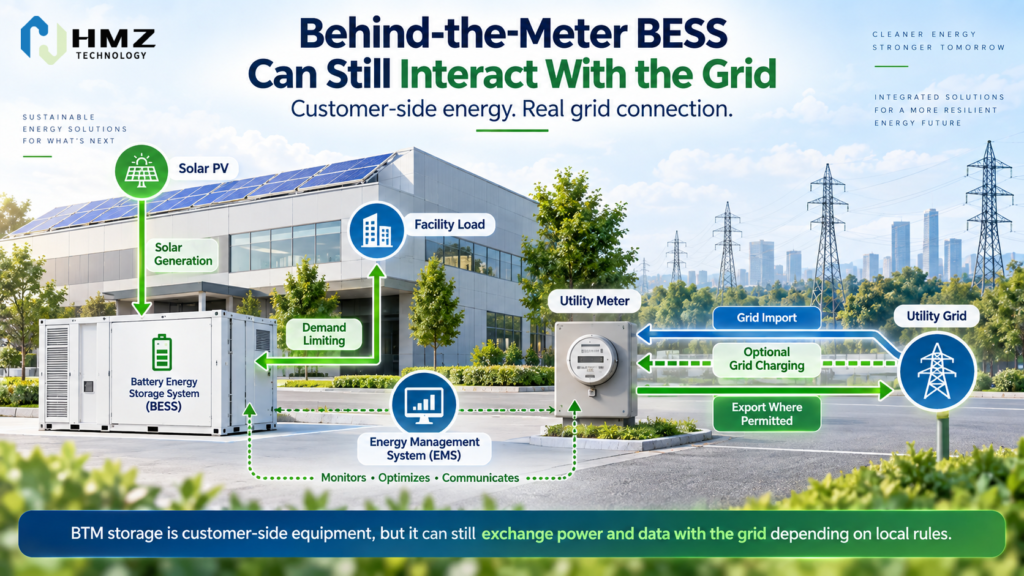
“Behind the meter” does not mean the battery is completely isolated from the grid.
A BTM system can still:
- import electricity,
- charge from the grid,
- limit grid demand,
- export energy where permitted,
- and potentially participate in demand-response or aggregation programs.
The distinction is that the system sits within the customer’s electrical environment and is normally designed first around customer-side value.
This boundary is becoming less rigid as energy markets develop.
A commercial battery may begin as a site-optimization asset and later participate in broader grid services through aggregation or a virtual power plant.
That is one reason BTM storage is becoming more interesting beyond traditional peak shaving.
Which Model Is More Relevant to Commercial Customers?
For most factories, warehouses, hotels, farms and commercial buildings looking at HMZ C&I storage products, the project will usually be behind the meter.
The site normally wants to solve one or more of these problems:
- high electricity cost,
- demand peaks,
- poor solar self-consumption,
- unstable grid,
- generator dependence,
- backup requirements.
That is classic BTM storage territory.
Front-of-meter storage becomes more relevant when the project itself is being developed as an energy-market or grid asset.
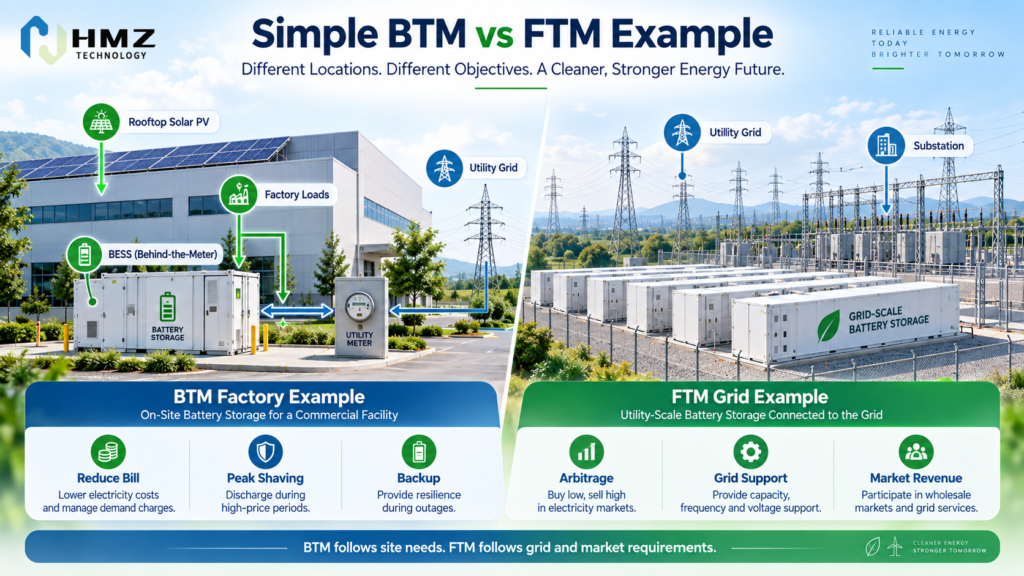
A Simple BTM Example
Consider a factory with:
- 600 kW peak demand,
- rooftop solar,
- high afternoon electricity cost,
- and 150 kW of critical load.
The battery is installed behind the meter.
During midday:
Solar → Load
Excess PV:
Solar → Battery
During the afternoon peak:
Battery → Load
During a grid outage:
Battery → Critical Load
The battery’s value is created inside the site.
That is a BTM project.
A Simple FTM Example
Now consider a utility-scale battery connected directly to the distribution or transmission system.
The battery charges during periods of lower market prices.
Later, it discharges during high-value periods or responds to a grid-service requirement.
There is no single factory load driving the decision.
The project follows grid conditions and market signals.
That is a FTM project.
How Project Economics Differ
The financial model for BTM storage often focuses on avoided cost.
Examples:
- electricity not purchased,
- demand charges avoided,
- solar energy retained,
- generator fuel avoided,
- production losses avoided.
That is why our earlier article on battery storage payback period is particularly relevant to BTM projects.
FTM projects are more likely to rely on revenue streams.
Examples:
- market arbitrage,
- capacity payments,
- frequency regulation,
- grid-service contracts.
That makes project economics highly dependent on market structure.
BTM Systems Still Need Correct Sizing
It is easy for a commercial buyer to say:
“We have enough space, so let’s install a larger battery.”
But extra battery capacity only creates value when the site can use it.
A larger battery may increase:
- CAPEX,
- idle capacity,
- thermal-management requirements,
- installation cost.
If the site’s load, solar surplus or tariff does not create enough charging and discharge opportunities, the larger system may be underutilized.
That is why our article on battery oversizing is important for BTM projects.
How HMZ Technology Fits Into BTM Projects
HMZ’s current C&I energy-storage portfolio is primarily aligned with customer-side commercial and industrial applications.
Typical use cases include:
- solar + storage,
- peak shaving,
- load shifting,
- backup support,
- distributed microgrids,
- generator reduction.
50kW / 112kWh All-in-One C&I ESS
Suitable for smaller commercial and distributed-energy applications.
125kW / 241kWh All-in-One C&I ESS
Suitable for larger C&I loads and commercial energy-management projects.
125kW / 261kWh Liquid-Cooled C&I ESS
Suitable for higher-duty commercial and industrial applications requiring more precise thermal management.
Learn more about the 50kW/112kWh and 125kW/241kWh All-in-One C&I Energy Storage Systems.
For higher-duty applications, see the 125kW/261kWh Liquid-Cooled C&I Energy Storage System.
BTM vs FTM Is Really a Question of Who the Battery Serves
The technical distinction starts at the meter.
The practical distinction is broader.
A BTM battery primarily serves:
the customer site.
A FTM battery primarily serves:
the grid or energy market.
That difference affects:
- system sizing,
- controls,
- tariff model,
- ownership,
- project economics,
- interconnection,
- and operating strategy.
So before selecting battery hardware, first decide which side of the market the project belongs to.
Conclusion
Behind-the-meter and front-of-meter storage may use similar battery technology, but they are built around different problems.
BTM storage focuses on the customer.
It helps businesses manage:
- electricity cost,
- peak demand,
- solar energy,
- backup,
- and local resilience.
FTM storage focuses more directly on the grid.
It supports:
- market arbitrage,
- grid balancing,
- capacity,
- renewable integration,
- and utility services.
For most commercial and industrial users considering a C&I battery system, the relevant question will usually be:
How should the BTM system be sized and operated for this site?
That is where load data, tariff structure, solar generation and operating objectives become more important than the battery cabinet itself.
FAQ Schema
Question 1
What is behind-the-meter battery storage?
Answer
Behind-the-meter battery storage is installed on the customer’s side of the utility meter and is typically used for peak shaving, solar self-consumption, tariff optimization, backup power and other site-level energy-management applications.
Question 2
What is front-of-meter battery storage?
Answer
Front-of-meter battery storage connects more directly to the utility grid and is typically used for energy arbitrage, grid balancing, frequency response, capacity support and other market or utility services.
Question 3
What is the main difference between BTM and FTM BESS?
Answer
The main difference is the connection point and project objective. BTM storage primarily serves a customer site, while FTM storage primarily serves the grid or energy market.
Question 4
Is commercial battery storage usually behind the meter?
Answer
Yes. Many commercial and industrial battery projects are behind the meter because they are designed around the customer’s electricity bill, load profile, solar generation and backup requirements.
Question 5
Can behind-the-meter batteries interact with the grid?
Answer
Yes. BTM systems can import from the grid, charge from the grid, limit grid demand and, where regulations permit, export power or participate in demand-response and aggregation programs.
Question 6
Which is larger, BTM or FTM battery storage?
Answer
FTM systems are often larger, but size alone does not define the category. The distinction is based mainly on connection point, ownership and operating objective.
Build Your Intelligent Energy Future with HMZ
HMZ Technology helps businesses move beyond traditional solar systems by combining solar PV, battery storage and intelligent microgrid control.
Our integrated energy solutions are designed for industrial facilities, commercial buildings and remote energy applications requiring reliable, efficient and flexible power.
Contact HMZ Technology today to explore your next solar storage or microgrid project.
Related Insights from HMZ Technology
Industrial energy management is rapidly evolving. While rooftop solar PV provides an effective way for factories to generate clean electricity, many businesses are now looking beyond solar generation and exploring integrated solutions such as energy storage, intelligent energy management, and microgrid systems.
To better understand how commercial and industrial users can optimize their energy strategy, explore more insights from HMZ Technology’s renewable energy knowledge center, including solar PV solutions, C&I energy storage systems, and practical applications for industrial energy management.