
One of the first questions in a commercial backup project is usually:
“How many hours of battery backup do we need?”
It sounds like a simple sizing question.
It is not.
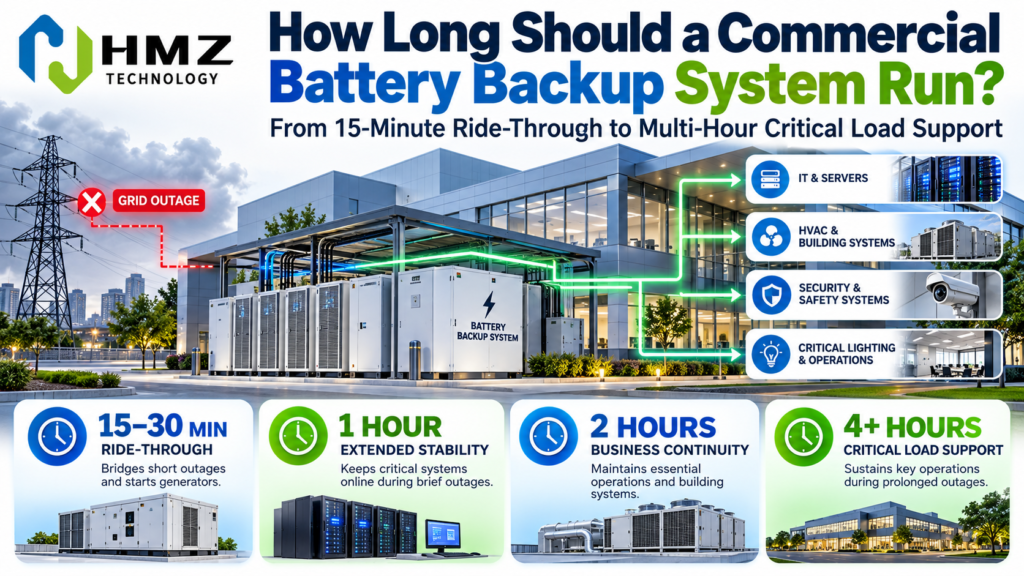
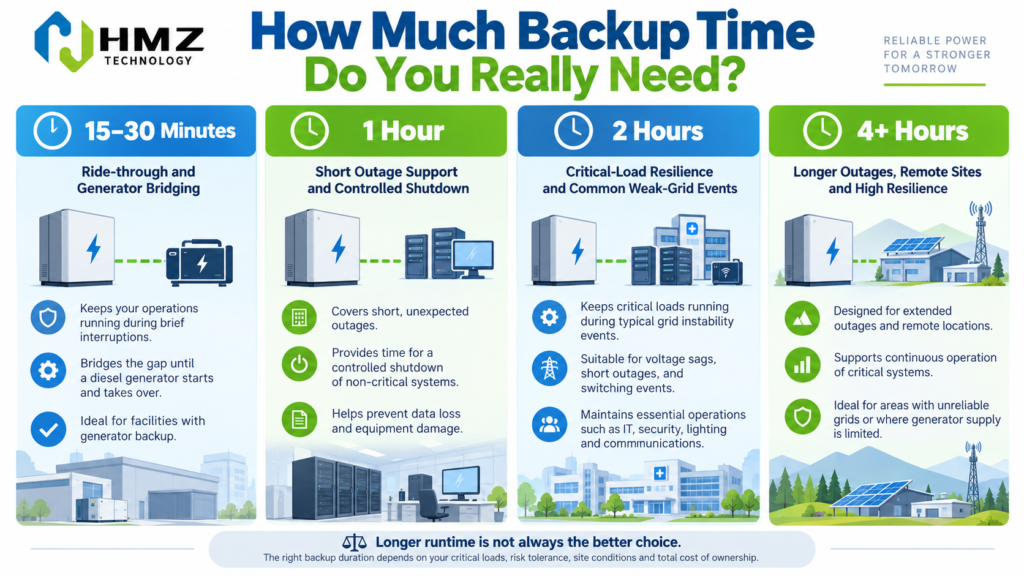
A factory may need only 15 minutes of battery support while a generator starts.
A cold-storage facility may need two hours to protect temperature-sensitive products.
A clinic, data center or remote industrial site may need much longer.
That is why commercial battery backup duration should be based on the site’s actual operating risk, not on a standard number such as one hour, two hours or four hours.
The correct duration depends on:
- critical load,
- outage frequency,
- typical outage length,
- generator availability,
- solar contribution,
- battery SOC strategy,
- and the financial impact of downtime.
The battery should run long enough to solve the problem.
No longer simply for the sake of having a larger system.
What Does Commercial Battery Backup Duration Actually Mean?
Commercial battery backup duration is the amount of time a battery energy storage system can support a defined electrical load during a grid interruption.
The key phrase is:
defined electrical load.
Backup duration cannot be discussed separately from load.
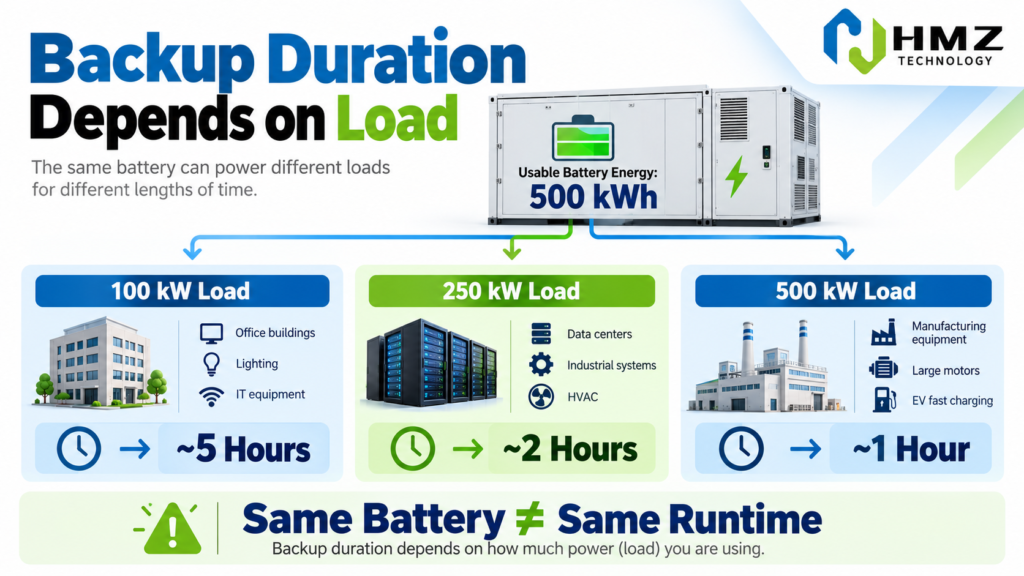
A 500 kWh usable battery may support:
100 kW Load
Approximately 5 hours in a simplified calculation.
250 kW Load
Approximately 2 hours.
500 kW Load
Approximately 1 hour.
Same battery.
Different backup duration.
That is why the question should not be:
“How many hours does this battery last?”
It should be:
“How long can this battery support our critical load?”
The Basic Battery Runtime Calculation
A simplified relationship is:
Backup Duration (hours) = Usable Battery Energy (kWh) ÷ Backup Load (kW)
For example:
Usable battery energy:
600 kWh
Critical load:
300 kW
Simplified runtime:
600 ÷ 300 = 2 hours
This is useful for early-stage estimation.
But a real system must also account for:
- inverter efficiency,
- auxiliary consumption,
- SOC limits,
- reserve,
- battery degradation,
- temperature,
- transient loads.
So a theoretical 2-hour result should not automatically be treated as a guaranteed 2-hour operating time.
For the basic relationship between battery power and energy, see kW and kWh in commercial energy storage.
Why 15 Minutes of Backup Can Be Enough
Not every battery backup project needs hours of stored energy.
In some commercial facilities, the battery only needs to bridge a short interruption.
A common use case is:
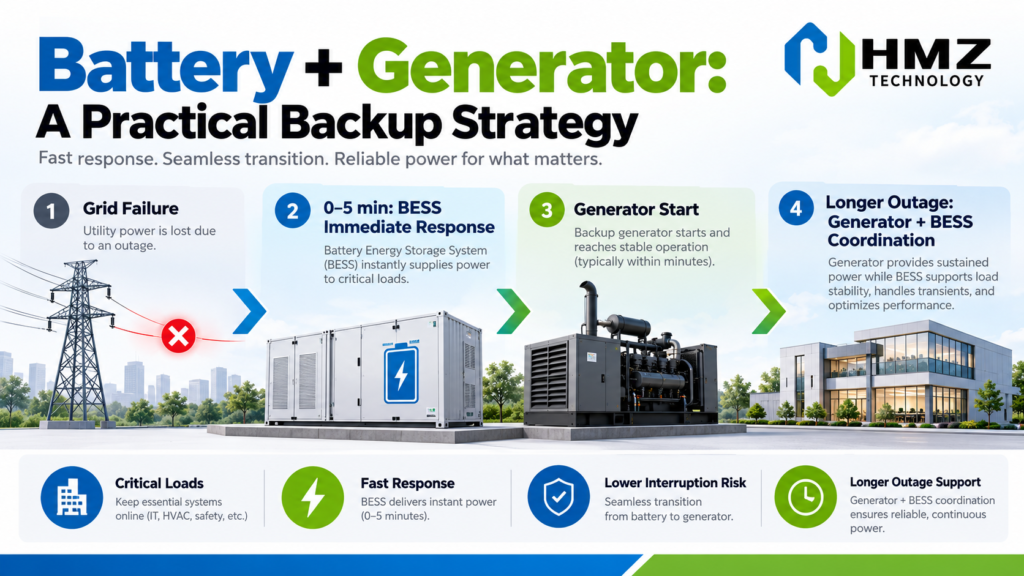
Grid fails → Battery responds immediately → Generator starts → Generator takes over
If the generator typically starts and stabilizes within a few minutes, the battery may mainly be used for:
- fast response,
- ride-through,
- avoiding process interruption,
- covering generator start delay.
In this situation, 15–30 minutes of battery support may already create significant value.
The goal is not long-duration energy supply.
The goal is continuity.
This is especially relevant where even a few seconds of interruption can stop production equipment, IT systems or control processes.
When 1 Hour of Commercial Battery Backup Makes Sense
One hour can be appropriate when:
- outages are usually short,
- the site can tolerate longer outages by shutting down safely,
- generator backup is available,
- only essential loads need support,
- one hour provides enough time for operators to respond.
For example, a factory may use one hour of backup to:
- keep process controls online,
- maintain critical pumps,
- preserve refrigeration,
- perform an orderly shutdown if the grid does not return.
In that case, the battery buys operational time.
It does not need to run the entire factory indefinitely.
When 2 Hours of Commercial Battery Backup Makes Sense
Two hours is common in projects where the customer wants more resilience but does not need full-day island operation.
Possible use cases include:
- cold storage,
- food processing,
- commercial buildings,
- clinics,
- light industrial facilities,
- weak-grid locations.
Two hours may cover many routine outages while still keeping battery CAPEX under control.
But even here, load classification matters.
Two hours of backup for:
200 kW
requires much less energy than two hours for:
800 kW.
This is why critical-load analysis should come before backup-duration selection.
When 4 Hours or More May Be Justified
Longer-duration backup can be reasonable when outages are frequent or extended.
Typical cases may include:
- remote industrial sites,
- weak-grid regions,
- telecommunications facilities,
- critical medical infrastructure,
- long generator-refueling gaps,
- sites with high outage-related losses.
But four-hour backup is not simply “two-hour backup with twice the battery.”
The project should check whether the load stays constant.
In many real outages, the load can be reduced over time.
For example:
First Hour
300 kW
Second Hour
250 kW
Third and Fourth Hour
150 kW
A staged load-shedding strategy can reduce the required energy significantly.
Backup Duration Should Be Based on Critical Loads, Not Total Site Load
Consider a facility with:
Total Site Load: 900 kW
But critical load during an outage is only:
250 kW
If the customer wants four hours of backup:
Full-Site Approach
900 kW × 4 h = 3,600 kWh
Critical-Load Approach
250 kW × 4 h = 1,000 kWh
That is a major difference.
The correct design may still need additional margin.
But the core lesson is clear:
Backup duration becomes much more affordable when the right loads are selected.
This is why the earlier step of separating critical and non-critical loads is essential.
Outage History Should Influence Backup Duration
A backup system should reflect the outages the site actually experiences.
Useful questions include:
- How many outages occurred last year?
- What was the average duration?
- What was the longest outage?
- Are outages seasonal?
- Are they predictable?
- Does grid voltage fluctuate before failure?
- Does the facility already use a generator?
Suppose a site experiences:
- 20 outages per year,
- most under 20 minutes,
- longest typical outage around 45 minutes.
A four-hour battery may be technically attractive.
But the additional capacity may be underused.
Now consider another site where outages regularly last 3–6 hours.
The same four-hour battery may be far more justified.
The Cost of Downtime Matters More Than Outage Duration Alone
A five-minute outage can be more expensive than a two-hour outage if it stops the wrong process.
Imagine a production line where a short interruption causes:
- product loss,
- machine reset,
- cleaning,
- restart delay,
- several hours of lost production.
In that case, the value of battery backup comes from avoiding interruption.
Not necessarily from supporting the site for many hours.
This is why backup planning should ask:
What happens financially if the load loses power?
The answer may justify a high-power, shorter-duration battery instead of a very large energy system.
Commercial Battery Backup Duration and Generator Integration
If a generator already exists, the battery and generator can divide the backup job.
A practical strategy may be:
0–5 Minutes
Battery supplies critical loads immediately.
5–30 Minutes
Generator starts and stabilizes.
Longer Outage
Generator supplies most load while battery provides:
- transient support,
- load balancing,
- generator optimization,
- reserve.
This can reduce the amount of battery energy required.
It can also reduce inefficient generator operation.
For some sites, the best backup system is not:
Battery or Generator
It is:
Battery + Generator
Solar Can Extend Commercial Battery Backup Duration
Solar PV can also contribute during an outage.
If the microgrid is designed for island operation, daytime solar may:
- supply loads directly,
- reduce battery discharge,
- recharge the battery.
Consider a site with:
Critical load:
200 kW
Battery usable energy:
600 kWh
Without solar, simplified runtime is:
3 hours
But if solar supplies an average of 100 kW during part of the outage, the battery discharge rate may fall significantly.
This can extend runtime.
However, the benefit depends on:
- time of day,
- weather,
- PV capacity,
- inverter architecture,
- islanding capability.
Solar contribution should not be assumed when sizing guaranteed backup unless the project strategy explicitly allows it.
Battery SOC Reserve Changes Available Backup Duration
A commercial battery may not enter an outage at 100% SOC.
If the same BESS is also used for:
- peak shaving,
- TOU optimization,
- solar self-consumption,
its SOC may be lower when the outage begins.
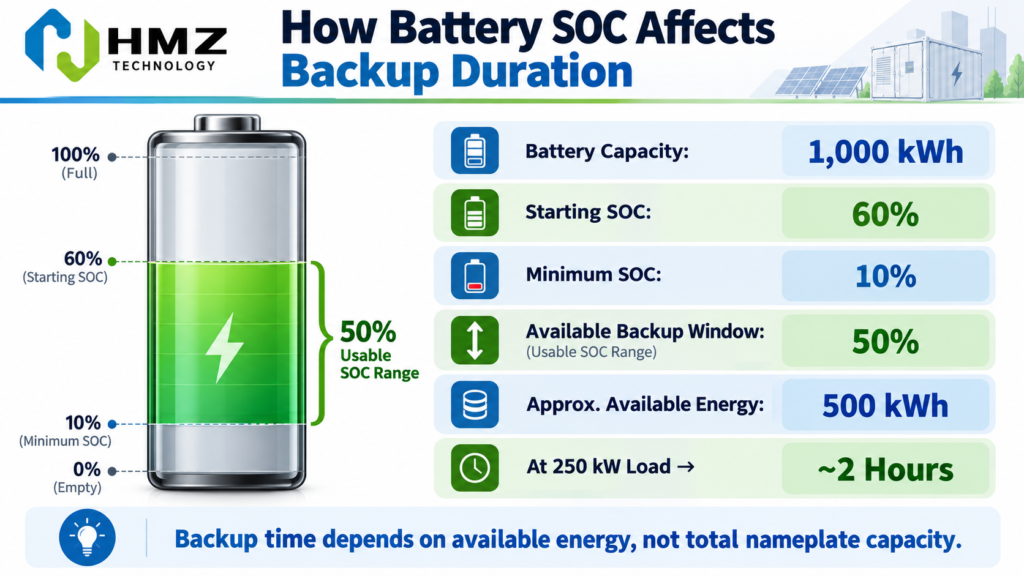
Suppose:
Nominal battery capacity:
1,000 kWh
Available SOC at outage:
60%
Minimum allowed SOC:
10%
Usable emergency energy:
approximately 500 kWh before considering losses.
If the critical load is:
250 kW
simplified backup duration is:
2 hours
not four.
This is why the EMS needs a backup-reserve strategy.
Backup Reserve Competes with Daily Energy Savings
This creates an important commercial trade-off.
Suppose the battery has 500 kWh of usable energy.
The EMS can use that energy for:
- peak shaving,
- TOU arbitrage,
- solar shifting,
- backup reserve.
If the customer requires:
300 kWh always reserved for backup
only:
200 kWh
remains available for daily economic optimization.
More backup reserve improves resilience.
It may reduce daily savings.
That trade-off should be visible in the operating strategy and ROI model.
Longer Backup Duration Can Reduce Battery Utilization
A larger battery may spend most of its life waiting for an outage.
That can be justified if backup is extremely valuable.
But the project should understand the economics.
Suppose the site needs:
200 kW critical load
for one hour during typical outages.
The normal requirement is around:
200 kWh
Now the customer requests four hours “just to be safe.”
The energy requirement becomes roughly:
800 kWh
before margin.
The extra capacity may rarely be used.
This is where battery oversizing becomes relevant.
How to Choose the Right Commercial Battery Backup Duration
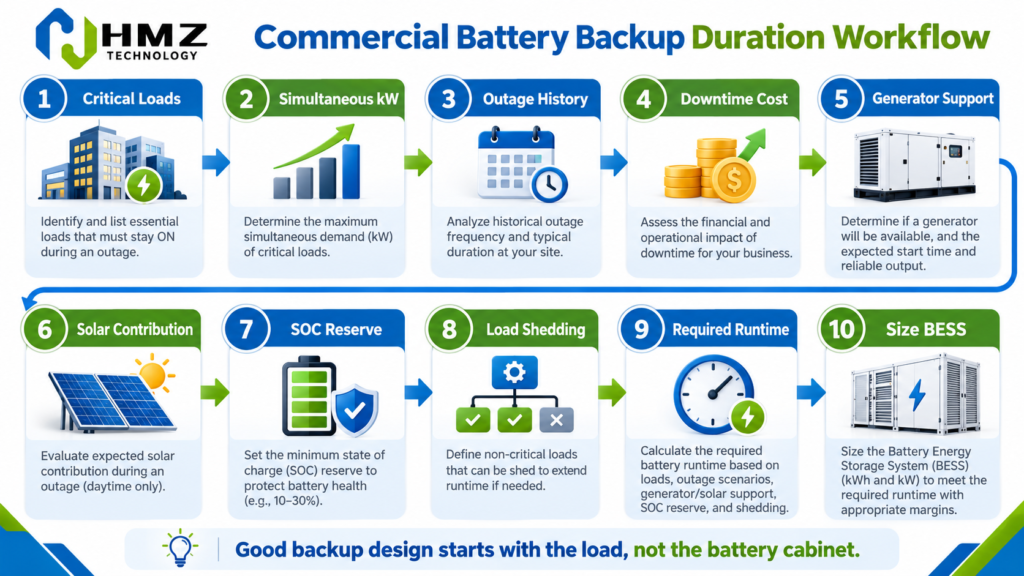
A useful decision process is:
Step 1 — Define Critical Loads
Which loads absolutely need power?
Step 2 — Calculate Simultaneous Critical kW
How much must operate at the same time?
Step 3 — Review Outage History
How long do outages normally last?
Step 4 — Calculate Downtime Cost
What happens if power is unavailable?
Step 5 — Review Generator Support
Can a generator take over after a short period?
Step 6 — Review Solar Contribution
Can PV operate during island mode?
Step 7 — Define SOC Reserve
How much battery should remain available at all times?
Step 8 — Consider Load Shedding
Can lower-priority loads be removed as the outage continues?
Step 9 — Determine Required Runtime
15 min, 1 h, 2 h, 4 h or project-specific duration.
Step 10 — Size BESS kW and kWh
Match power and energy to the actual backup strategy.
A Practical Backup-Duration Example
Consider a food-processing plant.
Critical load:
300 kW
Typical outage duration:
30–90 minutes
Longest common outage:
2 hours
Existing generator:
Available, but requires several minutes to start and is expensive to operate.
The customer initially requests:
4 hours of battery backup
A better analysis may show:
First 15 Minutes
Battery supplies 300 kW.
After Generator Starts
Generator carries most critical load.
Battery Role Afterward
Battery provides:
- transition support,
- generator optimization,
- reserve.
In this case, a full four-hour battery may not be necessary.
The final answer depends on the customer’s resilience objective and generator strategy.
The important point is that duration is designed.
Not guessed.
What If There Is No Generator?
Without a generator, battery duration becomes much more important.
The project then depends on:
- battery energy,
- solar availability,
- load shedding,
- grid-restoration time.
For a remote site with frequent long outages, a larger battery may be justified.
For a grid-connected commercial building with rare short outages, it may not be.
The operating environment decides.
How HMZ Technology Approaches Commercial Battery Backup Duration
For a commercial backup project, HMZ would typically need:
- critical-load list,
- simultaneous critical power,
- startup loads,
- required backup time,
- outage history,
- PV capacity,
- generator capacity,
- electrical single-line diagram,
- desired SOC reserve,
- installation environment.
From there, the project can define:
required backup power in kW
and
required usable energy in kWh
before matching the need to an available storage configuration.
HMZ’s current C&I storage portfolio includes:
50kW / 112kWh All-in-One C&I ESS
Suitable for smaller commercial backup and distributed-energy applications.
125kW / 241kWh All-in-One C&I ESS
Suitable for larger C&I loads and mixed energy-management applications.
125kW / 261kWh Liquid-Cooled C&I ESS
Suitable for higher-duty commercial and industrial applications.
Learn more about our 50kW/112kWh and 125kW/241kWh All-in-One C&I Energy Storage Systems.
For higher-duty projects, see the 125kW/261kWh Liquid-Cooled C&I Energy Storage System.
Commercial Battery Backup Duration Checklist
Critical Loads
- critical equipment identified
- simultaneous load confirmed
- startup load checked
- priority levels assigned
Outage Risk
- outage frequency reviewed
- typical duration reviewed
- longest recurring outage reviewed
Backup Resources
- generator available
- PV islanding capability reviewed
- load shedding possible
Battery Strategy
- starting SOC defined
- minimum SOC defined
- reserve requirement defined
- degradation margin considered
Business Impact
- cost of downtime estimated
- maximum acceptable interruption defined
- required recovery time understood
A good backup-duration decision balances resilience and cost.
Conclusion
There is no universal answer to:
“How many hours should a commercial battery backup system run?”
The right commercial battery backup duration may be:
- 15 minutes,
- one hour,
- two hours,
- four hours,
- or something completely different.
The duration should come from:
critical load
outage behavior
generator and solar support
SOC strategy
cost of downtime
Longer backup is not automatically better.
The best system is the one that keeps the right loads online for the amount of time the business actually needs.
Frequently Asked Questions
How do you calculate commercial battery backup duration?
A simplified calculation is usable battery energy in kWh divided by the supported load in kW. Real design should also account for efficiency, SOC limits, reserve and battery degradation.
Is one hour of battery backup enough for a commercial building?
It can be, depending on outage duration, critical loads, generator availability and the cost of downtime.
Why would a business choose only 15 minutes of battery backup?
A short-duration battery may provide ride-through power while a generator starts or allow equipment to shut down safely.
Is four hours of battery backup always better than two hours?
No. Longer duration requires more battery energy and higher CAPEX. It should be justified by outage risk and business requirements.
Can solar extend battery backup duration?
Yes, if the system can operate in island mode and sufficient solar generation is available during the outage.
Does battery SOC affect backup time?
Yes. Backup duration depends on the energy available between the starting SOC and the minimum permitted SOC
Build Your Intelligent Energy Future with HMZ
HMZ Technology helps businesses move beyond traditional solar systems by combining solar PV, battery storage and intelligent microgrid control.
Our integrated energy solutions are designed for industrial facilities, commercial buildings and remote energy applications requiring reliable, efficient and flexible power.
Contact HMZ Technology today to explore your next solar storage or microgrid project.
Related Insights from HMZ Technology
Industrial energy management is rapidly evolving. While rooftop solar PV provides an effective way for factories to generate clean electricity, many businesses are now looking beyond solar generation and exploring integrated solutions such as energy storage, intelligent energy management, and microgrid systems.
To better understand how commercial and industrial users can optimize their energy strategy, explore more insights from HMZ Technology’s renewable energy knowledge center, including solar PV solutions, C&I energy storage systems, and practical applications for industrial energy management.