
For many people, the phrase zero carbon house sounds futuristic.
But in reality, it is becoming a very practical topic.
As electricity prices rise, grid reliability becomes less predictable in some regions, and sustainability expectations continue to grow, more homeowners, developers and project planners are asking the same question:
Can a house produce and manage its own clean energy in a smarter way?
The answer is yes — but a zero carbon house is not just about putting solar panels on the roof.
It is about building a complete energy logic around the house: generation, storage, consumption and control.
At HMZ Technology, we see zero carbon housing not as a concept for marketing brochures, but as a real energy solution that can be adapted to modern homes, villas, vacation properties, eco-lodges and remote residential applications. With the right combination of solar PV, battery storage, inverter technology and smart energy management, a house can move much closer to low-carbon or even near-zero-carbon operation.
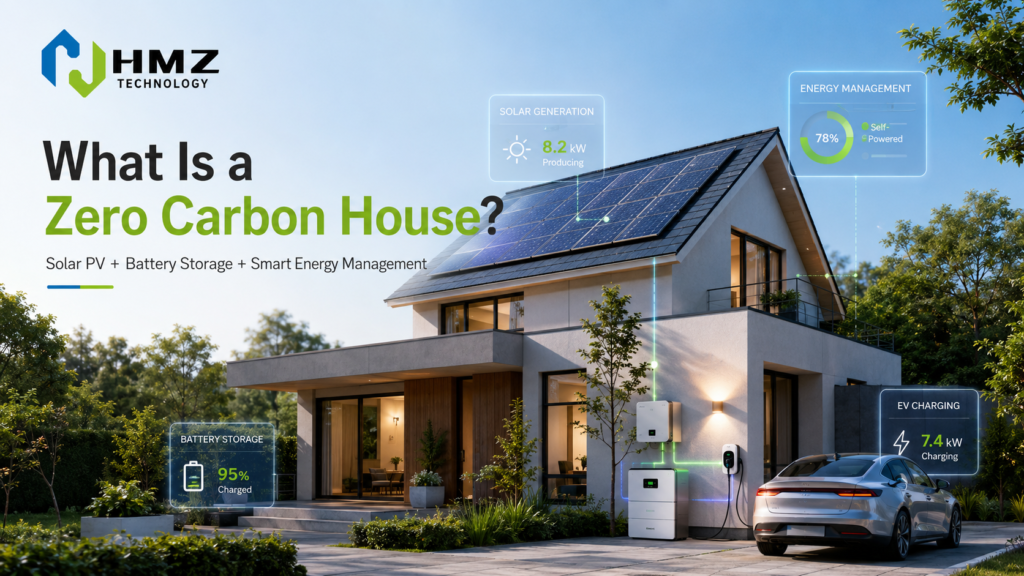
What Is a Zero Carbon House?
A zero carbon house is a residential building designed to minimize or offset carbon emissions generated through daily operation. In simple terms, it aims to reduce the home’s dependence on fossil-fuel-based electricity and lower its long-term environmental impact.
This usually involves several core elements:
- rooftop solar PV for clean power generation
- battery energy storage for self-consumption and backup power
- high-efficiency appliances and lighting
- thermal insulation and energy-saving building materials
- smart energy control to optimize how electricity is used
- in some cases, EV charging and heat pump integration
A true zero carbon house does not always mean the house is completely disconnected from the grid. In many cases, it means the house is designed to keep operational carbon emissions as low as possible while maximizing renewable energy use.
If you are already exploring home energy storage solutions, this is where the idea becomes practical: the house is no longer just a place that consumes electricity — it becomes part of the energy system.
Why Is the Zero Carbon House Concept Becoming More Popular?
The growing interest is not difficult to understand.
In many markets, homeowners face three pressures at the same time:
- Higher electricity bills
- Unstable grid supply or peak-time price pressure
- Stronger interest in cleaner and more resilient living
A zero carbon house responds to all three.
Instead of relying completely on external electricity supply, the home can generate power during the day, store excess energy in batteries, and use that stored electricity at night or during outages. This improves energy independence and makes the house more future-ready.
For some users, the main driver is carbon reduction.
For others, it is economics.
For many, it is both
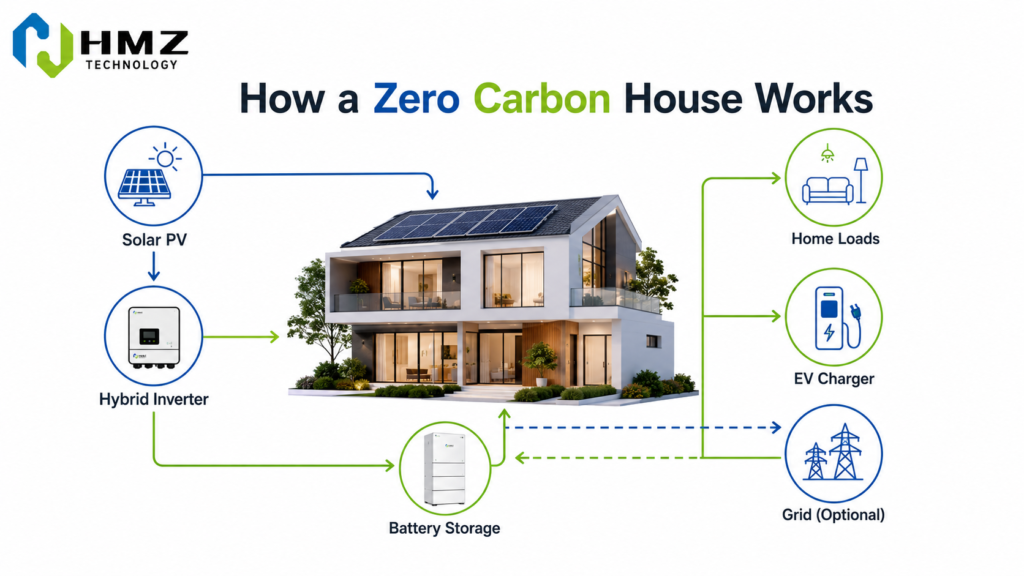
How Does a Zero Carbon House Work?
A practical zero carbon house usually works as an integrated system.
1. Solar PV generates electricity
Solar panels convert sunlight into electricity during the day.
2. The inverter manages power flow
The inverter converts and distributes electricity for household use, export, or battery charging.
3. The battery stores excess power
When solar generation exceeds current consumption, surplus energy is stored instead of wasted.
4. Smart control improves efficiency
An energy management system decides when to use solar power directly, when to charge the battery, and when to draw from the grid if needed.
5. The house reduces grid dependence
At night or during power interruptions, stored electricity can support essential loads and improve household resilience.
This is why the design matters. A zero carbon house is not just a single product. It is a coordinated system.
At HMZ Technology, this is how we approach it: not just equipment supply, but integrated solar and storage systems designed around real usage patterns.
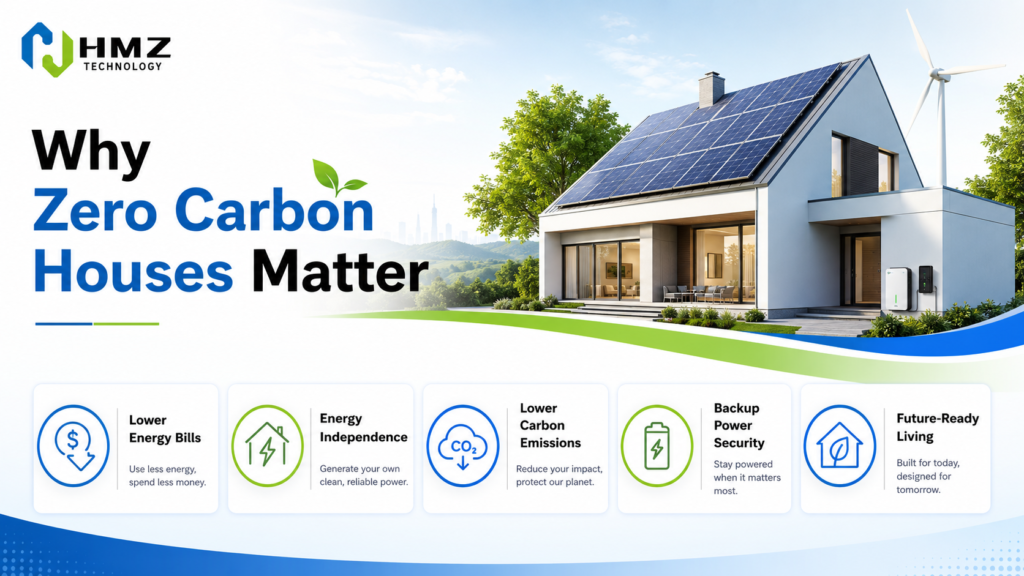
Main Benefits of a Zero Carbon House
1. Lower electricity costs
By generating and storing your own electricity, you reduce how much power you need to buy from the grid.
2. Better energy independence
The home becomes less vulnerable to outages, weak-grid conditions or tariff increases.
3. Reduced carbon footprint
A larger share of household energy comes from renewable sources rather than fossil-fuel-based supply.
4. Higher property value
Sustainable and energy-efficient homes are becoming more attractive in many markets.
5. Better long-term resilience
A well-designed system supports future loads such as EV charging, smart appliances and home electrification.
What Are the Challenges or Limitations?
It is important to be realistic.
A zero carbon house has clear advantages, but it also comes with design and investment considerations.
1. Initial investment
Solar panels, batteries and smart energy equipment require upfront capital.
2. System design complexity
The wrong battery size, inverter size or load estimate can lead to underperformance or unnecessary overspending.
3. Roof and site limitations
Not every roof has the same available space, orientation or shading conditions.
4. Seasonal generation differences
Solar production changes by season and weather, so system sizing must consider local conditions.
5. Maintenance and lifecycle planning
Although modern systems are reliable, users still need basic planning for inspection, cleaning and battery life expectations.
This is why a zero carbon house should not be sold as a “one-size-fits-all” package.
It should be matched to the actual project.
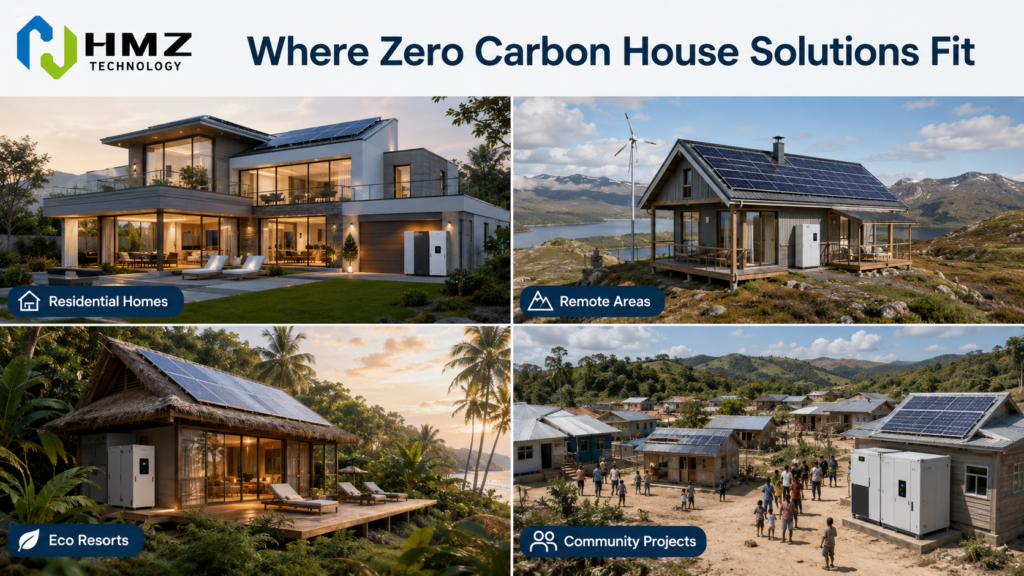
Where Can a Zero Carbon House Be Used?
The idea is broader than a standard family home. Common scenarios include:
Urban villas and high-end residences
These users often want energy savings, power backup and a more premium smart-living experience.
Remote homes or weak-grid regions
In areas where the grid is unstable, a solar-plus-storage house becomes highly practical.
Vacation homes and eco-retreats
These projects often prioritize sustainability, low noise and clean self-supply.
Rural housing and farm residences
Users may need both household energy and support for small pumps, lighting, refrigeration or communication loads.
Demonstration projects and green buildings
Developers and institutions may use zero carbon houses as sustainability showcases.
In some cases, a project may later expand from residential use into a small community energy model.
That is also where lessons from commercial and industrial energy storage systems can sometimes help shape broader planning logic.
How Do You Match the Right System for a Zero Carbon House?
This is one of the most important parts.
A good zero carbon house system should be matched based on real conditions, not assumptions.
Step 1: Estimate daily electricity consumption
Start with the household’s average daily load in kWh.
Step 2: Identify critical loads
Which loads must stay on during an outage?
For example: refrigerator, lights, internet, security, water pump, essential air conditioning.
Step 3: Check roof space
Available installation area affects how much solar capacity can be installed.
Step 4: Decide the target
Do you want:
- lower bills only?
- backup power?
- high self-sufficiency?
- near off-grid operation?
Step 5: Match the right system size
A practical solution may include:
- solar PV modules
- hybrid inverter
- battery storage system
- mounting system
- monitoring platform
At HMZ Technology, we recommend that users think in terms of system matching, not just product selection.
Battery size without solar logic is incomplete.
Solar size without load analysis is risky.
And backup expectations without inverter planning often lead to disappointment.
That is why the right path is always a matched solution, not just a shopping list.
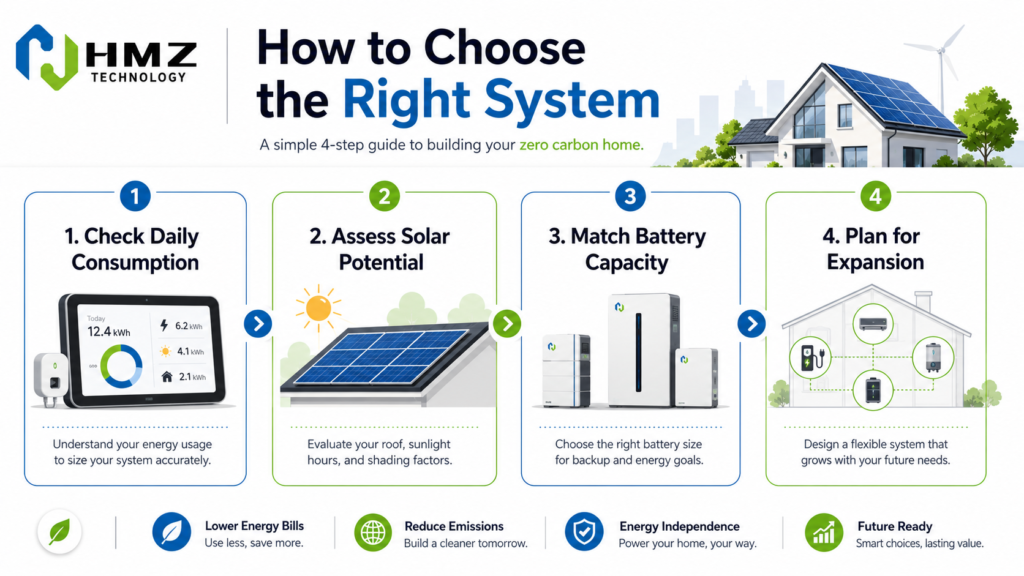
A Practical Way to Think About System Matching
Different users may need different solutions:
- A family focused mainly on electricity savings may choose a moderate solar-plus-battery setup.
- A villa owner seeking premium energy security may need a larger battery and stronger backup capability.
- A weak-grid home may prioritize higher battery autonomy and more careful load management.
- An eco-lodge or demonstration house may place more emphasis on sustainability visibility and smart control.
This is also where HMZ can add value.
We are not just talking about isolated components.
We help customers think from the perspective of overall energy use, future expansion and application logic.
Why HMZ Technology Cares About Zero Carbon Housing
At HMZ Technology, our broader focus is renewable energy and energy storage solutions that can be applied across residential, commercial and industrial scenarios.
For residential users, zero carbon housing represents more than a sustainability trend.
It represents a shift in how homes interact with energy.
Instead of being passive power consumers, homes can become active, intelligent energy nodes.
That is why we continue to pay attention to system-based applications — from residential solar-storage concepts to larger integrated solutions. If you want to understand how energy storage logic scales from home to business scenarios, you can also explore our All-in-One C&I Energy Storage System solutions for broader application reference.
Final Thoughts
A zero carbon house is not about chasing a perfect label.
It is about building a smarter and more efficient way for a house to use energy.
When designed properly, it can reduce electricity bills, improve resilience, support sustainability goals and create a stronger long-term value proposition for the property.
The key is not whether the phrase sounds advanced.
The key is whether the system behind it is practical.
At HMZ Technology, we believe the future of housing energy is not just cleaner — it is also more intelligent, more flexible and more user-centered.
If you are evaluating a residential solar and storage solution, or planning a low-carbon housing project, the best starting point is always the same: understand your loads, define your goals, and build the right system around them.
Related Insights from HMZ Technology
Industrial energy management is rapidly evolving. While rooftop solar PV provides an effective way for factories to generate clean electricity, many businesses are now looking beyond solar generation and exploring integrated solutions such as energy storage, intelligent energy management, and microgrid systems.
To better understand how commercial and industrial users can optimize their energy strategy, explore more insights from HMZ Technology’s renewable energy knowledge center, including solar PV solutions, C&I energy storage systems, and practical applications for industrial energy management.