
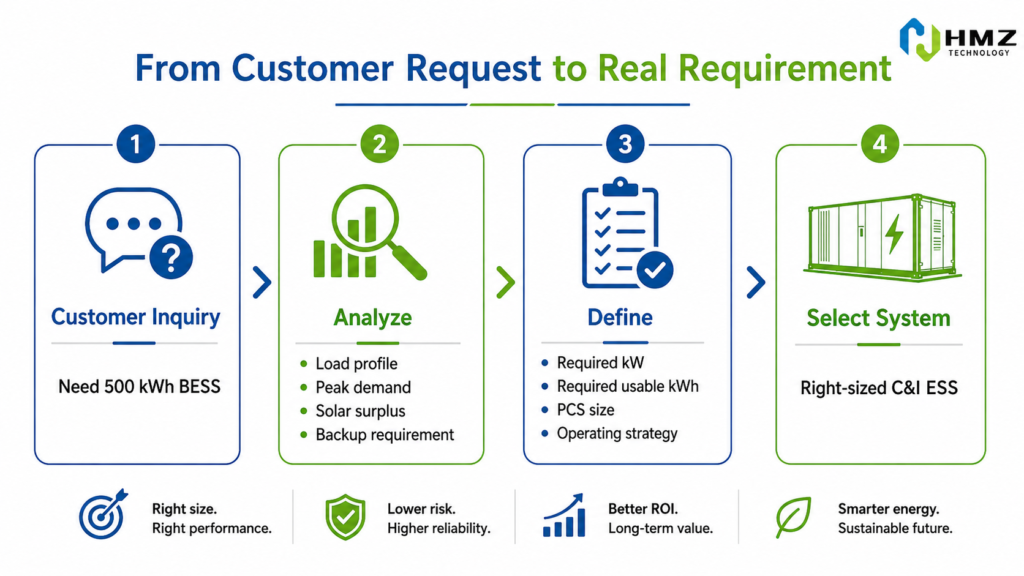
A customer asks for a 500 kWh battery.
It sounds like enough information to prepare a quotation.
Usually, it is not.
The next question should be:
How much power does the site need the battery to deliver?
A 500 kWh system could be paired with a 100 kW PCS, a 250 kW PCS, or another power configuration depending on the application.
Those systems may all store roughly the same amount of energy, but they will behave very differently when connected to a factory or commercial building.
This is where one of the most common misunderstandings in C&I energy storage begins.
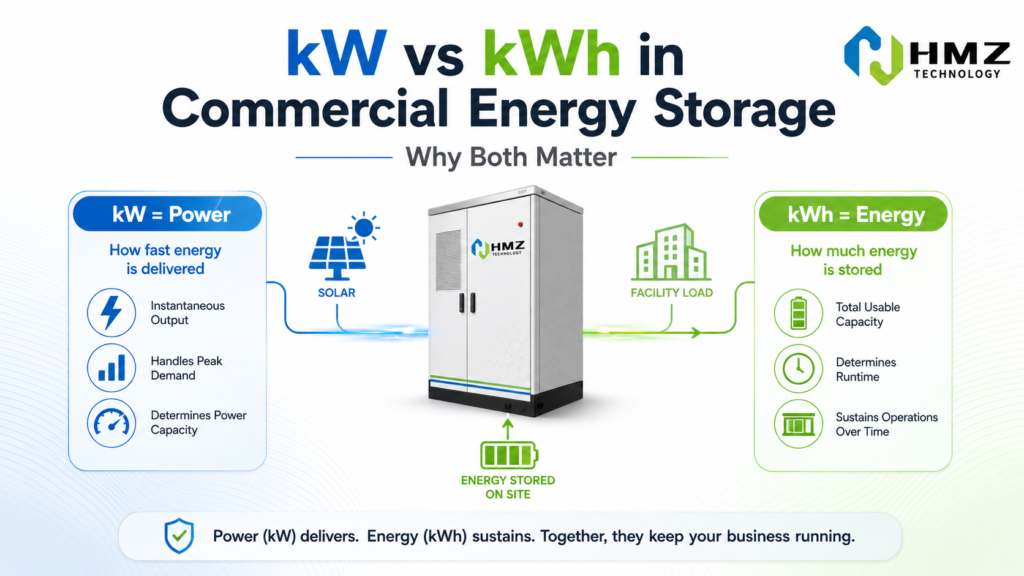
kW and kWh are related, but they are not interchangeable.
kW tells you how much power the system can deliver at a given moment.
kWh tells you how much energy is available over time.
If a project is selected by kWh alone, the battery may have plenty of stored energy but still be unable to support the required load.
If it is selected by kW alone, it may deliver enough instantaneous power but run out of usable energy much sooner than the customer expects.
For commercial storage procurement, both numbers need to be understood before equipment is selected.
kW: How Much Power Can the Battery Deliver Right Now?
kW, or kilowatt, is a unit of power.
In a C&I battery storage system, it describes how much power the system can deliver or absorb at a given moment.
Think about a factory operating at 400 kW.
If the site wants the battery to cover a 150 kW demand peak, then the storage system needs enough discharge power to provide that 150 kW when required.
The battery may contain hundreds of kilowatt-hours of energy, but if the PCS can only deliver 100 kW, it cannot provide 150 kW to the load.
That is a power limitation.
For many commercial applications, the kW rating is closely linked to the PCS or inverter power rating.
Typical questions include:
- How large is the site peak?
- How much of that peak should the battery cover?
- What is the maximum charge power?
- What is the maximum discharge power?
- Are there motor-starting or short-duration high-power events?
- How quickly does the load change?
These questions are about power, not total stored energy.
kWh: How Long Can the Battery Keep Supplying Energy?
kWh, or kilowatt-hour, is a unit of energy.
It describes how much energy the battery stores.
A simple way to understand the difference is:
kW = how strong the battery is at one moment
kWh = how long it can keep doing the job
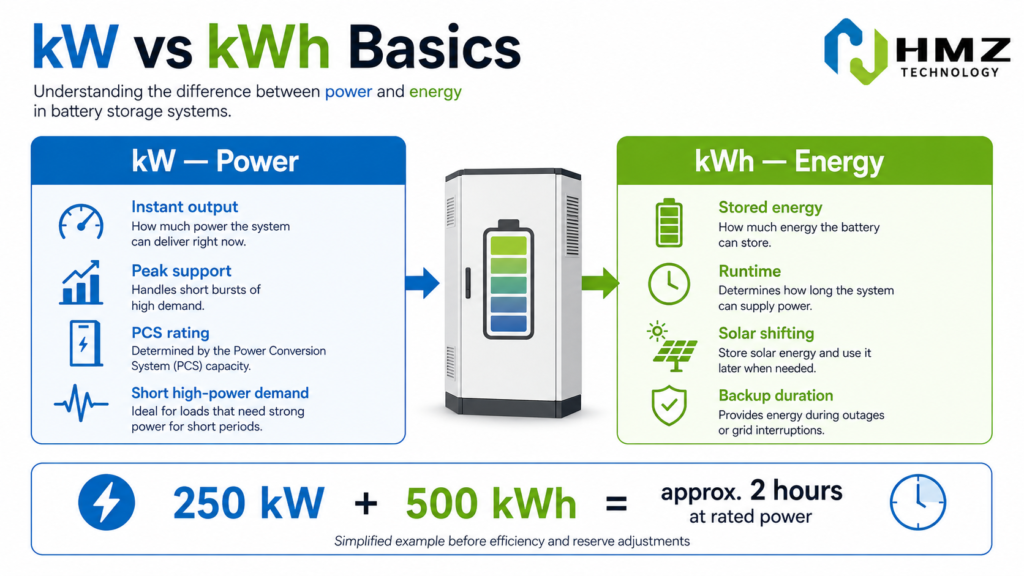
Suppose a battery system has:
250 kW power
and
500 kWh energy capacity
Ignoring losses and reserve margins for a moment, the basic duration relationship is:
500 kWh ÷ 250 kW = 2 hours
At full rated power, the battery could theoretically support 250 kW for around two hours.
If the same 500 kWh battery only supplied 100 kW, the duration would be much longer.
That is why a battery cannot be judged by kWh alone.
The same energy capacity can support very different operating patterns depending on the power demand.
Why Buyers Often Focus Too Much on kWh
Battery suppliers and customers often talk about storage in kWh because it is an easy number to compare.
112 kWh.
241 kWh.
261 kWh.
500 kWh.
1 MWh.
The number feels like a direct measure of “how big the battery is.”
But in a real project, the battery does not simply sit there storing energy.
It has a job to perform.
A customer buying 1 MWh of storage may still be disappointed if the system can only discharge at 125 kW and the site needs 400 kW of support during a peak.
The energy is there.
The power is not.
This is similar to having a large fuel tank connected to an engine that is too small for the required work.
More stored energy does not automatically mean more instantaneous capability.
Procurement Mistake 1: “I Need 500 kWh” Without Defining the Load
A buyer may send an inquiry that says:
We need a 500 kWh commercial battery system.
Before quoting, a supplier should still understand:
- What is the site’s peak demand?
- What is the normal operating load?
- Is the battery for backup, peak shaving or solar storage?
- How long should it discharge?
- What percentage of the load must it support?
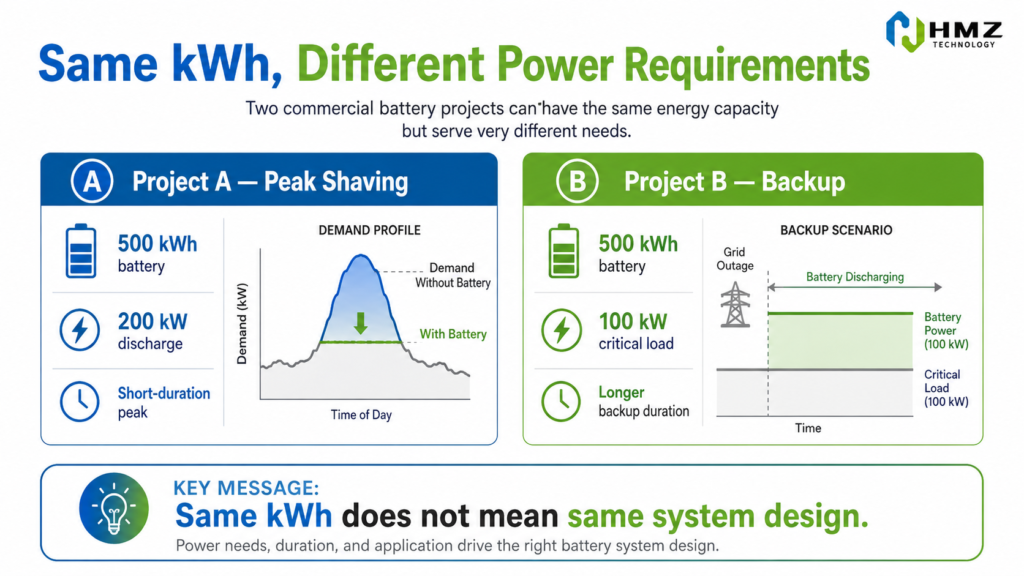
Consider two projects.
Project A
Battery requirement:
500 kWh
Application:
Peak shaving
Peak reduction required:
200 kW for 30 minutes
Project B
Battery requirement:
500 kWh
Application:
Backup power
Critical load:
100 kW for four hours
Both projects may appear to need similar energy capacity.
Their required power profiles are completely different.
Project A needs relatively high power for a short period.
Project B needs lower power for a much longer duration.
The correct PCS and battery configuration will not necessarily be the same.
Procurement Mistake 2: Matching Battery kW Directly to the Entire Facility Load
Another common reaction is to look at the factory peak and say:
The factory peaks at 800 kW, so we need an 800 kW battery system.
Not necessarily.
What is the battery expected to do?
If the goal is only to shave 150 kW from the peak, the storage system may not need to supply the full 800 kW.
The load might look like this:
Factory load: 800 kW
Grid target: 650 kW
Battery contribution: 150 kW
The battery only needs to cover the difference required by the operating strategy.
For backup applications, the situation may be different again.
The site may have an 800 kW total load, but only 220 kW of that may be classified as critical during a grid outage.
Designing a storage system around the full facility load when only critical loads require backup can increase project cost dramatically.
The right number comes from the operating objective, not from automatically copying the facility peak.
Peak Shaving Usually Starts With kW
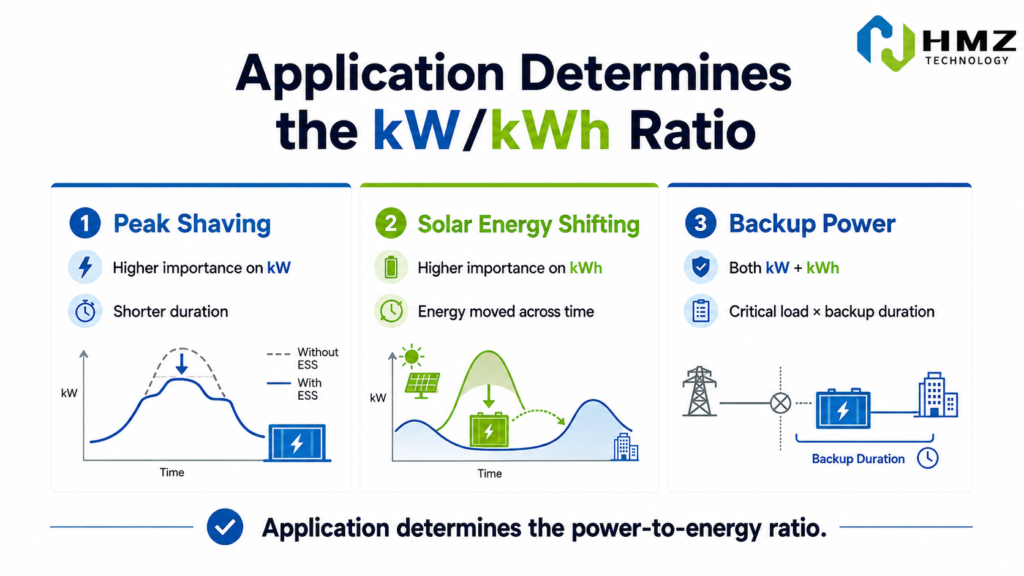
Peak shaving is primarily a power problem.
The project team first needs to identify:
- the existing peak demand,
- the desired grid-demand limit,
- and how long the peak normally lasts.
Imagine a site with the following load pattern:
Normal demand:
450 kW
Short afternoon peak:
650 kW
Target grid limit:
500 kW
Required battery contribution:
150 kW
If the peak typically lasts 30 minutes, the theoretical energy needed for the event is:
150 kW × 0.5 hours = 75 kWh
In practice, the design requires additional margin for efficiency, SOC limits, battery degradation and operating reserve.
But the important point is that this application begins with a 150 kW power requirement.
Simply selecting a large kWh number without understanding the peak will not solve the problem.
Backup Power Usually Starts With Both kW and Duration
Backup is different.
First ask:
What loads must stay online?
Then ask:
For how long?
Suppose a facility identifies these critical loads:
- Control equipment: 30 kW
- Refrigeration: 60 kW
- IT and communication: 20 kW
- Essential lighting and auxiliary systems: 40 kW
Total critical load:
150 kW
If the site requires two hours of battery backup:
150 kW × 2 hours = 300 kWh
That is the theoretical energy requirement before losses, reserve margin and battery operating limits are considered.
Now both numbers matter:
Power requirement: at least 150 kW
Energy requirement: approximately 300 kWh plus design margin
A 300 kWh battery paired with a 100 kW PCS would not meet the load requirement, even though the energy number appears sufficient.
This is one of the clearest examples of why kW and kWh must be considered together.
Solar Energy Shifting Is Often More kWh-Driven
Solar shifting usually puts more emphasis on energy capacity.
Suppose a factory has excess PV production between 11:00 a.m. and 2:00 p.m.
The site generates roughly 500 kWh more solar energy than it can consume during that window.
The customer wants to store that energy and use it during evening production.
The question becomes:
How much of that 500 kWh surplus can the battery realistically capture and discharge later?
Battery kWh becomes central.
But power still matters.
If 500 kWh of solar surplus arrives within a very short charging window, the battery and PCS must be able to absorb the required charging power.
A large energy capacity with insufficient charging power may leave part of the available solar energy unused.
Even in an energy-driven application, kW cannot be ignored.
What Does a “2-Hour Battery” Actually Mean?
Storage projects are often described using duration.
You may hear:
- 1-hour BESS
- 2-hour BESS
- 4-hour BESS
This refers to the relationship between rated power and energy capacity.
For example:
125 kW / 250 kWh
is roughly a two-hour system at rated output.
Similarly:
250 kW / 1,000 kWh
is roughly a four-hour system.
This is useful shorthand, but it should not be treated as guaranteed operating time under every condition.
Actual usable duration can be affected by:
- SOC operating limits
- battery reserve
- conversion efficiency
- temperature
- degradation
- auxiliary loads
- discharge-power profile
A “two-hour battery” may not always deliver exactly two hours to the facility under every operating condition.
The project should be modeled using usable energy, not nameplate energy alone.
Nominal kWh Is Not the Same as Usable kWh
This is another procurement detail worth checking.
A battery cabinet may have a nominal capacity of 261 kWh.
That does not necessarily mean all 261 kWh should be assumed available for daily discharge.
The EMS may maintain:
- a lower SOC limit,
- an upper SOC limit,
- or a backup reserve.
There are also system losses between the battery and the load.
Suppose a customer wants 200 kWh of usable energy at the AC load side.
Selecting a battery with exactly 200 kWh nominal capacity would leave no margin for:
- operating SOC limits,
- conversion losses,
- degradation,
- or reserve.
The correct nameplate capacity normally needs to be higher than the usable energy requirement.
How much higher depends on the project and equipment.
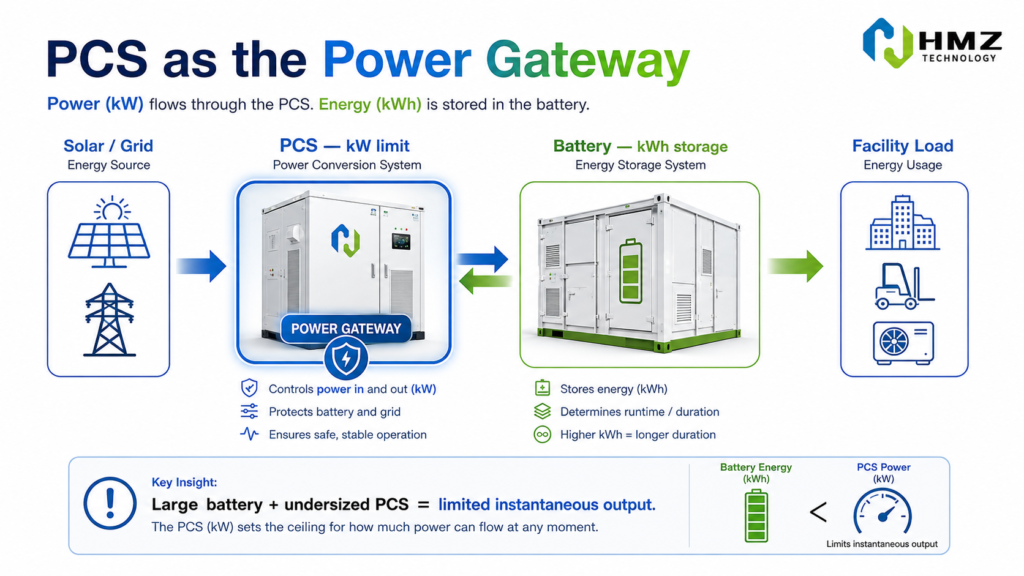
PCS Power Can Become the Hidden Bottleneck
Customers often spend a lot of time comparing battery-cell capacity and very little time looking at PCS power.
That can be a mistake.
The PCS determines how quickly power can move between the AC system and the battery.
If the battery contains 500 kWh but the PCS is rated at 100 kW, then the battery cannot suddenly provide 300 kW just because the load needs it.
The same issue applies to charging.
A large PV system may create a strong midday surplus, but a limited PCS may restrict how quickly that energy can be stored.
When reviewing a C&I ESS quotation, the following should be clear:
- PCS rated power
- Battery nominal energy
- Usable energy
- Maximum charge power
- Maximum discharge power
- Supported operating duration
- Expected application
Without those numbers, comparing systems becomes difficult.
A Larger kWh Number Is Not Automatically a Better Purchase
Battery procurement often becomes a capacity comparison.
Supplier A:
241 kWh
Supplier B:
261 kWh
Supplier C:
280 kWh
At first glance, the largest number can look like the best value.
That comparison is incomplete.
The buyer should also ask:
- What is the PCS power?
- What is the usable capacity?
- What is the maximum charge/discharge current?
- What SOC range is recommended?
- What application is the system designed for?
- Can the system support the required load?
- Can the battery actually be fully utilized under the site’s operating profile?
An extra 20 or 40 kWh has little financial value if the site does not have enough usable energy-shifting opportunity.
Likewise, a slightly smaller battery with better power matching may perform the required job more effectively.
Why “Battery Price per kWh” Can Be Misleading
USD/kWh is useful for comparing storage equipment at a very high level.
It should not be used alone to select a commercial system.
Imagine:
System A
125 kW / 250 kWh
System B
250 kW / 250 kWh
They have the same energy capacity.
But System B provides twice the rated power.
Its PCS, electrical design and potential application are different.
Comparing only USD/kWh hides that difference.
For a complete commercial project, it can be more useful to evaluate:
- total installed CAPEX,
- required power,
- usable energy,
- expected annual utilization,
- and the value produced by the system.
A battery is not purchased to win a capacity comparison.
It is purchased to perform a specific energy-management job.
A Practical Procurement Example
Imagine a factory contacting HMZ with the following requirement:
We need approximately 500 kWh of battery storage.
After reviewing the site’s data, the actual requirement becomes clearer.
The factory has:
- normal load around 350 kW,
- short peaks up to 500 kW,
- approximately 150 kW of peak reduction required,
- excess PV production around midday,
- and a requirement to maintain 100 kW of critical loads during short outages.
Now the project is no longer simply “500 kWh.”
The design team needs to balance three different jobs:
Peak Shaving
The system must provide sufficient kW to reduce the 150 kW peak.
Solar Shifting
The battery needs enough usable kWh to capture meaningful midday surplus.
Backup
Enough energy should remain available to support the 100 kW critical load for the required period.
The final battery and PCS selection should come from that operating strategy.
Not from the original 500 kWh request alone.
How HMZ Technology Looks at kW and kWh
For commercial energy storage, battery capacity should be selected around the job the system needs to perform.
HMZ’s current C&I ESS portfolio includes configurations such as:
50kW / 112kWh All-in-One C&I Energy Storage System
This configuration combines 50 kW of system power with 112 kWh of battery energy.
It may suit smaller commercial facilities, distributed solar-plus-storage and light industrial applications where both energy shifting and shorter-duration power support are required.
125kW / 241kWh All-in-One C&I Energy Storage System
The higher power and energy capacity can support larger C&I loads and applications requiring more substantial daily energy management.
125kW / 261kWh Liquid-Cooled C&I Energy Storage System
This configuration maintains 125 kW power with 261 kWh of energy storage while using liquid cooling for more precise thermal management in more demanding operating conditions.
The important point is not which number is largest.
It is which combination of kW + usable kWh + operating strategy matches the project.
What Information Should You Provide Before Requesting a C&I ESS Quotation?
If you want a supplier to recommend a meaningful commercial battery configuration, “we need 500 kWh” is not enough.
A better inquiry includes:
- Maximum site load in kW
- Daily energy consumption in kWh
- 15-minute or hourly load profile
- Existing solar PV capacity
- Solar generation data if available
- Peak-demand period
- Required peak reduction
- Critical-load power
- Required backup duration
- Grid condition
- Electricity tariff
- Generator information, if applicable
With those inputs, a supplier can begin evaluating the actual power and energy requirements.
That usually leads to a much more useful quotation than selecting a battery purely from a catalogue.
Quick Procurement Checklist: kW and kWh
Before approving a commercial battery system, confirm:
Power
- PCS rated power in kW
- Maximum discharge power
- Maximum charging power
- Peak-load support requirement
- Critical-load power requirement
Energy
- Nominal battery capacity in kWh
- Usable battery capacity
- Required discharge duration
- SOC operating range
- Backup reserve requirement
Application
- Peak shaving
- Solar self-consumption
- Energy shifting
- Backup
- Generator support
- Multiple operating objectives
If the quotation does not clearly connect these three areas, there is probably still more sizing work to do.
Conclusion
The difference between kW and kWh is simple.
Using them correctly in a commercial storage project is not always simple.
kW tells you how much power the battery can deliver.
kWh tells you how much energy the battery can store and how long it can keep supplying that power.
A good commercial ESS needs both numbers to match the site.
A system with plenty of kWh but insufficient kW may fail to support the required peak.
A system with plenty of kW but too little kWh may meet the load briefly and then run out of usable energy.
So when comparing C&I battery systems, do not ask only:
“How many kWh does it have?”
Also ask:
“How many kW does the project actually need, for how long, and what job is the battery expected to perform?”
That is where meaningful system selection begins.
Frequently Asked Questions
What is the difference between kW and kWh in battery storage?
kW measures battery power—the amount of power the system can deliver or absorb at one moment. kWh measures energy—the amount of electricity the battery can store and provide over time.
Is kW or kWh more important for commercial battery storage?
Neither is universally more important. The application determines the balance. Peak shaving may place greater emphasis on kW, energy shifting on kWh, while backup applications require both power and duration to be considered together.
How do I calculate battery duration from kW and kWh?
A simplified calculation divides battery energy capacity in kWh by discharge power in kW. For example, 500 kWh divided by 250 kW equals approximately two hours before considering efficiency, SOC limits and reserve.
Can a 500 kWh battery supply a 500 kW load?
Only if the battery system and PCS are designed to deliver 500 kW. Energy capacity alone does not determine maximum output power.
Why is PCS power important in a BESS?
The PCS controls how much AC power can move into or out of the battery. A large battery paired with a lower-power PCS cannot exceed the PCS output simply because more stored energy is available.
Is a larger kWh battery always better?
No. Oversized battery capacity can increase project cost without creating proportional value if the site cannot use the additional stored energy.
Build Your Intelligent Energy Future with HMZ
HMZ Technology helps businesses move beyond traditional solar systems by combining solar PV, battery storage and intelligent microgrid control.
Our integrated energy solutions are designed for industrial facilities, commercial buildings and remote energy applications requiring reliable, efficient and flexible power.
Contact HMZ Technology today to explore your next solar storage or microgrid project.
Related Insights from HMZ Technology
Industrial energy management is rapidly evolving. While rooftop solar PV provides an effective way for factories to generate clean electricity, many businesses are now looking beyond solar generation and exploring integrated solutions such as energy storage, intelligent energy management, and microgrid systems.
To better understand how commercial and industrial users can optimize their energy strategy, explore more insights from HMZ Technology’s renewable energy knowledge center, including solar PV solutions, C&I energy storage systems, and practical applications for industrial energy management.