
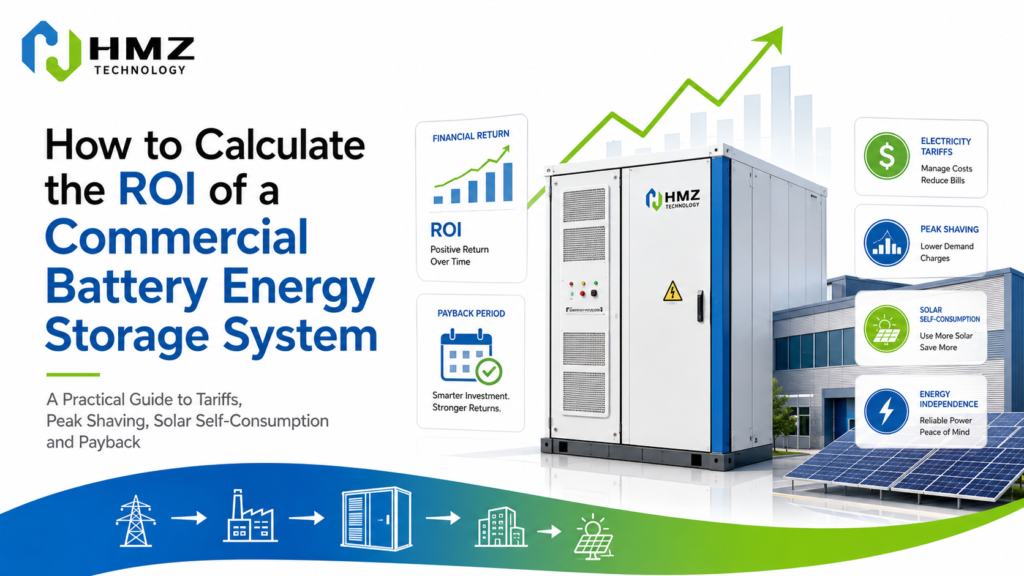
One of the first questions businesses ask before investing in battery storage is simple:
How long will it take to recover the investment?
It is an important question.
But commercial battery storage ROI is rarely determined by one number.
Two companies may install battery systems with similar capacities and pay similar equipment prices, yet achieve very different financial results.
Why?
Because battery storage does not create value simply by sitting on site.
It creates value when it is used at the right time, under the right electricity tariff, with the right operating strategy.
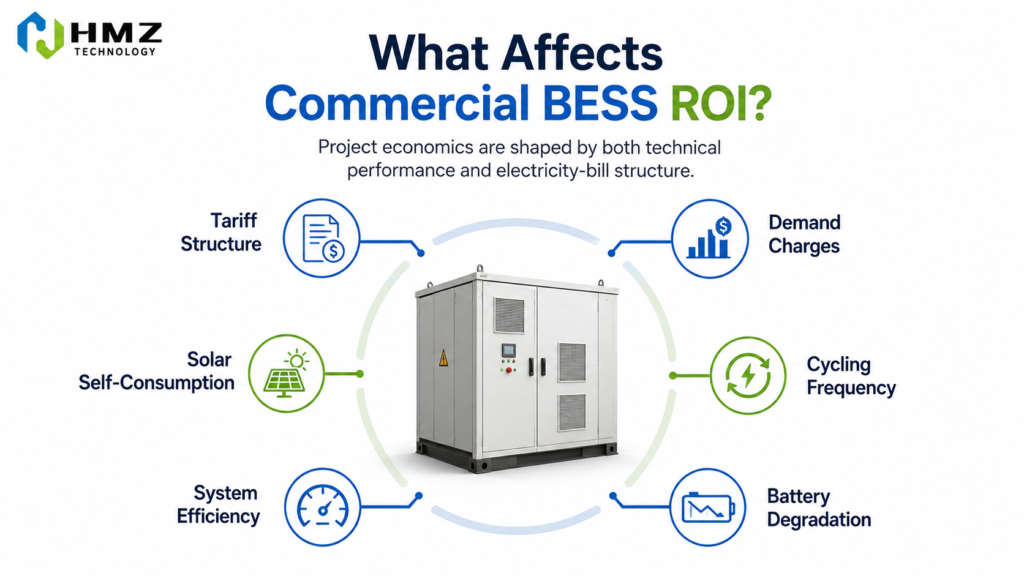
For a commercial or industrial project, the economic result is normally affected by several factors:
- Electricity price differences
- Demand charges
- Solar self-consumption
- Battery cycling frequency
- Battery utilization
- Operating strategy
- System efficiency
- Project lifetime
- Maintenance and operating costs
A realistic ROI analysis should therefore begin with the site’s actual energy situation—not with a generic payback promise.
What Does ROI Mean for a Commercial Battery Storage Project?
ROI, or Return on Investment, measures how much financial value an investment creates compared with its total cost.
For a battery energy storage project, the basic idea is straightforward:
Annual financial benefit
compared with
Total project investment
However, the difficult part is calculating the annual benefit accurately.
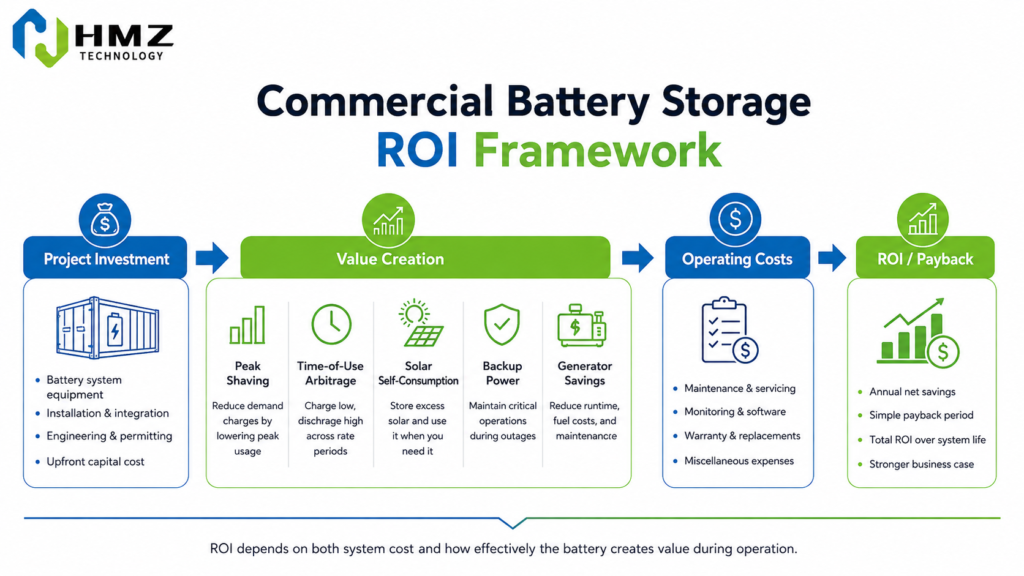
A commercial battery may create value through several different operating modes.
For example:
- Peak shaving
- Time-of-use optimization
- Solar energy shifting
- Increased solar self-consumption
- Backup power
- Reduced generator operation
Not every project uses all of these functions.
That is why ROI must be evaluated based on the actual application.
The Basic ROI Logic
A simplified calculation can begin with:
Annual Net Benefit = Annual Energy Savings + Other Measurable Benefits − Annual Operating Costs
Then:
Simple Payback Period = Total Project Investment ÷ Annual Net Benefit
For example, if a project costs USD 200,000 and generates USD 40,000 of net annual savings:
Simple payback would be approximately:
5 years
But this simple calculation should only be treated as an initial screening method.
A proper commercial analysis should also consider:
- Battery degradation
- Financing cost
- Electricity tariff changes
- Maintenance
- System availability
- Replacement costs
- Residual value
The goal is not to make the payback period look attractive.
The goal is to understand whether the project can create sustainable value over its operating life.
Factor 1: Electricity Price Difference
One of the most common sources of battery value is the difference between electricity prices at different times of day.
In some markets, electricity is relatively inexpensive during off-peak hours and more expensive during peak periods.
A battery can take advantage of this difference.
The basic operating strategy is:
Charge when electricity is cheaper
↓
Discharge when electricity is more expensive
This is commonly called energy arbitrage or time-of-use optimization.
Example
Suppose electricity costs:
- USD 0.08/kWh during off-peak hours
- USD 0.18/kWh during peak hours
The price difference is:
USD 0.10/kWh
If a battery can repeatedly shift energy from the lower-cost period to the higher-cost period, that difference becomes part of the project’s economic value.
However, the full price difference should not automatically be treated as profit.
The calculation should also consider:
- Battery charging losses
- PCS conversion losses
- Battery degradation
- Operating reserve
- Actual usable capacity
The larger and more consistent the tariff difference, the stronger the potential business case for this application.
Factor 2: Demand Charges and Peak Shaving
For many commercial and industrial users, electricity bills are not based only on energy consumption in kWh.
They may also include charges based on the site’s maximum demand in kW.
This is where peak shaving can create significant value.
Suppose a factory normally operates at around 400 kW, but occasionally reaches 600 kW during short demand peaks.
If the tariff includes a demand charge based on that maximum value, those short peaks can materially increase the electricity bill.
A battery can discharge during the peak period.
Instead of:
Grid supplies 600 kW
the system may operate like:
Grid supplies 450 kW
Battery supplies 150 kW
This reduces the measured peak demand.
The financial value depends on:
- Local demand-charge structure
- Size of the peak
- Duration of the peak
- Battery discharge power
- Frequency of peak events
This is why battery power in kW can be just as important as battery capacity in kWh.
A large battery with insufficient discharge power may not effectively control a sharp demand peak.
Factor 3: Increasing Solar Self-Consumption
Solar PV and battery storage often create more value together than either system creates independently.
Consider a commercial facility with rooftop solar.
During midday, solar generation may exceed the building’s electricity demand.
Without storage, the excess energy may be:
- Exported to the grid
- Curtailed
- Sold at a low export tariff
A battery allows some of this energy to be stored and used later.
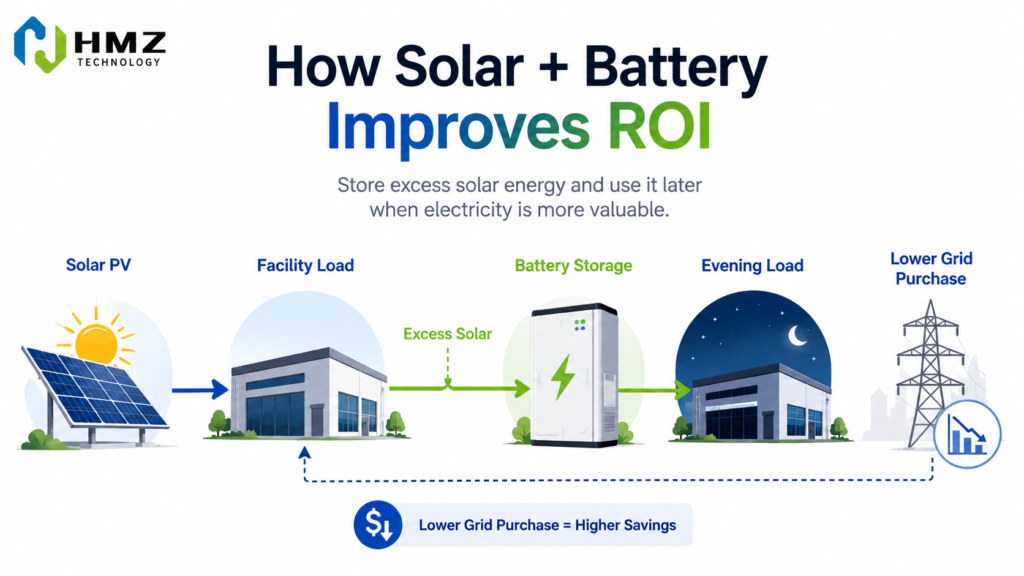
The operating logic becomes:
Solar PV → Facility Load
Then:
Excess Solar → Battery
Later:
Battery → Facility Load
This increases solar self-consumption.
Why does this matter economically?
Suppose the business buys electricity from the grid at a high retail tariff but receives a much lower value for exported solar electricity.
In that case, storing excess solar and using it later can be more valuable than exporting it.
The economic benefit depends on the difference between:
Grid electricity purchase price
and
Solar export value
The larger that difference, the more valuable solar energy shifting may become.
Factor 4: Battery Cycling Frequency
A battery project does not generate economic value simply because the battery is installed.
It generates value when the battery is actively used.
This makes cycling frequency an important ROI variable.
Consider two identical battery systems.
Project A
Battery cycles regularly because the site has:
- Clear tariff differences
- Consistent demand peaks
- Predictable solar surplus
Project B
Battery rarely cycles because:
- Tariffs are flat
- Peak demand is low
- Solar surplus is limited
Project A is likely to create more measurable economic value.
However, more cycling is not automatically better.
Every battery has a finite cycle life.
The objective is not:
Maximize the number of cycles.
The objective is:
Use the battery when each cycle creates sufficient value.
A strong EMS strategy can help determine when charging and discharging is economically worthwhile.
Factor 5: Battery Utilization Rate
Battery utilization is closely related to cycling, but it is not exactly the same thing.
A system may technically cycle every day but still use only a small percentage of its installed capacity.
For example:
A project installs a 1,000 kWh battery.
But daily operation typically uses only 250 kWh.
This may indicate that the storage capacity is oversized for the actual application.
Unused capacity represents capital that is not generating enough value.
This is one reason why larger storage systems do not automatically produce better ROI.
Correct sizing should balance:
- Energy requirements
- Power requirements
- Backup reserve
- Future expansion
- Investment cost
A smaller, well-utilized battery may sometimes create a better financial result than a larger battery with low utilization.
Factor 6: Battery Efficiency and System Losses
Battery storage is not 100% efficient.
Energy passes through several stages:
Grid or Solar
↓
PCS / inverter
↓
Battery charging
↓
Battery storage
↓
Battery discharge
↓
PCS / inverter
↓
Load
Energy is lost during the process.
These losses reduce the financial benefit of every charge-discharge cycle.
ROI calculations should therefore consider actual system efficiency rather than assuming that every kWh charged into the battery can later be delivered to the load.
The same principle applies to auxiliary consumption.
Cooling systems, controls, pumps and other supporting equipment consume electricity.
For commercial storage projects, these losses should be included in the economic model.
Factor 7: Battery Degradation
Battery performance changes over time.
As the battery ages and cycles accumulate, its usable capacity gradually decreases.
This means a battery that can deliver a certain amount of usable energy in Year 1 may deliver less energy several years later.
A realistic ROI model should therefore not assume identical performance throughout the entire project life.
Important factors include:
- Battery chemistry
- Depth of discharge
- Operating temperature
- Charge and discharge rate
- Cycling frequency
- State-of-charge strategy
This is especially important for projects with long financial evaluation periods.
Factor 8: Backup Power Has Value — But Not Always Direct Revenue
Battery storage may also be designed to provide backup power.
This creates an important distinction.
Some battery benefits are easy to calculate.
For example:
- Reduced demand charges
- Energy arbitrage
- Increased solar self-consumption
Backup value can be harder to quantify.
If a battery prevents a factory from losing production during a grid outage, the avoided loss may be extremely valuable.
But this benefit depends on:
- Frequency of outages
- Duration of outages
- Value of interrupted production
- Critical-load requirements
A hospital, data center or cold-storage facility may place a much higher value on backup capability than a building where short outages create little financial impact.
Backup value should therefore be considered separately from pure electricity-bill savings.
Factor 9: Generator Fuel Savings
In weak-grid and remote projects, batteries are often combined with diesel generators.
Without storage, generators may need to operate for long periods or run inefficiently at low load.
Battery storage can help by:
- Absorbing short load fluctuations
- Reducing unnecessary generator starts
- Supporting load during short periods
- Storing excess solar generation
- Reducing generator runtime
The economic benefit may include:
- Lower fuel consumption
- Reduced maintenance
- Fewer operating hours
For hybrid solar + battery + generator projects, these savings can become an important part of the ROI calculation.
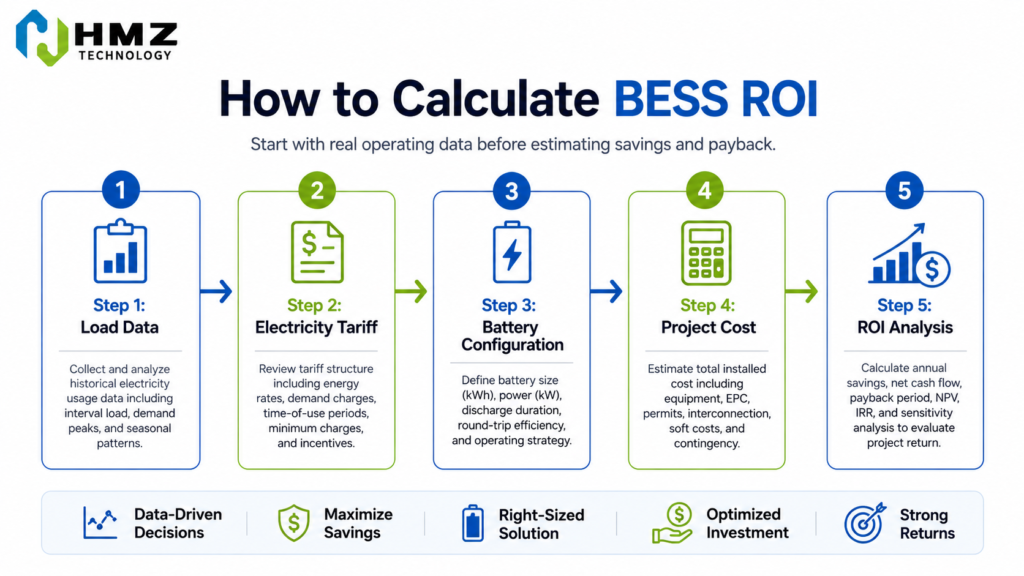
How to Build a More Realistic Battery Storage ROI Model
A useful commercial model should normally include five groups of inputs.
1. Energy Data
Collect:
- Daily electricity consumption
- Peak demand
- Hourly or interval load data
- Solar generation profile
- Existing generator usage
2. Electricity Tariff
Understand:
- Energy charge
- Peak tariff
- Off-peak tariff
- Demand charge
- Export tariff
- Seasonal pricing
3. Battery System Data
Include:
- Battery capacity in kWh
- PCS power in kW
- Usable SOC window
- System efficiency
- Expected cycling
- Degradation assumptions
4. Project Cost
Include more than the battery itself.
A complete project may include:
- Battery equipment
- PCS
- EMS
- Electrical equipment
- Installation
- Engineering
- Commissioning
- Civil works
- Protection
- Transportation
5. Operating Costs
Consider:
- Maintenance
- Auxiliary power consumption
- Insurance where applicable
- Software or monitoring costs
- Replacement components
Only after these inputs are understood should the project team calculate expected savings and payback.
Why Cheap Battery Systems Do Not Always Deliver Better ROI
It is tempting to evaluate battery projects primarily by equipment price.
But the lowest initial cost does not necessarily create the best return.
A cheaper system may create poor economics if it suffers from:
- Incorrect sizing
- Low efficiency
- Limited power capability
- Poor thermal management
- Weak EMS control
- Low availability
Conversely, a properly designed system may cost more initially but create more usable value during operation.
For commercial projects, the more useful question is therefore not:
“Which battery has the lowest price?”
It is:
“Which system creates the best economic value for this load profile and tariff structure?”
How EMS Can Improve Battery Storage Economics
An EMS plays an important role in maximizing storage value.
The EMS can monitor:
- Battery SOC
- Grid demand
- Solar generation
- Electricity tariffs
- Facility load
It can then determine when the battery should charge or discharge.
For example:
Low electricity price
Battery charges.
High electricity price
Battery discharges.
Demand peak approaching
Battery supports the load.
Excess solar available
Battery stores renewable energy.
Backup reserve required
EMS maintains minimum SOC.
This intelligent control allows the same battery to support several business objectives without operating randomly.
A Simple Commercial Battery ROI Example
Consider a commercial facility that installs a battery storage system for three main purposes:
- Reduce demand charges
- Increase solar self-consumption
- Shift electricity consumption from high-cost to lower-cost periods
Suppose the project creates the following annual savings:
- Peak shaving savings: USD 18,000
- Solar self-consumption benefit: USD 12,000
- Time-of-use savings: USD 10,000
Total annual gross benefit:
USD 40,000
Suppose annual maintenance and operating costs are:
USD 4,000
Annual net benefit:
USD 36,000
If the total project investment is:
USD 180,000
Simple payback is:
180,000 ÷ 36,000 = 5 years
This example is only for explaining the calculation method.
Actual project economics must be based on site-specific data.
The result may change significantly depending on tariff structure, load behavior, system utilization and project cost.
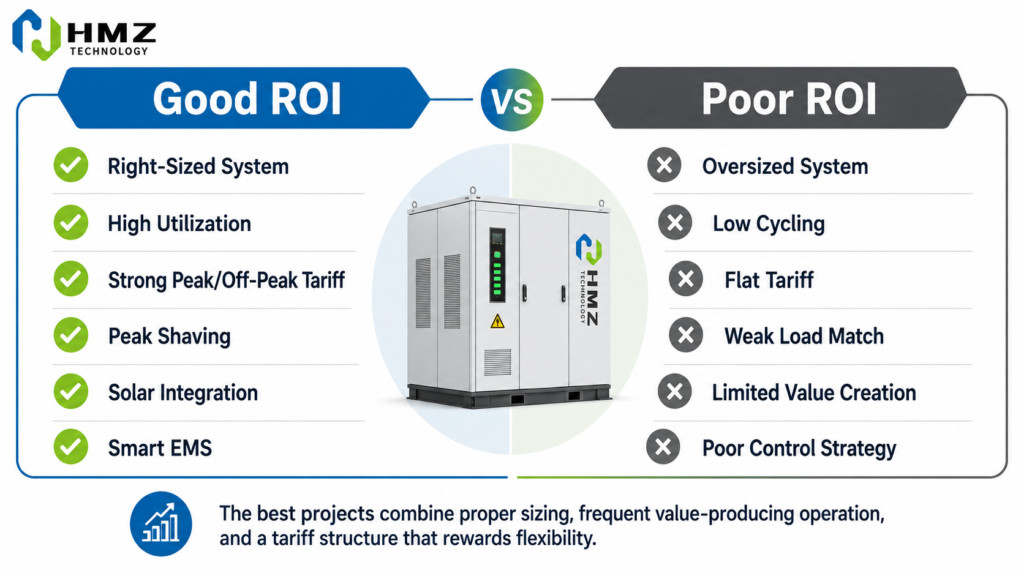
What Can Make Battery Storage ROI Better?
Several factors can strengthen the business case.
Large Peak Demand Charges
Peak shaving becomes more valuable.
Strong Peak / Off-Peak Price Difference
Energy shifting becomes more valuable.
High Solar Export Loss
Storing solar instead of exporting it can create more value.
Consistent Daily Cycling Opportunities
The installed battery is better utilized.
High Cost of Grid Outages
Backup capability creates additional value.
High Generator Fuel Cost
Battery storage can reduce generator operating expenses.
The strongest projects often combine more than one value stream.
For example:
Peak Shaving + Solar Self-Consumption + Backup Power
can create a stronger business case than relying on only one application.
What Can Make ROI Worse?
Battery economics may become weaker when:
- Electricity prices are flat
- Demand charges are low
- The battery rarely cycles
- Solar surplus is limited
- The battery is significantly oversized
- System efficiency is poor
- Project cost is too high
- The EMS strategy does not match the tariff
These factors should be identified before equipment is purchased.
How HMZ Technology Approaches Commercial Storage Economics
At HMZ Technology, we believe battery storage should be selected around the actual operating requirement.
A project should first understand:
- Load profile
- Electricity tariff
- Solar generation
- Peak demand
- Backup requirements
- Expected battery usage
Then the storage configuration can be matched to the application.
For commercial and industrial projects, HMZ provides solutions including:
50kW / 112kWh All-in-One C&I Energy Storage System
Suitable for smaller commercial facilities, distributed solar-plus-storage projects and light industrial applications.
125kW / 241kWh All-in-One C&I Energy Storage System
Suitable for larger commercial and industrial energy-management applications.
125kW / 261kWh Liquid-Cooled C&I Energy Storage System
Suitable for projects requiring higher energy density, more precise thermal control and more demanding operating conditions.
The objective should not be simply selecting the largest battery.
The objective is selecting the configuration that fits the customer’s energy use and creates sustainable value.
ROI Should Be Based on Real Data, Not a Fixed Payback Promise
It is common to hear statements such as:
“This battery pays back in three years.”
But without knowing the site’s electricity tariff, load profile and operating strategy, that statement has very little meaning.
The same battery can create excellent economics at one facility and poor economics at another.
A reliable analysis should therefore answer:
- How often will the battery operate?
- How much energy will be shifted?
- How much peak demand will be reduced?
- How much solar energy will be stored?
- What is the value of backup power?
- What does each cycle actually save?
These questions are more important than a generic ROI percentage.
Conclusion
The ROI of a commercial battery energy storage system is not determined by battery price alone.
It is created by the interaction between:
Electricity tariff
Load profile
Battery sizing
Solar generation
Operating strategy
System utilization
A well-designed battery system should therefore start with energy data before equipment selection.
For businesses evaluating C&I storage, the most important question is not simply:
“How much does the battery cost?”
It is:
“How much value can this battery create every year under our actual operating conditions?”
That is the foundation of a realistic commercial energy storage investment decision.
Planning a C&I Battery Storage Project?
If you are evaluating a commercial battery storage project, useful information to prepare includes:
- Monthly electricity bills
- Hourly or 15-minute load data
- Peak demand
- Electricity tariff
- Existing solar PV capacity
- Backup requirements
- Generator information
- Available installation space
HMZ Technology can use these project inputs to help determine an appropriate solar + battery storage configuration for the application.
Frequently Asked Questions
What is a good ROI for commercial battery storage?
There is no universal ROI target. The result depends on electricity tariffs, demand charges, battery utilization, project cost and operating strategy. Projects should be evaluated using site-specific data rather than a fixed industry payback claim.
How is battery storage payback calculated?
A simple payback calculation divides the total project investment by the annual net financial benefit generated by the battery system.
What creates the most value in a C&I battery system?
Common value streams include peak shaving, time-of-use optimization, solar self-consumption, backup power and reduced generator operation.
Does a larger battery always create better ROI?
No. An oversized battery may have low utilization and increase investment cost without creating proportional savings.
How does solar improve battery storage ROI?
Solar can charge the battery with excess renewable electricity that would otherwise be exported or curtailed. The stored energy can later be used when grid electricity is more expensive.
Why is the EMS important for battery economics?
The EMS determines when the battery charges and discharges. A good strategy helps the battery operate during periods when each cycle creates the most value.
Build Your Intelligent Energy Future with HMZ
HMZ Technology helps businesses move beyond traditional solar systems by combining solar PV, battery storage and intelligent microgrid control.
Our integrated energy solutions are designed for industrial facilities, commercial buildings and remote energy applications requiring reliable, efficient and flexible power.
Contact HMZ Technology today to explore your next solar storage or microgrid project.
Related Insights from HMZ Technology
Industrial energy management is rapidly evolving. While rooftop solar PV provides an effective way for factories to generate clean electricity, many businesses are now looking beyond solar generation and exploring integrated solutions such as energy storage, intelligent energy management, and microgrid systems.
To better understand how commercial and industrial users can optimize their energy strategy, explore more insights from HMZ Technology’s renewable energy knowledge center, including solar PV solutions, C&I energy storage systems, and practical applications for industrial energy management.