
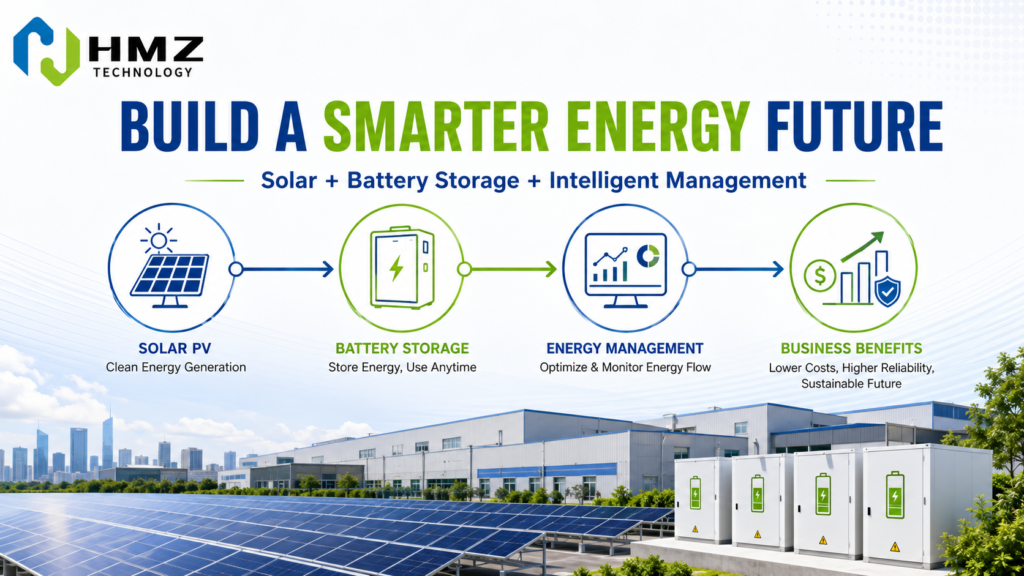
Over the past few years, solar PV has become one of the most practical ways for businesses to reduce electricity costs and increase renewable energy usage.
Many factories, warehouses and commercial buildings have already installed rooftop solar systems.
The idea behind solar is simple:
Generate clean electricity on-site and reduce dependence on the grid.
However, after operating solar systems for some time, many businesses discover another challenge:
Solar power is available when the sun is shining, but businesses do not always need electricity at the same time.
A factory may generate a large amount of solar energy during the daytime, but production may continue after sunset.
A commercial building may have higher electricity demand in the evening when solar generation has already stopped.
This is where solar + battery storage becomes increasingly important.
By combining solar PV with battery energy storage systems (BESS), businesses can store renewable energy, improve energy flexibility and gain better control over electricity usage.
At HMZ Technology, we see this trend clearly: companies are moving from simply generating electricity toward managing energy more intelligently.
Why Solar PV Alone Cannot Solve Every Energy Challenge
Solar PV has already changed the way businesses think about energy.
It allows companies to generate clean electricity, reduce grid electricity consumption and make better use of available rooftop space.
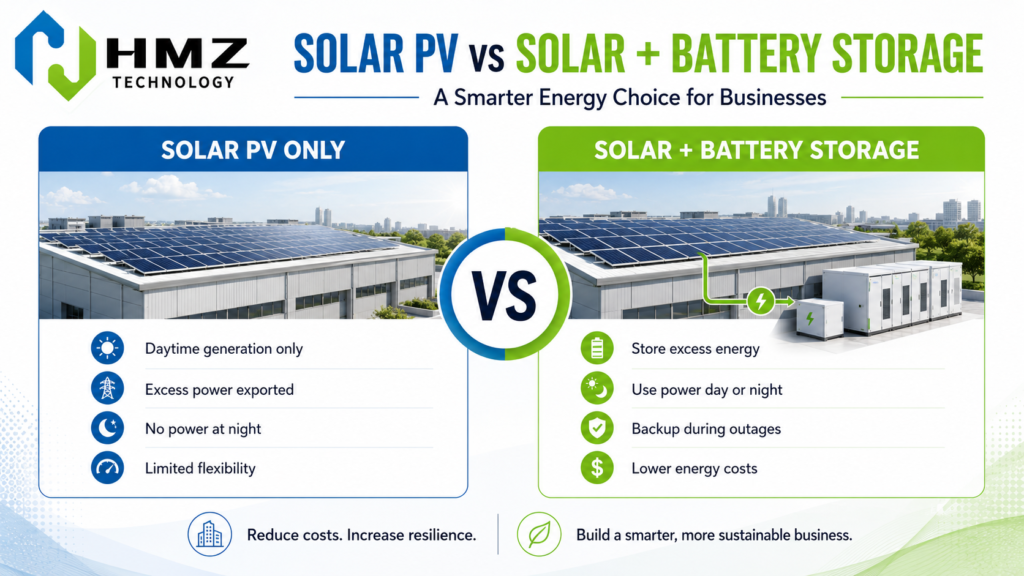
However, a solar-only system also has limitations.
Solar Generation Does Not Always Match Energy Demand
The biggest challenge is timing.
Solar panels usually generate the highest amount of electricity during daylight hours.
However, many businesses consume electricity according to their own operating schedules.
For example:
- Manufacturing facilities may operate early in the morning or late into the evening.
- Commercial buildings may have higher electricity demand after working hours.
- Industrial facilities may require continuous power supply.
This creates a simple but important problem:
Energy generation and energy consumption do not always happen at the same time.
Battery storage helps solve this issue by storing excess solar energy and making it available when businesses actually need it.
Excess Solar Energy Is Not Always Fully Utilized
Another challenge is what happens when solar production is higher than current electricity demand.
For example:
A factory may generate more solar power than it can consume during weekends or low-production periods.
Without battery storage, this excess electricity may:
- Be sent back to the grid
- Have limited economic value
- Be restricted by local grid conditions
A battery energy storage system allows businesses to capture this unused renewable energy and use it later.
This means companies can gain more value from their existing solar investment.
Solar Alone Does Not Provide Complete Energy Reliability
For many businesses, electricity reliability is just as important as electricity cost reduction.
A short power interruption can affect:
- Production schedules
- Manufacturing processes
- Equipment operation
- Business continuity
Solar panels alone cannot provide continuous electricity when sunlight is unavailable.
By combining solar PV with battery storage, businesses can create a more flexible energy system that supports both daily operation and unexpected power conditions.
How Solar + Battery Storage Creates a Better Energy System
The difference between traditional solar and solar-plus-storage is not only adding batteries.
It represents a change in how businesses manage energy.
A solar PV system mainly answers:
How much electricity can we generate?
A solar + battery storage system answers:
How can we generate, store and use electricity more efficiently?
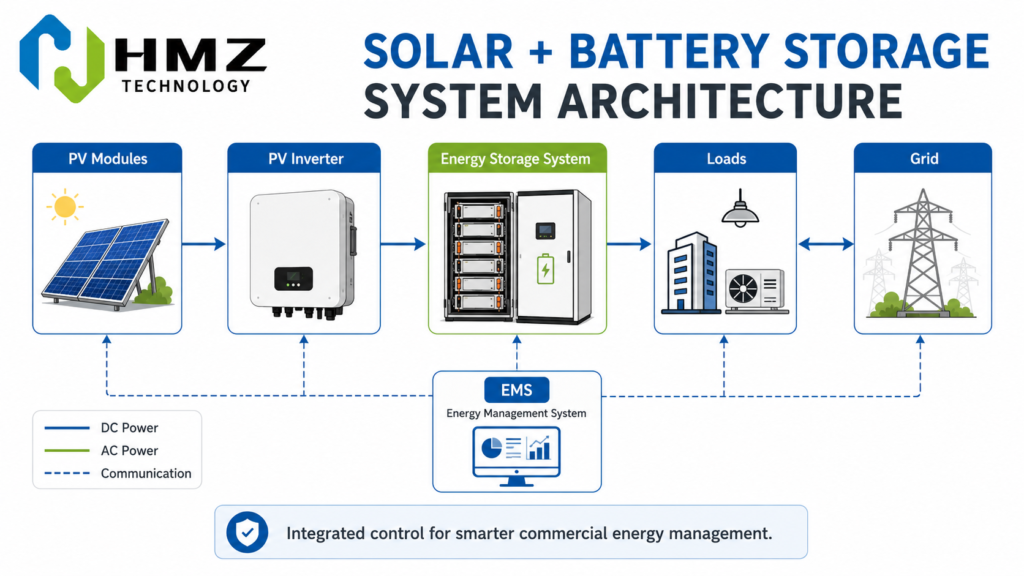
A complete solution normally includes three key parts:
Solar PV System
Solar panels generate renewable electricity from sunlight.
The electricity can be:
- Used directly by the business
- Stored in batteries
- Managed through an energy control system
Solar PV remains the foundation of the entire solution.
Battery Energy Storage System (BESS)
The battery system stores electricity when energy generation is higher than consumption.
Later, stored energy can be used during:
- Evening hours
- Peak electricity periods
- Grid interruptions
This improves renewable energy utilization and reduces dependence on external electricity supply.
Energy Management System (EMS)
The EMS acts as the control center of the system.
It monitors:
- Solar generation
- Battery status
- Electricity consumption
- Grid conditions
Based on real-time data, the system can optimize charging and discharging strategies.
Why More Commercial and Industrial Customers Are Choosing Solar + Storage
Different businesses have different reasons for adopting battery storage.
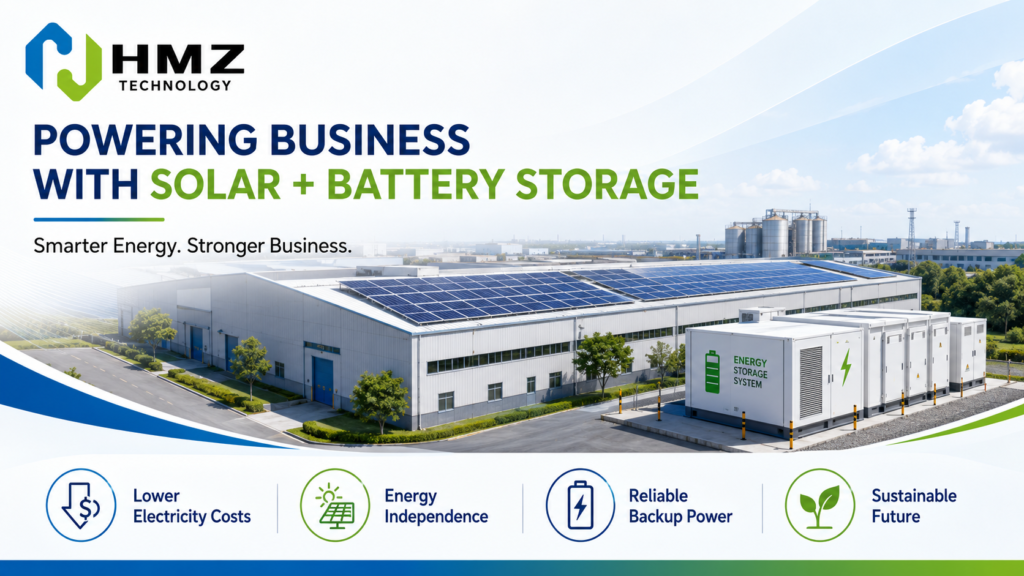
For some companies, the priority is reducing electricity costs.
For others, it is improving energy reliability.
For many industrial users, both factors are equally important.
Common applications include:
Manufacturing Facilities
Factories usually have:
- High electricity demand
- Long operating hours
- Large rooftop areas
- Strict power reliability requirements
Solar + battery storage can help reduce energy pressure while improving operational flexibility.
Industrial Parks
Industrial parks often include multiple energy users with different electricity patterns.
A combined solar and storage system can support:
- Renewable energy integration
- Energy management
- Future energy expansion
Commercial Buildings
Office buildings, hotels and commercial facilities can use battery storage to optimize electricity consumption and improve sustainability performance.
Weak Grid Areas
In regions where grid reliability is challenging, solar + battery storage can provide a more stable energy solution.
Solar + Battery Storage Is More Than Just Adding a Battery
A common misunderstanding is that energy storage simply means adding a battery after installing solar panels.
In reality, a successful solar-plus-storage project requires system-level planning.
Important factors include:
- Electricity consumption patterns
- Solar generation capacity
- Battery capacity
- Backup requirements
- Future expansion plans
The goal is not to install the largest battery.
The goal is to design a system that matches the real energy needs of the business.
How HMZ Technology Supports Solar + Battery Storage Projects
At HMZ Technology, we provide integrated renewable energy solutions for commercial and industrial applications.
Our approach focuses on combining:
- Solar PV systems
- Battery energy storage systems
- Hybrid power solutions
- Intelligent energy management
For different project requirements, HMZ provides C&I energy storage solutions including:
50kW/112kWh All-in-One C&I Energy Storage System
Designed for small and medium commercial applications requiring flexible deployment.
125kW/241kWh All-in-One C&I Energy Storage System
Suitable for larger commercial and industrial energy applications.
125kW/261kWh Liquid-Cooled C&I Energy Storage System
Designed for projects requiring higher energy density and advanced thermal management.
HMZ Technology helps customers move from simple electricity generation toward smarter energy management.
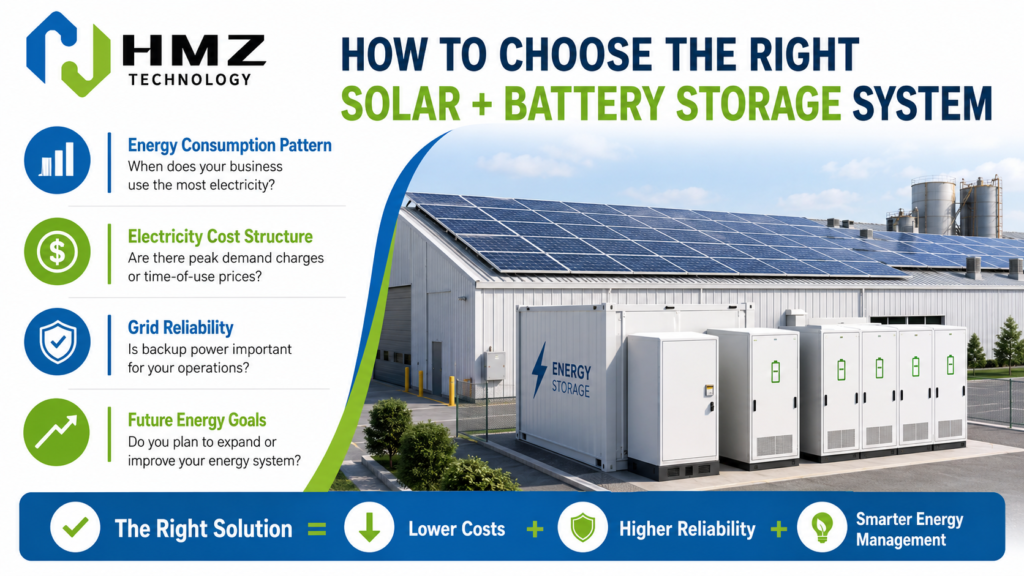
How Businesses Should Choose the Right Solar + Battery Storage System
There is no single solution suitable for every project.
Before selecting a system, businesses should consider:
Electricity Consumption Pattern
When does the business consume the most electricity?
Solar Generation Potential
How much renewable energy can the site generate?
Backup Power Requirements
Which loads need to continue operating during power interruptions?
Future Expansion
Will electricity demand increase in the coming years?
A well-designed solar battery storage system should always be based on real project conditions.
The Future of Commercial Energy Is Solar Plus Storage
The energy transition is moving beyond simply generating electricity.
Businesses are now focusing on a bigger question:
How can we use energy more efficiently?
Solar PV has become the starting point.
Battery storage is the next step.
Together with intelligent energy management, solar-plus-storage creates a more flexible and resilient energy system.
The future commercial energy model will not simply be:
Solar.
It will be:
Solar + Battery Storage + Intelligent Energy Management.
Conclusion
Solar PV has already helped businesses reduce electricity costs and increase renewable energy usage.
However, solar alone cannot solve every energy challenge.
By combining solar generation with battery storage, businesses can improve renewable energy utilization, reduce electricity costs and build more reliable energy systems.
At HMZ Technology, we help businesses develop customized solar + battery storage solutions based on real application requirements.
FAQ
Why is solar alone not enough for businesses?
Solar generation depends on sunlight availability and may not match electricity demand. Battery storage allows businesses to store and use renewable energy when needed.
What are the benefits of solar + battery storage?
Solar plus battery storage improves renewable energy utilization, reduces electricity costs and increases energy reliability.
What is a C&I energy storage system?
A C&I energy storage system is a battery-based solution designed for commercial and industrial applications such as factories, warehouses and industrial facilities.
Can battery storage work with existing solar systems?
Yes. Battery storage can often be integrated with existing solar PV systems depending on system design and equipment compatibility.
Why are businesses investing in energy storage?
Businesses are investing in energy storage to improve energy control, reduce operating costs and increase resilience against grid challenges.
Related Insights from HMZ Technology
Industrial energy management is rapidly evolving. While rooftop solar PV provides an effective way for factories to generate clean electricity, many businesses are now looking beyond solar generation and exploring integrated solutions such as energy storage, intelligent energy management, and microgrid systems.
To better understand how commercial and industrial users can optimize their energy strategy, explore more insights from HMZ Technology’s renewable energy knowledge center, including solar PV solutions, C&I energy storage systems, and practical applications for industrial energy management.