
Quick Answer
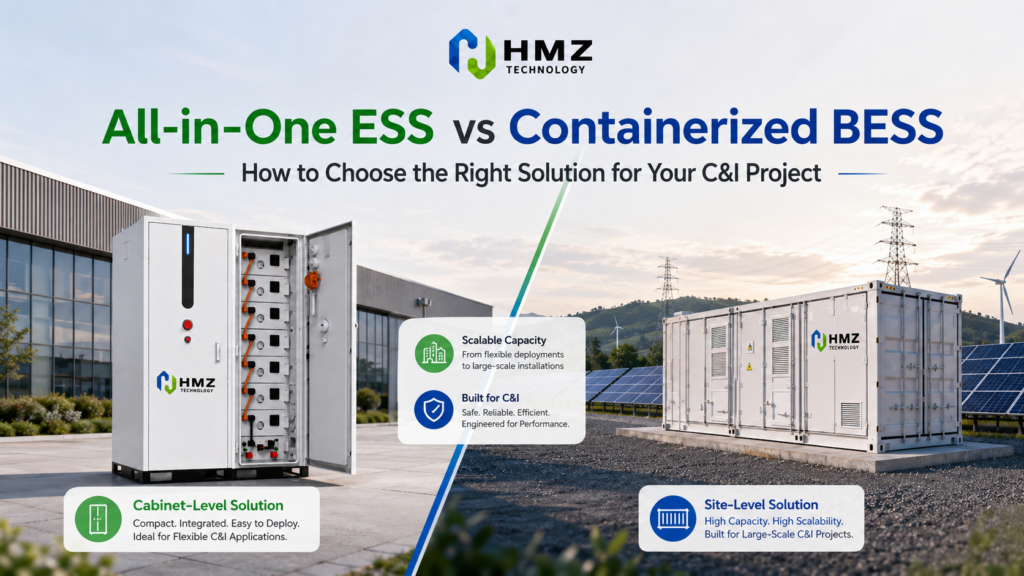
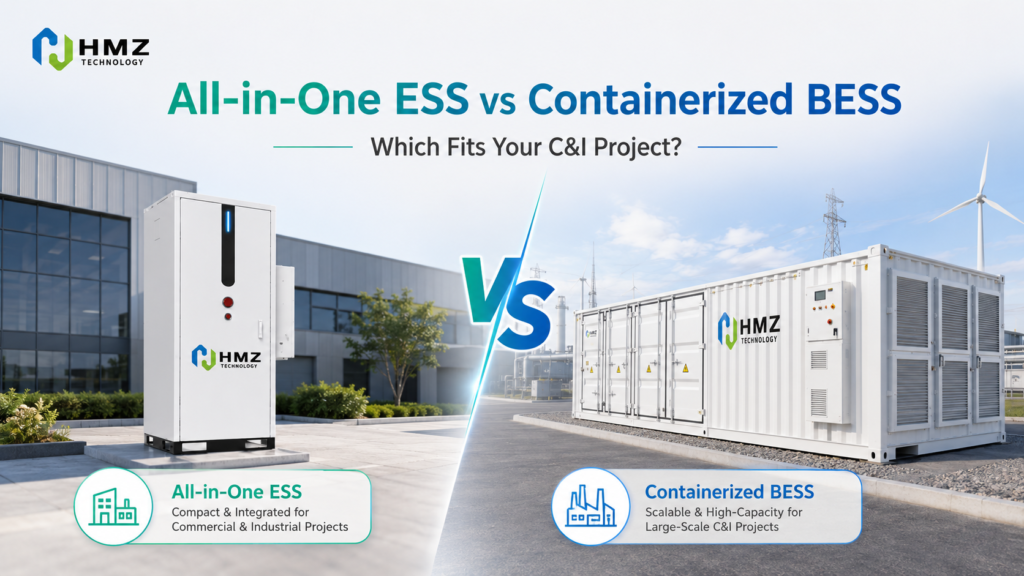
For most small and medium commercial and industrial energy storage projects, an All-in-One ESS is usually the more practical choice. It is compact, easier to install, faster to deploy and suitable for commercial buildings, small factories, farms, PV + storage projects, backup power and small-scale microgrids.
A Containerized BESS is more suitable for larger projects that require MWh-level capacity, large installation space, stronger site engineering, professional O&M and long-term expansion. It is commonly used in large industrial parks, utility-scale energy storage, renewable energy plants and grid-support projects.
In simple terms:
Choose an All-in-One ESS when your project needs compact design, faster deployment and practical C&I energy storage.
Choose a Containerized BESS when your project needs large-scale capacity, grid-level operation and future MWh-level expansion.
If you are still deciding between air cooling and liquid cooling before choosing the system form, you can first read our Air-Cooled vs Liquid-Cooled C&I Energy Storage Systems: How to Choose guide.
Why This Question Matters for C&I Buyers
Many commercial and industrial buyers know they need battery energy storage.
But they are not always sure what type of system is suitable.
Some suppliers recommend an All-in-One ESS.
Some recommend a containerized battery energy storage system.
Some customers think containerized BESS must be better because it looks bigger.
Others choose a small cabinet because it looks cheaper.
In real projects, the better choice is not decided by appearance.
It depends on:
- Project capacity
- Load size
- Backup time
- Installation space
- Site conditions
- Grid connection requirements
- PV capacity
- Diesel generator integration
- Budget
- Maintenance capability
- Future expansion plan
A small commercial building does not need a large containerized BESS.
A large industrial park may outgrow a small cabinet system quickly.
This article explains how to choose between All-in-One ESS and Containerized BESS from a real C&I project perspective.
What Is an All-in-One ESS?
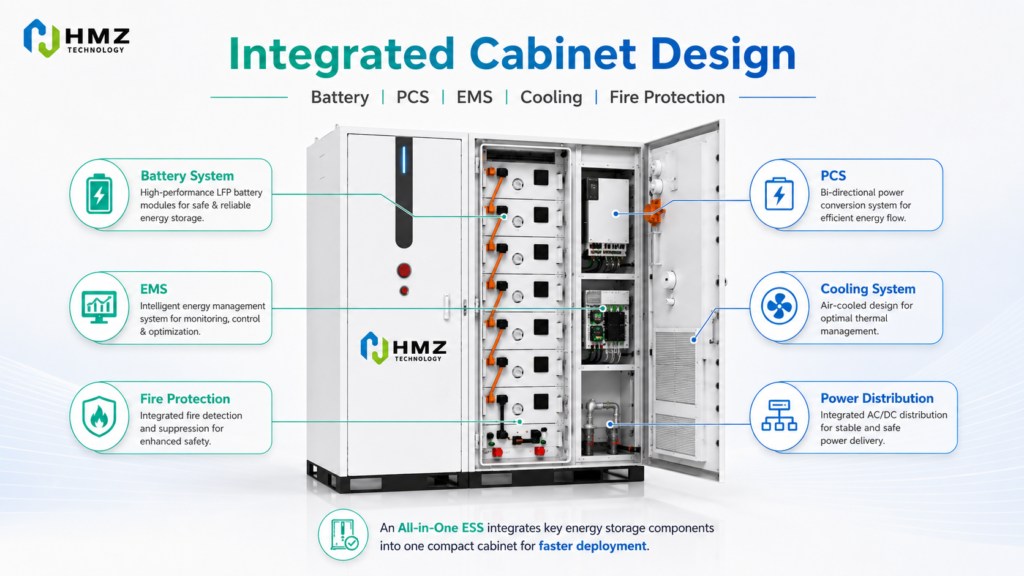
An All-in-One ESS is a compact energy storage system that integrates key components into one cabinet.
A typical All-in-One C&I ESS may include:
- LFP battery modules
- PCS
- EMS
- BMS
- Power distribution
- Cooling system
- Fire protection
- Monitoring and communication system
The biggest advantage is integration.
Instead of designing and assembling multiple external systems on site, customers receive a more compact and pre-integrated solution. This reduces installation complexity and makes the system easier to deploy for small and medium C&I projects.
HMZ provides a 50kW/112kWh & 125kW/241kWh All-in-One C&I Energy Storage System for commercial and light industrial applications. It integrates LFP battery modules, PCS, EMS, power distribution, intelligent air cooling and fire protection into one cabinet.
This type of system is especially suitable for users who want practical energy storage without building a large-scale energy station.
What Is a Containerized BESS?
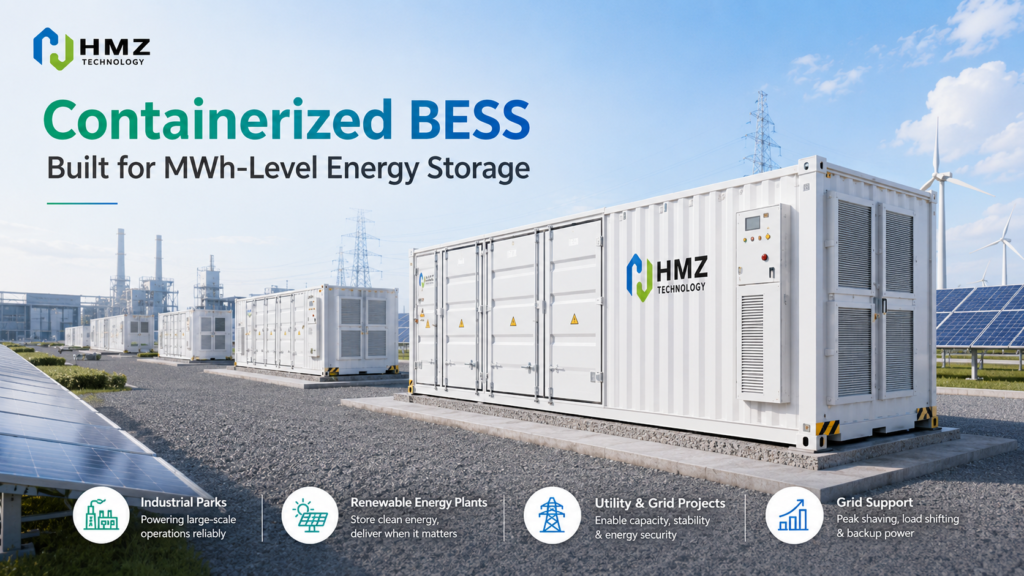
A Containerized BESS is a battery energy storage system installed inside a standard container or container-like enclosure.
It usually includes battery racks, PCS, HVAC or liquid cooling, fire protection, EMS, power distribution and auxiliary systems. Depending on the design, a containerized BESS may be built in 10ft, 20ft or 40ft container formats.
Containerized BESS is usually designed for larger projects.
Typical applications include:
- Utility-scale energy storage
- Large industrial parks
- Large PV or wind power plants
- Grid support projects
- MWh-level commercial and industrial storage
- Large microgrids
- Renewable energy smoothing
- Large-scale backup power systems
A containerized system is powerful, scalable and suitable for large projects. But it also requires more site planning, installation space, engineering design, transportation planning, grid connection work and professional operation.
For small C&I users, a containerized BESS may be oversized.
All-in-One ESS vs Containerized BESS: Key Differences
| Comparison Item | All-in-One ESS | Containerized BESS |
|---|---|---|
| Typical Project Scale | Small to medium C&I projects | Medium to large C&I or utility-scale projects |
| Capacity Range | Usually cabinet-level, hundreds of kWh | Usually MWh-level or scalable to MWh-level |
| Installation Space | Smaller footprint | Larger site area required |
| Deployment Speed | Faster and simpler | Requires more site engineering |
| System Integration | Highly integrated cabinet | Container-level system integration |
| Transportation | Easier for smaller projects | Requires container logistics |
| O&M Requirement | Easier for local service teams | Requires more professional O&M |
| Expansion | Can be modular, but limited by cabinet scale | Stronger expansion for large projects |
| Best Applications | Commercial buildings, farms, small factories, small microgrids | Industrial parks, large PV plants, grid support, utility projects |
| Typical Buyer | C&I users, distributors, EPCs, small project owners | Utilities, large EPCs, industrial park operators, project developers |
When Is an All-in-One ESS the Better Choice?
An All-in-One ESS is usually better when the project is small or medium-sized, the installation space is limited and the customer needs a fast, practical and cost-effective solution.
For example, a commercial building may need peak shaving and backup power. A farm may need PV + storage to support pumps or cold storage. A small factory may need battery storage to reduce electricity costs and protect key equipment during outages.
In these projects, the customer may not need a large container.
They need a system that is:
- Compact
- Integrated
- Easy to deploy
- Easier to maintain
- Suitable for moderate capacity
- Compatible with PV + storage
- Practical for commercial and light industrial use
All-in-One ESS is a strong fit for:
- Commercial buildings
- Small factories
- Farms
- Light industrial facilities
- Small business parks
- Distributed PV + storage projects
- Backup power for commercial loads
- Small-scale industrial microgrids
- Areas with high electricity tariffs or unstable grids
For these scenarios, HMZ’s 50kW/112kWh & 125kW/241kWh All-in-One C&I Energy Storage System provides a practical cabinet-level solution for peak shaving, load shifting, PV + storage integration and backup power.
When Is a Containerized BESS the Better Choice?
A containerized BESS is usually better when the project requires larger energy capacity, stronger scalability and site-level energy infrastructure.
For example, a large industrial park may need MWh-level energy storage to support multiple factories. A renewable energy project may need battery storage to smooth solar or wind output. A grid-support project may require large energy capacity, longer discharge duration and stronger control systems.
In these projects, cabinet-level systems may not be enough.
Containerized BESS is more suitable when the project needs:
- MWh-level capacity
- Large site space
- Utility-scale or industrial-scale operation
- Centralized energy management
- Stronger expansion capability
- Higher voltage system design
- Professional installation and O&M
- Integration with large PV, wind or grid systems
A containerized BESS is not simply a bigger cabinet. It is a site-level energy storage asset.
Project Scale: The First Decision Filter
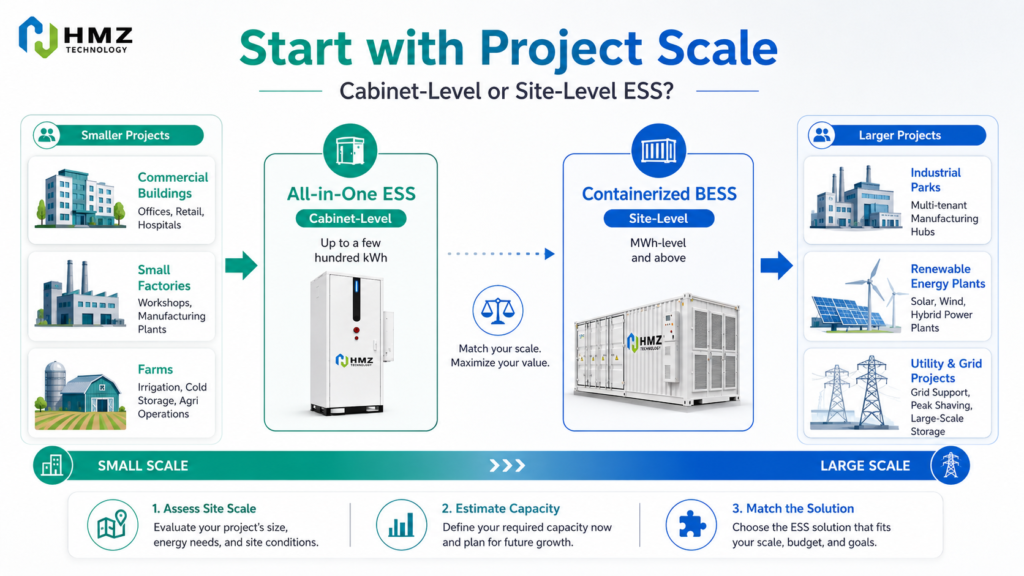
Before comparing system appearance or price, buyers should first ask:
How large is the project?
If the required capacity is around hundreds of kWh, an All-in-One ESS may be more suitable.
If the project requires several MWh or future expansion to utility scale, containerized BESS may be more appropriate.
Practical scale reference
| Project Type | Recommended Direction |
|---|---|
| Small commercial building | All-in-One ESS |
| Small factory | All-in-One ESS |
| Farm or rural business | All-in-One ESS |
| Small PV + storage project | All-in-One ESS |
| Medium commercial complex | All-in-One ESS or multiple cabinets |
| Large industrial park | Containerized BESS or multiple liquid-cooled systems |
| Utility-scale project | Containerized BESS |
| Large renewable energy plant | Containerized BESS |
For most small and medium C&I projects, choosing a containerized BESS too early may increase cost and complexity.
For large projects, relying only on small cabinets may limit system expansion.
Installation Space and Site Conditions
Space is another important factor.
An All-in-One ESS has a compact footprint and can often be placed near commercial buildings, small factories, PV systems or load centers. It is easier to fit into limited project sites.
A containerized BESS requires more site planning. The project may need:
- Sufficient ground space
- Foundation construction
- Access road for container transport
- Crane or lifting equipment
- Fire safety distance
- Grid connection planning
- Site drainage and ventilation consideration
- Professional commissioning work
For a small commercial user, this may be too much.
For a large industrial or utility project, this is normal project infrastructure.
The right system form should match the site conditions.
Deployment Speed and Project Complexity
All-in-One ESS usually supports faster deployment because the main components are already integrated into the cabinet.
This can help reduce:
- On-site wiring complexity
- System matching risk
- Installation time
- Commissioning difficulty
- Coordination between different equipment suppliers
Containerized BESS usually requires more engineering work. It may involve site-level electrical design, transformer matching, grid interconnection, fire safety review, foundation construction and more professional commissioning.
For urgent C&I projects, such as a factory that needs backup power quickly or a commercial building that wants to reduce peak tariff costs, an All-in-One ESS may be more practical.
For large infrastructure projects, the longer engineering process of containerized BESS is acceptable because the system scale is larger.
Cooling Method: Cabinet Design vs Container Design
Cooling is important in both All-in-One ESS and Containerized BESS.
An All-in-One ESS may use air cooling or liquid cooling depending on the capacity and application. Air-cooled cabinets are often used for standard C&I applications, while liquid-cooled cabinets are suitable for higher energy density, higher cycling frequency and more demanding sites.
HMZ provides both directions:
- 50kW/112kWh & 125kW/241kWh air-cooled All-in-One C&I ESS
- 125kW/261kWh liquid-cooled C&I ESS with built-in PCS
Containerized BESS may also use air cooling or liquid cooling depending on system scale, energy density and project requirements.
If you are not sure which cooling method is better for your project, the cooling decision should be made together with project scale, ambient temperature and cycling frequency.
This is why system form and cooling method should not be separated.
A small air-cooled cabinet, a liquid-cooled cabinet and a containerized BESS may all be correct in different projects.
Cost: Do Not Compare Only Price per kWh
Many buyers compare All-in-One ESS and Containerized BESS only by price per kWh.
This is not enough.
A containerized system may look attractive for large projects because it can scale efficiently. But for small C&I projects, the extra site work, logistics, installation and grid connection cost may reduce the advantage.
An All-in-One ESS may have a higher cabinet-level unit cost in some cases, but it can reduce project complexity and save installation time.
A better cost comparison should include:
- Equipment cost
- Transportation cost
- Installation cost
- Foundation and site preparation
- Commissioning cost
- O&M cost
- Expansion plan
- Downtime risk
- Project schedule
- Grid connection requirement
The cheapest system on paper is not always the lowest-cost system in real operation.
Expansion: How Much Growth Do You Need?
Expansion is one of the strongest advantages of containerized BESS.
If a project is planned to grow from hundreds of kWh to multiple MWh, containerized BESS may be a better long-term direction.
But many C&I projects do not need that level of expansion.
A commercial building, small factory or farm may only need a stable and practical cabinet-level system. In these cases, an All-in-One ESS is often easier to purchase, install and operate.
Expansion decision logic
| Expansion Requirement | Better Option |
|---|---|
| No major future expansion | All-in-One ESS |
| Small capacity increase | Multiple All-in-One ESS cabinets |
| Future MWh-level expansion | Containerized BESS |
| Multi-site distributed projects | All-in-One ESS |
| Centralized large energy station | Containerized BESS |
The question is not whether expansion is possible.
The question is how much expansion the project really needs.
Application Comparison
Commercial Buildings
Commercial buildings usually need peak shaving, backup power and PV self-consumption. Space may be limited, and project owners usually prefer simpler installation.
Recommended direction: All-in-One ESS
Small Factories
Small factories need energy cost control and backup power for key equipment. If the load is moderate, cabinet-level ESS is often enough.
Recommended direction: All-in-One ESS
Farms and Rural Businesses
Farms may need storage for pumps, cold storage, lighting and weak-grid backup. Smaller PV + storage projects usually do not need containers.
Recommended direction: All-in-One ESS
Industrial Parks
Industrial parks may have multiple users, larger loads and stronger expansion needs. For small park-level applications, liquid-cooled cabinets may be suitable. For large MWh-level projects, containerized BESS may be better.
Recommended direction: Liquid-cooled cabinet ESS or Containerized BESS depending on scale
Utility-Scale Projects
Utility-scale projects require large capacity, grid support, centralized control and professional O&M.
Recommended direction: Containerized BESS
Recommended HMZ Selection Logic
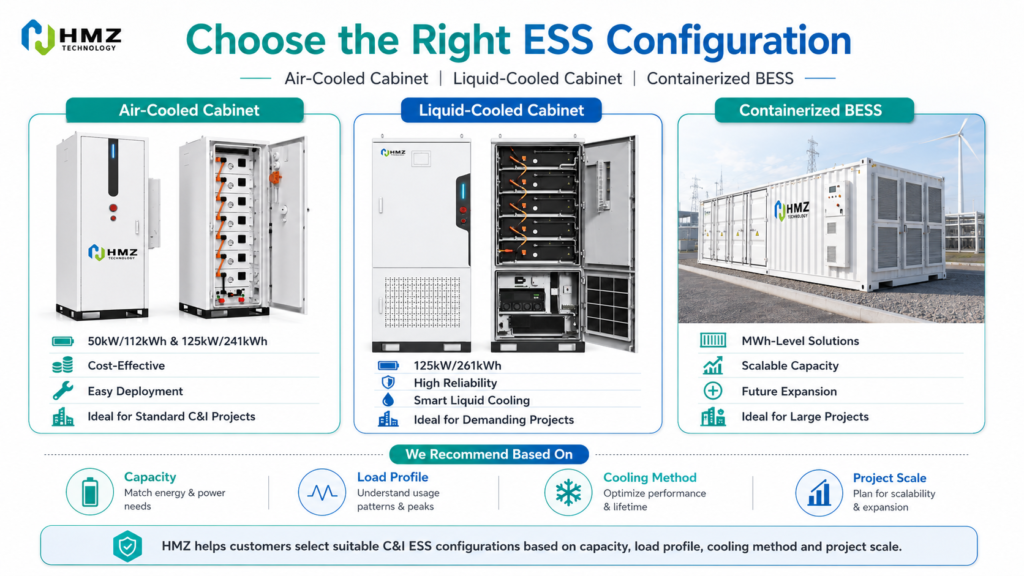
For commercial buildings, small factories, farms, light industrial facilities and small PV + storage projects, HMZ’s 50kW/112kWh & 125kW/241kWh All-in-One C&I Energy Storage System is a practical choice. It offers integrated design, intelligent air cooling, LFP battery technology, PCS/EMS integration and easier deployment for standard C&I applications.
For industrial parks, high-temperature sites, data centers, hospitals, demand response and frequent cycling applications, HMZ’s 125kW/261kWh Liquid Cooled C&I Energy Storage System with Built-in PCS provides stronger temperature control, higher system integration and better suitability for demanding C&I energy storage projects.
For very large MWh-level projects, a containerized BESS may be evaluated based on project size, site conditions, grid connection and long-term expansion plan.
If your project is still in the early design stage, you can contact HMZ Technology with your load profile, PV capacity, backup time, grid condition and available installation space. Our team can help recommend whether an All-in-One ESS, liquid-cooled cabinet ESS or containerized BESS is more suitable.
Internal Reading Guide
This article focuses on system form: All-in-One ESS vs Containerized BESS.
If you are comparing thermal management methods, read our Air-Cooled vs Liquid-Cooled C&I Energy Storage Systems: How to Choose article first.
If you are choosing between air cooling and liquid cooling based on project size, cycling frequency and ambient temperature, read our Air-Cooled vs Liquid-Cooled C&I ESS: A Project-Based Selection Guide.
If your next question is how much capacity your project needs, our upcoming guide How to Size a C&I Energy Storage System will explain how to prepare load data, PV capacity, backup time and operating mode before requesting a quotation.
Buyer Checklist: All-in-One ESS or Containerized BESS?
Before requesting a quotation, prepare the following information:
- Project location
- Application scenario
- Daily electricity consumption
- Peak load power
- Required backup time
- Existing or planned solar PV capacity
- Diesel generator information if available
- Grid condition
- Available installation space
- Expected daily cycling frequency
- Required expansion capacity
- Project budget range
- On-grid, off-grid or hybrid operation mode
- Local installation and O&M capability
With this information, suppliers can recommend a system based on real project conditions instead of simply offering a standard cabinet or container.
FAQ
1. Is an All-in-One ESS suitable for commercial buildings?
Yes. All-in-One ESS is often suitable for commercial buildings because it is compact, integrated and easier to install. It can support peak shaving, backup power and PV self-consumption.
2. Is Containerized BESS better than All-in-One ESS?
Not always. Containerized BESS is better for large-scale or MWh-level projects. For small and medium C&I projects, All-in-One ESS is often more practical and cost-effective.
3. Which solution is better for small factories?
Small factories usually benefit more from All-in-One ESS because it offers easier deployment, smaller footprint and enough capacity for peak shaving and backup power.
4. Which solution is better for industrial parks?
It depends on the project size. Small industrial parks may use multiple cabinet ESS systems, while larger industrial parks with MWh-level demand may need containerized BESS.
5. Can All-in-One ESS work with solar PV?
Yes. All-in-One ESS can be used in PV + storage projects to store excess solar energy, improve self-consumption and provide backup power.
6. Can containerized BESS be used for C&I projects?
Yes. Containerized BESS can be used for large C&I projects, especially industrial parks, utility-scale storage, renewable energy plants and grid support applications.
7. Which option is faster to install?
All-in-One ESS is usually faster to install because the system is more compact and integrated. Containerized BESS requires more site planning, foundation work and grid connection design.
8. How do I know which system my project needs?
You should evaluate project capacity, peak load, backup time, PV capacity, site space, cycling frequency, budget and future expansion plan. If the project is small to medium-sized, All-in-One ESS is often suitable. If the project requires MWh-level energy storage, containerized BESS should be considered.
Conclusion
All-in-One ESS and Containerized BESS are not competing solutions for every project.
They serve different project scales.
An All-in-One ESS is usually the better choice for commercial buildings, small factories, farms, light industrial facilities, PV + storage projects and small-scale microgrids. It is compact, integrated, easier to deploy and practical for small to medium C&I users.
A Containerized BESS is better for larger industrial parks, utility-scale storage, renewable energy plants and MWh-level projects that require stronger scalability and professional site-level engineering.
For most C&I buyers, the best decision starts with one question:
Is this a cabinet-level project or a site-level energy storage project?
Once that question is clear, the choice becomes much easier.
HMZ Technology provides air-cooled and liquid-cooled C&I energy storage solutions for commercial and industrial users. Contact HMZ with your project data, and our team will help recommend the most suitable ESS configuration for your application.