
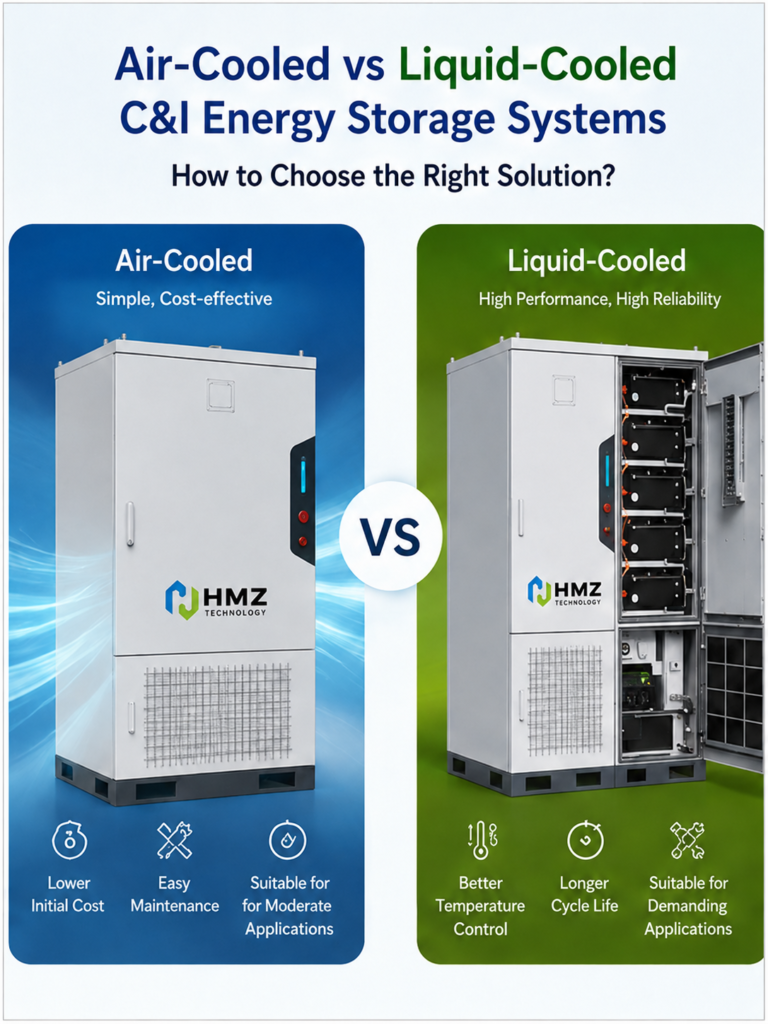
Air-Cooled-vs-Liquid-Cooled-CI-Energy-Storage-System
When investing in commercial and industrial (C&I) energy storage, project developers often obsess over selecting the perfect battery brand. But in reality, the most expensive mistake you can make has nothing to do with the cells themselves.
It’s choosing the wrong cooling method.
On paper, an air-cooled system and a liquid-cooled system might both look great. The capacity fits, the power rating is acceptable, and the initial price is attractive. You sign the contract, install the cabinet, and feel good about your investment.
Then, the real operating environment kicks in.
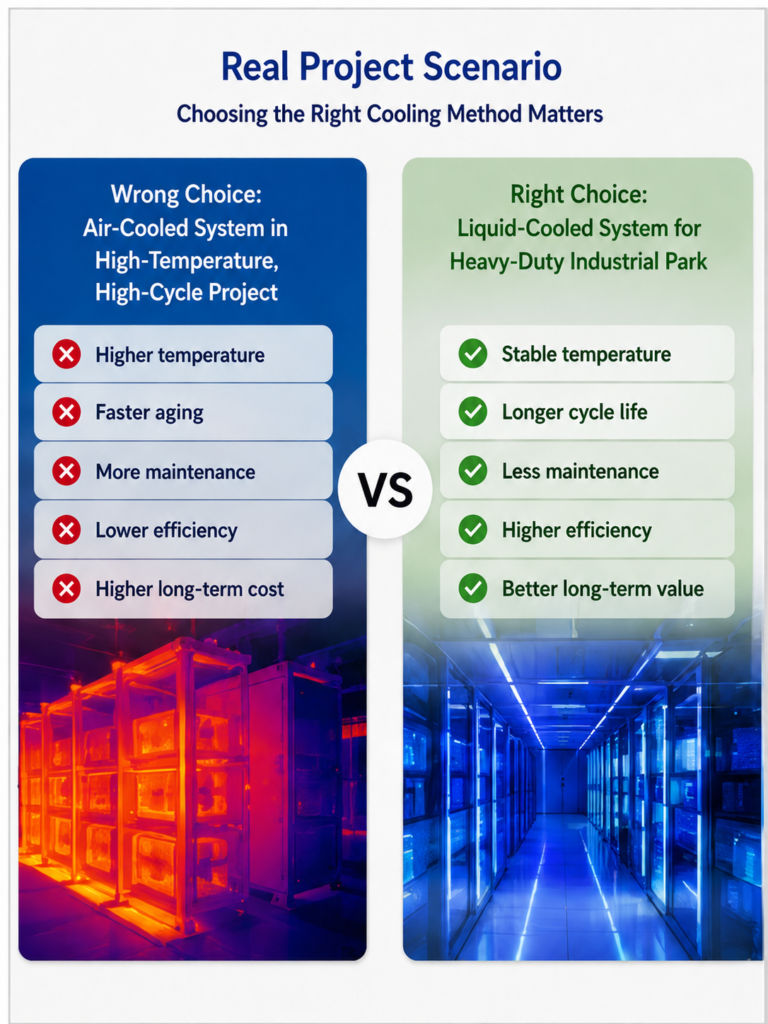
Imagine your system sitting outside in a hot industrial park. The batteries charge and discharge daily, factory loads fluctuate violently, and solar PV output spikes. Soon, the air temperature inside the cabinet creeps up. After just a few months, you might start noticing a chain reaction:
- Temperature gaps between battery cells widen.
- Overall system efficiency drops.
- Cooling fans run 24/7, driving up auxiliary power consumption.
- The battery begins aging significantly faster than the warranty predicted.
You are left asking one painful question: Did we buy the right system for this project?
For factories, commercial buildings, and microgrids, cooling isn’t just a technical spec—it is the lifeline of your system. Here is a practical, jargon-free guide to understanding the difference between air-cooled and liquid-cooled C&I energy storage, and how to choose the right one for your specific needs.
Why Thermal Management is Your System’s Lifeline
A C&I energy storage system (ESS) is a heavy-duty battery solution designed for peak shaving, backup power, solar-plus-storage integration, and microgrid support. Unlike residential batteries that sit quietly in a garage, C&I systems face demanding conditions: continuous cycling, high charging/discharging power, and harsh outdoor climates.
Lithium-ion cells are incredibly sensitive to heat. If a cabinet gets too hot, the batteries degrade prematurely. More importantly, if the temperature difference between individual cells grows too large, the system loses consistency. The weakest, hottest cell will ultimately drag down the performance of the entire pack.
This is why thermal management isn’t just about “cooling the cabinet”—it is about protecting a multi-year financial investment.
Option 1: Air-Cooled C&I Energy Storage
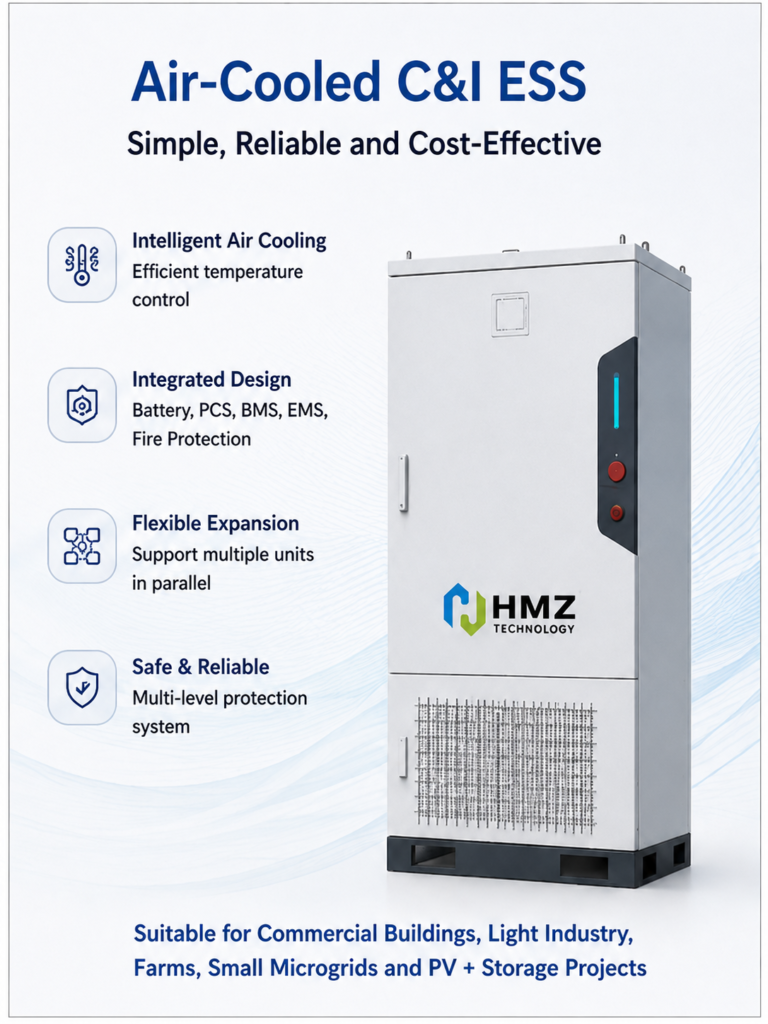
Air-cooled systems rely on forced air circulation to remove heat. Using heavy-duty fans, air ducts, and dedicated HVAC units, cool air is pushed across the battery modules to regulate the internal temperature.
It is a mature, universally understood, and highly cost-effective technology.
The Advantages
- Lower Upfront Cost: Air-cooled systems have a simpler mechanical design, making them more affordable at the point of purchase.
- Straightforward Maintenance: Local technicians easily understand fans, filters, and standard AC units. There are no specialized coolants to manage.
- Fewer Points of Failure: No liquid pipelines or complex sealing gaskets means zero risk of fluid leaks.
The Trade-offs
Air has a relatively low thermal capacity. In exceptionally hot environments or during heavy-duty, high-frequency cycling, air-cooling can struggle to maintain a tight, uniform temperature across a massive bank of batteries.
Best Suited For: Moderate-demand applications like commercial office buildings, light manufacturing facilities, farms, and small PV-plus-storage projects.
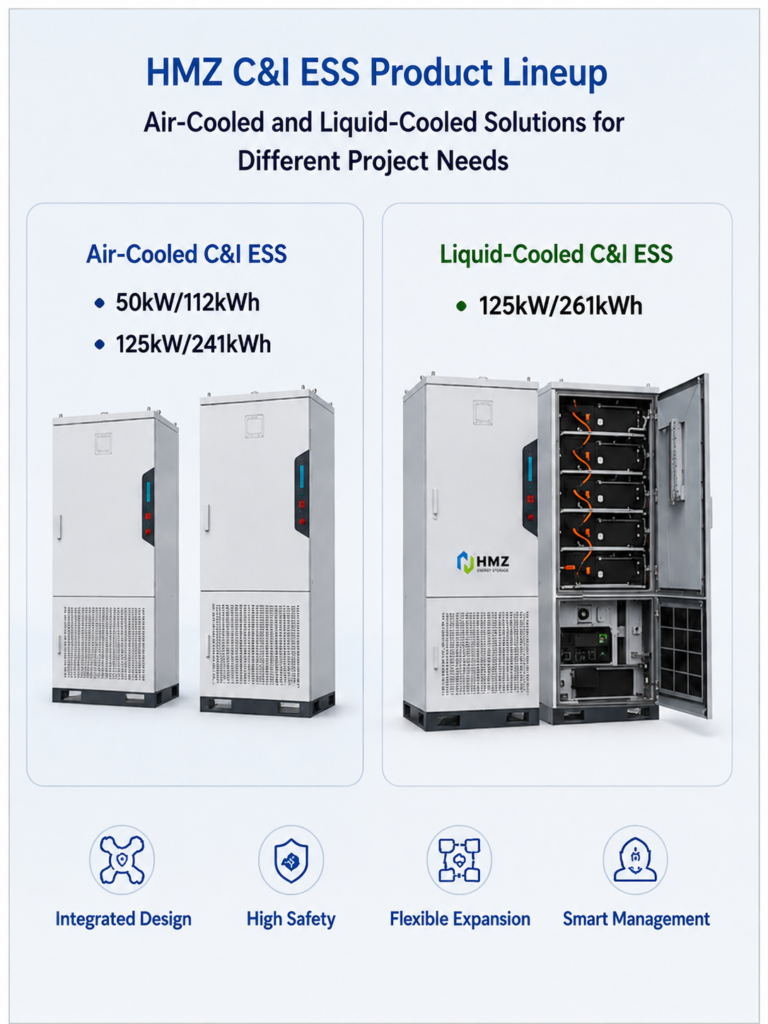
HMZ Solution: The HMZ 50kW/112kWh and 125kW/241kWh intelligent air-cooled systems offer an excellent balance of cost, reliability, and flexible expansion for standard commercial profiles.
Option 2: Liquid-Cooled C&I Energy Storage
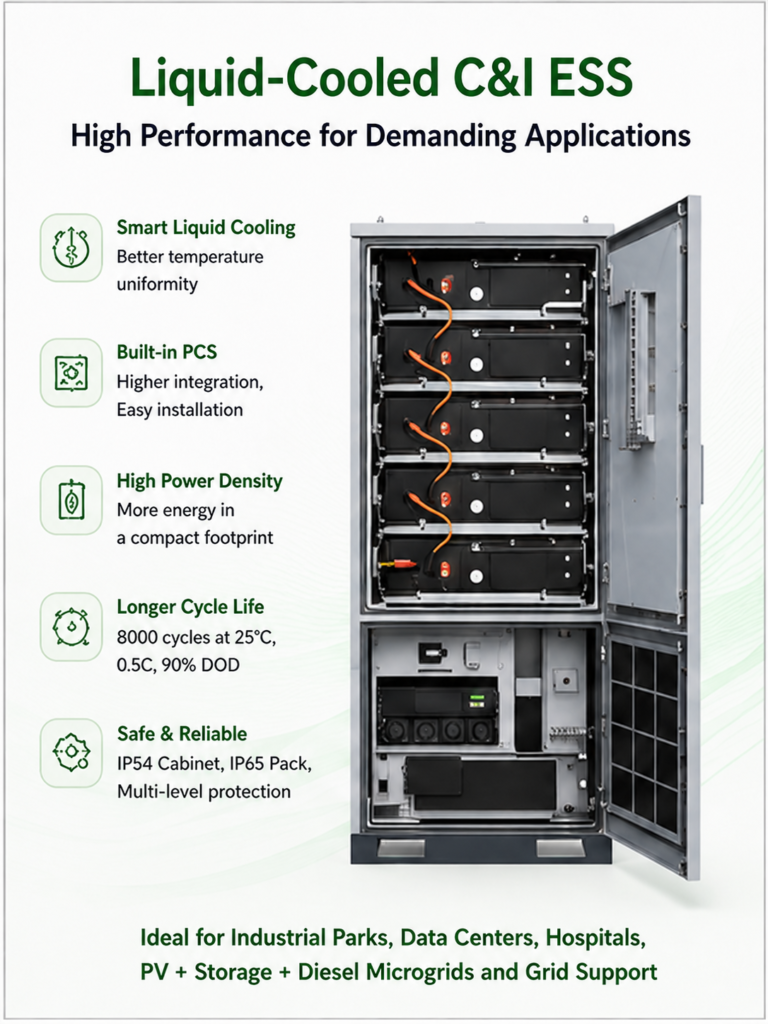
Instead of relying on air currents, liquid-cooled systems pump a dedicated liquid coolant through specialized cold plates embedded directly within the battery modules.
The Advantages
- Superior Temperature Uniformity: Liquid absorbs and transfers heat much faster than air. It keeps the temperature gap between cells exceptionally tight, which preserves battery health over thousands of cycles.
- Maximum Lifespan: Stable, precise temperature control helps the battery safely reach its maximum rated cycle life.
- High Energy Density: Because liquid cooling components take up less physical space than bulky air ducts, these systems pack more power into a smaller cabinet footprint.
- Extreme Resilience: Liquid systems are highly sealed, making them highly resistant to high ambient temperatures, dust, and humidity.
The Trade-offs
The initial purchasing cost is higher due to advanced components like pumps, valves, and chillers. Maintenance also requires technicians who are trained to handle coolant systems.
Best Suited For: Heavy industrial parks, continuous daily cycling, data centers, hospitals, and high-temperature regions.
HMZ Solution: The HMZ 125kW/261kWh Liquid-Cooled System features a built-in PCS, 832V nominal voltage, and robust IP54/IP65 protection. It boasts up to 8000 cycles (at 25°C, 0.5C, 90% DOD), making it the ultimate workhorse for heavy-duty applications.
The Ultimate Comparison
| Feature | Air-Cooled ESS | Liquid-Cooled ESS |
| Initial Investment | Lower | Higher |
| Cooling Precision | Good (Sensitive to ambient air) | Excellent (Direct contact transfer) |
| Footprint / Density | Requires more space for airflow | Compact and highly dense |
| Ideal Cycling Frequency | Light to moderate | Heavy-duty and continuous |
| Maintenance Profile | Simple (Filter/fan replacements) | Specialized (Coolant system checks) |
| Best Environments | Controlled climates, shaded areas | High heat, dusty, or humid conditions |
Real-World Scenarios: Which is Right For You?
Don’t buy based on which technology sounds “cooler.” Buy based on your operational reality.
Scenario A: The Heavy-Duty Industrial Park
A factory operates 16 hours a day with heavy machinery causing sharp power spikes. They experience blistering summers and plan to cycle the battery daily to dodge peak utility rates.
The Verdict: Liquid-cooled is the only viable choice. An air-cooled system here would run its fans constantly, wasting power, and the cells would degrade years ahead of schedule. The higher upfront cost of liquid cooling pays for itself via a longer, healthier asset lifespan.
Scenario B: The Suburban Commercial Office
A standard five-story office building wants a battery primarily for emergency backup power and minor peak shaving during a narrow 2-hour afternoon window. Space isn’t a tight constraint, and the budget is strict.
The Verdict: Air-cooled is the smarter, more economical choice. Paying a premium for liquid cooling would be overkill, as the system isn’t generating extreme internal heat.
The Buyer’s Checklist
Before you request a quote, audit your project by asking these 5 straightforward questions:
- How often will the system cycle? (Daily heavy use = Liquid; Occasional backup = Air)
- What are the local peak summer temperatures? (Extreme heat = Liquid; Mild climates = Air)
- Is space limited? (Tight footprint = Liquid)
- Is the load critical? (Hospitals/Data Centers = Liquid)
- Are you optimizing for initial CAPEX or long-term ROI? (Strict upfront budget = Air; Lifetime value = Liquid)
Evaluating a C&I energy storage system solely on a “price per cabinet” basis is a trap. Sometimes an air-cooled system is exactly what you need. Sometimes, a liquid-cooled system costs more on day one but saves you tens of thousands of dollars over a 10-year lifespan.
Frequently Asked Questions (FAQ)
1. Is liquid cooling always better than air cooling?
Not necessarily. While liquid cooling offers superior thermal performance, it is often an unnecessary expense for small to medium C&I projects with light cycling requirements. Air cooling remains a highly reliable and cost-effective choice for standard applications.
2. Which system is better for industrial parks?
For large industrial parks with heavy machinery and frequent charge/discharge cycles, a liquid-cooled ESS provides the necessary thermal stability. For lighter manufacturing, air cooling usually suffices.
3. Can air-cooled ESS be used for solar PV-plus-storage projects?
Absolutely. Many distributed PV-plus-storage projects utilize air-cooled systems, especially when the daily cycling demands are moderate and the installation environment is relatively shaded or temperature-controlled.
4. Why is liquid cooling heavily recommended for data centers and hospitals?
These facilities require zero-compromise reliability and highly stable backup power. Liquid cooling ensures the battery cells remain in perfect health, reducing the risk of downtime or premature system failure during critical outages.
Looking for a reliable C&I energy storage solution tailored to your exact needs?
HMZ Technology provides both premium air-cooled and liquid-cooled C&I systems. Stop guessing which thermal management system is right for your facility—contact HMZ today to discuss your project requirements and let our engineers match you with the perfect configuration.